On this page
Chapter 12 of *Madhurima*, the new NCERT Art Education book for Class 9, shows how dance links people across regions and countries. It has two halves: dances tied to moments in Indian life, and the Rāmāyaṇa retold in dance across Southeast Asia. Below: the chapter, its marks and practice questions.
What is Cultural Connections Through Dance about?
The chapter's starting idea is that enjoying each other's dances builds respect between cultures. Its examples are Dandiya and Bhangra, which moved abroad with the Indian diaspora and became part of local culture wherever they are danced. The book's photos show Bhangra at flashmobs in Birmingham, at NBA half-time shows in the USA, at stage contests in Singapore, and at Lohri in Punjab (NCERT Madhurima, Chapter 12).
The 2026-27 curriculum gives the chapter 7.30 hours, or 9 periods, in three parts: Indian dance cultures, career journeys of artists, and a comparison of dance stories in India and Southeast Asia (CBSE Art Education Class IX curriculum 2026-27).
Which dances go with which moments in life?
The book says India has a dance for almost every stage of life. Grouped by occasion (NCERT Madhurima, Chapter 12):
Birth: Badhāī (Madhya Pradesh) and Sohar (Bihar).
Weddings and processions: Khoriyā (Haryana) and Chholiyā Nṛitya (Kumaon region, Uttarakhand). Nāṭī of Himachal Pradesh is also danced at weddings and other celebrations.
Funeral rites: Naṭa-Saṅkīrtana, among the Vaishnavite communities of Manipur.
Death and rebirth: Bārḍo Chham of Arunachal Pradesh, shown as good winning over evil.
Harvest: Bihu (Assam), Hojāgirī (Tripura) and Ummattāṭ (Karnataka), which opens by invoking the river Kaveri and grew out of harvest festivals.
All year: Jhūmar of Bihar.
In Taraṅgmel of Goa, dancers carry bright flags, move to the dhol and tāśhā, and call out "ho ho" together, which keeps them energised and in step. And Rani Machaiah received the Padma Shri in March 2023 for preserving the Ummattāṭ dance of the Koḍava community.
What do the chapter activities ask you to do?
Most of the chapter is hands-on:
Journal: record dances of your own State or UT and of one that does not border it: instruments, songs, costumes, occasions and venues.
Learn two forms: in small groups, learn one dance from your region and one from elsewhere, then present them.
Fusion piece: combine elements of two forms respectfully in a short dance.
Dance podcast: interview a dancer, teacher or dance school in three stages: pre-production, production and post-production.
Rāmāyaṇa scene: choreograph one episode in any style your group chooses.
How does the Rāmāyaṇa link India and Southeast Asia?
The book traces sea trade from India's eastern coast from the first century BCE, which carried culture, religion and language. Bāli-jātrā in Odisha still recalls those voyages with songs and dances. Between the seventh and fourteenth centuries CE, a common movement vocabulary grew across Southeast Asia (NCERT Madhurima, Chapter 12).
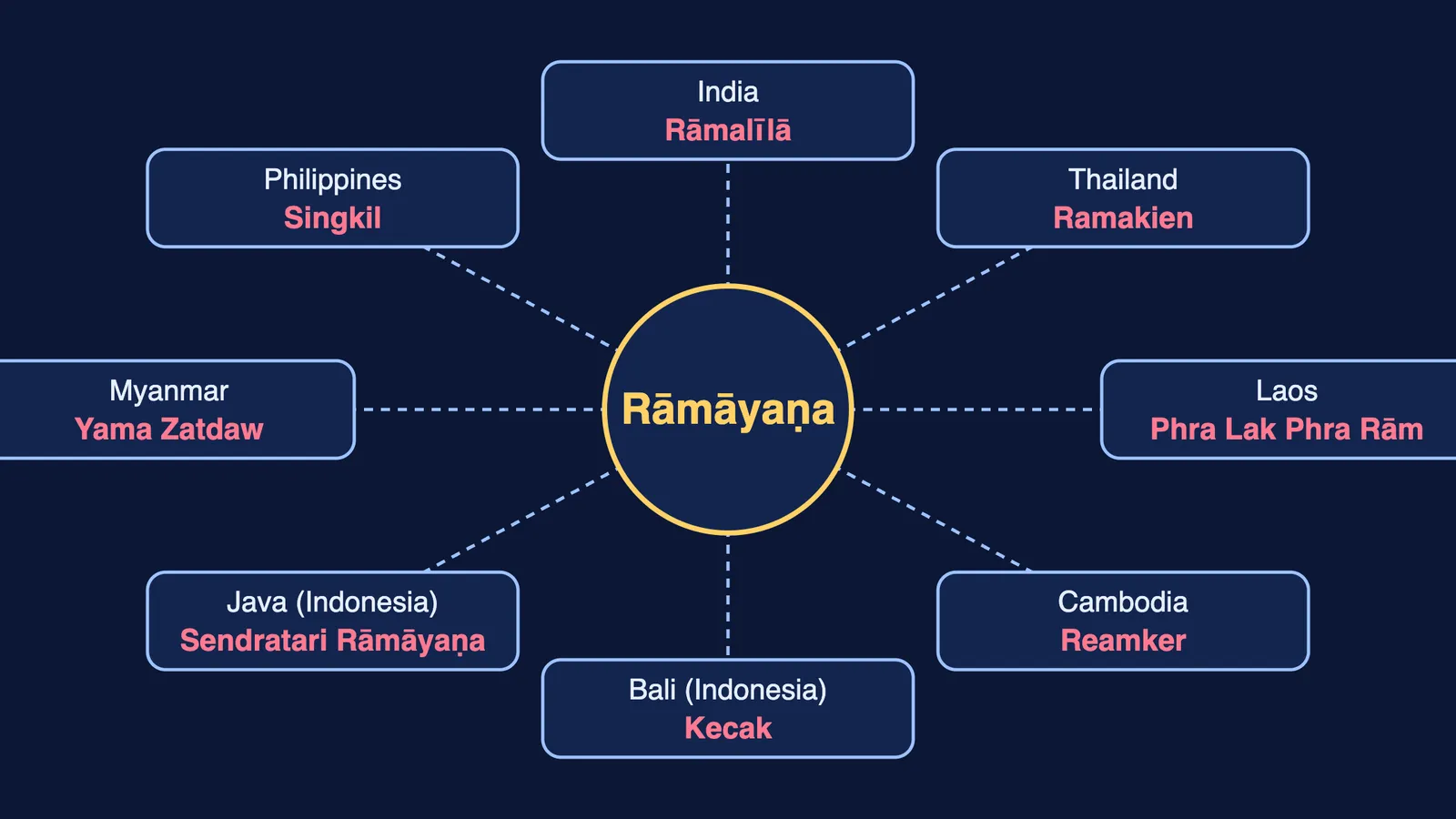
In India, Rāmalīlā has roots in the Kuśhīlava traditions, took its present form in the seventeenth century CE, and is staged around Dussehra. The chapter's table lists seven versions in Southeast Asia:
Thailand: Ramakien, as the masked dance-drama Khon.
Java (Indonesia): Sendratari Rāmāyaṇa, a large open-air dance-drama.
Bali (Indonesia): Kecak, a group dance with chanted "cak-cak".
Myanmar: Yama Zatdaw, a dance-drama.
Philippines: Singkil, which narrates a segment resembling the Rāmāyaṇa.
Laos: Phra Lak Phra Rām, a classical dance-drama.
Cambodia: Reamker, danced by the Royal Khmer Ballet.
A note for teachers in the chapter says "South Asian versions", but the text and table place all seven in Southeast Asia.
How many marks does the dance section carry?
Class 9 Art Education is assessed entirely by the school, out of 100: theory 40 and practical 60 (CBSE curriculum 2026-27). In the 2-hour theory paper, Dance has 4 marks shared by all four dance chapters; there is no separate figure for Chapter 12. The dance practical includes 10 marks for presenting a classical, tribal, folk or contemporary form, which these activities prepare you for.
The book's About the Book section makes Chapter 1 and the first chapter of each section compulsory for students at Learning Standards 1 and 2 (Madhurima prelims), so ask your teacher whether your school takes up Chapter 12.
Practice questions
Mark values are our suggestion.
Name one dance for birth and one for a wedding, with the State for each. (1 mark)
Why do Taraṅgmel dancers call out "ho ho" together? (1 mark)
Why does a chapter on dance stories mention Bāli-jātrā of Odisha? (2 marks)
Java and Bali are both in Indonesia. Give one difference in how their Rāmāyaṇa versions are presented. (1 mark)
List two tasks for each of the three stages of a dance podcast. (2 marks)
With one example, explain how one story can look different in two dance traditions. (2 marks)
Not sure where to begin revising? Fermi's AI tutor works out what you already know and builds a plan for the session.
If dance matters beyond school, read about balancing classical dance training with studies and what a BA or BPA in dance involves.