On this page
Chapter 7 of Madhurima, NCERT's new Class 9 arts textbook (First Edition, April 2026), treats music as both an art and a science. In eight pages it links music to physics through vibrating strings, biology through the human voice, and maths through rhythm and the Lowest Common Multiple (LCM).
What does The Science of Music cover in Class 9?
The chapter has six activities on three ideas.
Sound (physics). Stretch a rubber band over an empty box and pluck it. Tightening it raises the pitch, the hollow box changes the loudness, and a thicker band or another material changes the quality of the sound. Instruments such as the sitar use the same ideas.
Voice (biology). Three linked subsystems produce your voice, and Activity 7.3 lets you feel each one, starting with your hands on your belly.
Rhythm (maths). Phrases are built from syllable blocks, and the LCM tells you when two cycles meet again.
C.V. Raman (1888–1970) studied the mridangam and tabla. He showed that the way the mridangam's membranes are prepared makes them vibrate in complex patterns, largely because of the black centre patch (karanai or syahi) of iron or manganese powder, starch and water. Texts such as the Natyashastra and Sangita-ratnakara discussed dhvani (sound), nada (musical sound), shruti (discernible intervals) and svara (notes).
One gap: the CBSE 2026-27 Art Education curriculum suggests changing a string's length to change its frequency, while the book's activities use tightness, thickness and the hollow body. For pitch and frequency, see our Class 9 sound waves guide.
How many marks is this chapter worth?
Your school assesses Class 9 Art Education fully, out of 100: 40 marks for theory (a 2-hour paper) and 60 for practical work, says the CBSE 2026-27 curriculum. There is no board exam for it.
In theory, Music carries 4 marks for the whole Music section, so Chapter 7 has no separate figure. In the Music practical (out of 60), 5 marks go to showing a tala on your hand, with its beats and matras and how they link to calculations.
What are the three subsystems of the human voice?
The chapter names three parts:
Air pressure system: the diaphragm, lungs and surrounding muscles, which supply the breath.
Vibratory system: the voice box (larynx) and vocal folds, also called vocal cords, where breath becomes vibration.
Resonating system: the throat, mouth and nasal cavities; changing your mouth shape turns a hum into "aa", "oo" or "ee".
For voice care it lists enough water, avoiding very oily or acidic food, and not shouting. Its daily warm-up has breathing, humming (Bhramari pranayama), lip trills and sargam patterns at different speeds. This is a study summary of the textbook, not medical advice.
How does LCM work in tala?
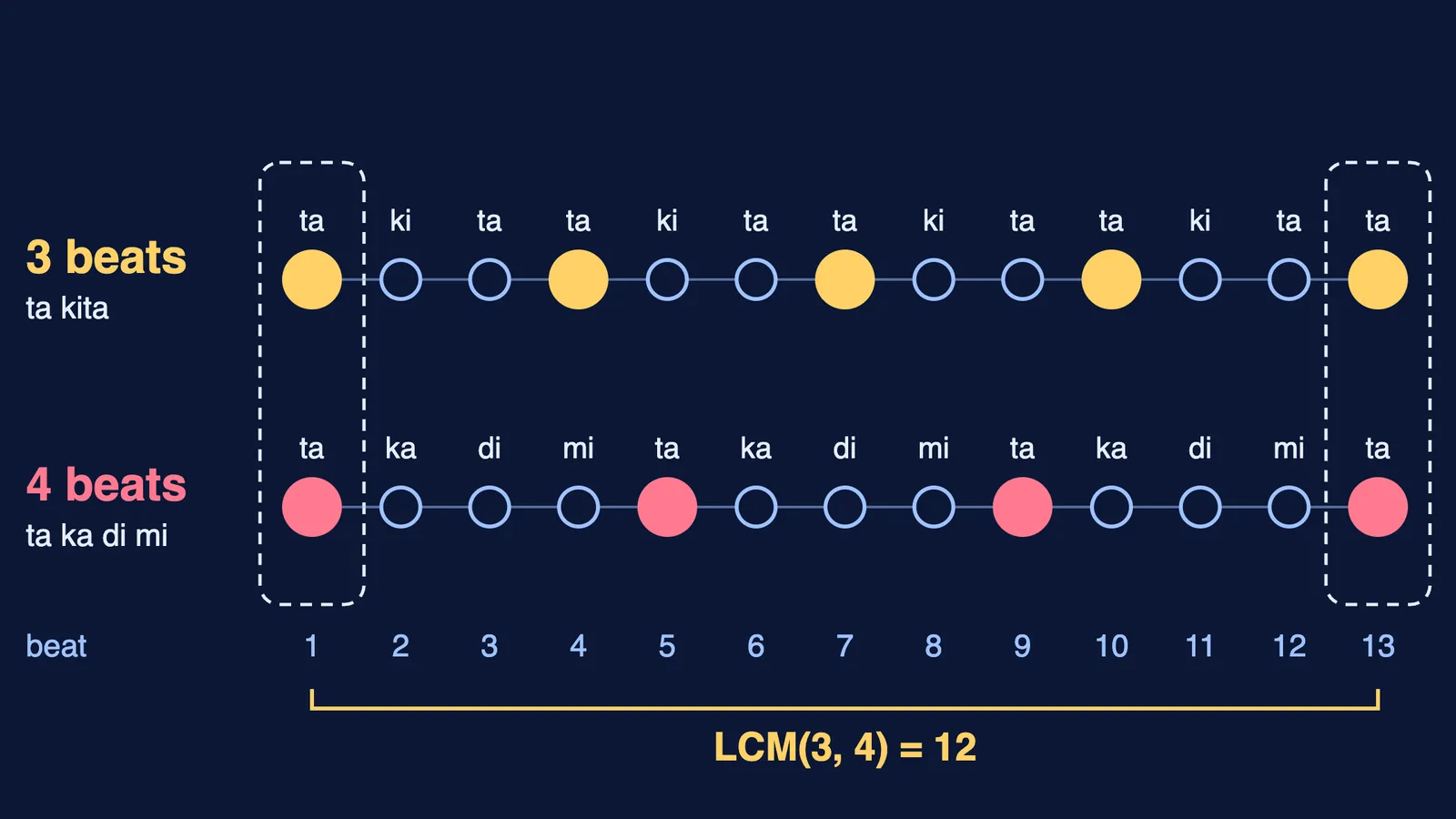
The LCM of two numbers is the smallest number both divide exactly. In Activity 7.6, one group recites ta kita (3 beats), another ta ka di mi (4 beats), each clapping on "ta". They clap together on beat 1 and next after 12 beats, because LCM(3, 4) = 12: four cycles of 3, three cycles of 4.
A note on the book: ta kita has two "ta" syllables, and clapping on both would make the groups meet on beat 9. The book's answer of 12 counts one clap per cycle, so clap only on each phrase's first "ta". (Its block list spells the 4-beat phrase "tha ka di mi".)
Worked example 1 (ours). Group A recites ta kita (3 aksharas); Group B recites taka takita (2 + 3 = 5). Each claps on its first "ta" only. The first multiple of both is 15, so LCM(3, 5) = 15. Group A finishes 5 cycles, Group B 3, and their claps meet again on beat 16.
Worked example 2 (ours). The book gives Jhaptala 10 beats and Ektala 12. Factorise: 10 = 2 × 5 and 12 = 2 × 2 × 3. Take each prime at its highest power: 2 × 2 × 3 × 5 = 60. After 60 beats Jhaptala has done 6 cycles and Ektala 5.
For three cycles, try our guide to the LCM of three numbers by common division.
Practice questions (marks are our suggestion)
Name the subsystem that includes the larynx and vocal folds. (1 mark)
In the rubber-band model, which change alters the quality of the sound rather than its pitch? (1 mark)
A veena player loosens one string slightly. Predict the change in that string's note and link it to the rubber-band model. (2 marks)
Write two different 11-akshara phrases using only 3- and 4-akshara blocks. (2 marks)
Teen Tala (16 beats) and Jhaptala (10 beats) start together. When do both next finish full cycles together, and how many cycles has each done? (3 marks)
What did C.V. Raman show about the mridangam's membranes, and why? (3 marks)
Answer to Q5: 16 = 2 × 2 × 2 × 2 and 10 = 2 × 5, so the LCM is 16 × 5 = 80. Teen Tala completes 5 cycles; Jhaptala completes 8.
Unsure where to start? Fermi's AI tutor works out what you already know and builds a plan for the session.