On this page
Chapter 13 of Madhurima, NCERT's Class 9 arts textbook (First Edition, April 2026) ends the Dance section by asking you to build a dance of your own. Here is what it covers, how it is assessed in 2026-27, and a worked plan you can adapt.
What is dance choreography in Class 9 Art Education?
In Chapter 13 of Madhurima, choreography means making and ordering dance movements so that together they form a visual design. The choreographer decides placement, direction, pauses and movement.
The Indian term the book gives for this work is nṛitya-saṁrachanā, meaning dance creation.
The chapter traces the idea to Sage Bharata, author of the Nāṭyaśhāstra, who more than 2,000 years ago described Piṇḍībandhas: group formations in which dancers cluster, weave, link and travel in shapes. Such ideas still shape choreography today.
It is teamwork: ideas are tested with the dancers and refined. Music can be sung, instrumental or absent, and steps may follow the rhythm or cross it.
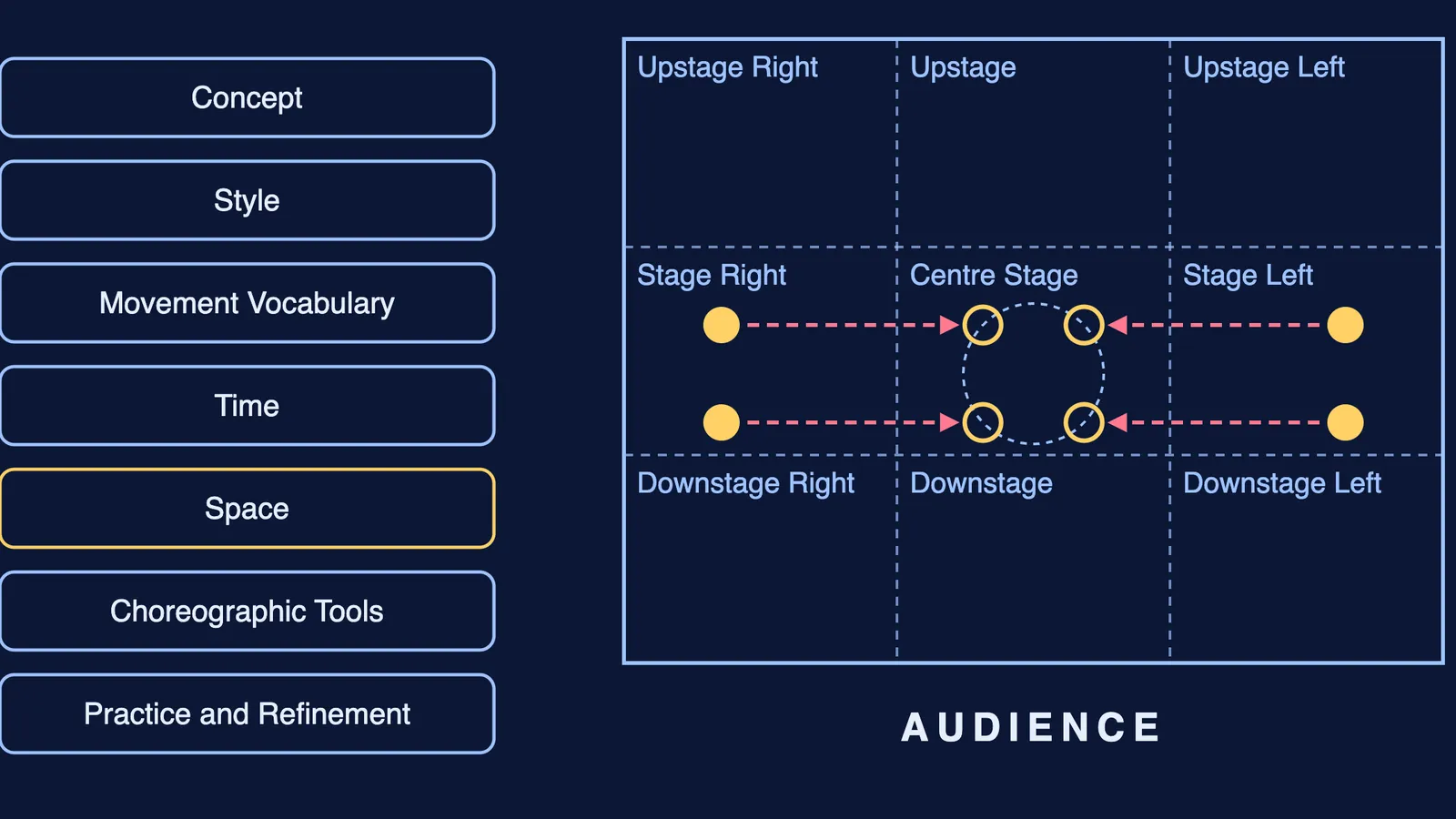
What are the seven parts of a choreography?
Concept: the subject, story or theme, such as seasons or a festival.
Style: the genre, for example narrative, lyrical, folk-inspired or abstract.
Movement vocabulary: the dance styles you draw on: classical, folk, contemporary or a mix.
Time: rhythm, tempo, pauses and timing, which set mood and pace.
Space: formations, directions, levels, gaps between dancers and paths across the floor.
Choreographic tools: unison, canon, repetition, contrast, variation, mirroring, changing formations and props.
Practice and refinement: rehearsing and editing until the piece is clear, together and expressive.
How do choreographers use movement patterns and stage space?
Patterns come from linking movements, shaping the body, placing dancers in formations, and choosing symmetry or asymmetry. In folk traditions they often echo daily life, nature and community, and human pyramids appear in several Indian forms. The chapter's photographs include Bhangra (Punjab), Karagāṭṭam (Tamil Nadu), Mallakhamba (Maharashtra) and the Bagurumba butterfly dance (Assam).
It also profiles Manjushree Chaki Sarkar, who trained in Kolkata in the 1950s, spent years in the USA, and back home built Nava Nritya, a contemporary vocabulary rooted in Indian aesthetics, helped by her daughter Ranjabati. She won the Sangeet Natak Akademi award in 1994.
The book maps a stage two ways. A traditional plan names areas after the eight directions, with performers facing east towards the audience; the book notes these are not compass readings. The modern plan (Fig. 13.10) splits the floor into nine areas, from upstage right to downstage left, with the audience in front. A separate stage-mapping figure marks the kutapa, the orchestra's place, at the back of the stage.
A worked example: planning a four-dancer piece
An original plan, the kind Activity 13.2 asks for:
Concept: the first monsoon rain after a hot summer.
Style: narrative.
Movement vocabulary: folk-inspired steps with hand gestures for clouds and rain.
Time: slow, with long pauses for the heat, then faster as rain arrives, ending in stillness.
Space: two dancers wait at stage right and two at stage left, like distant dry fields. When the rain starts they travel in to form a circle at centre stage, as the hero diagram shows.
Tools: canon for the first drops, unison for the downpour, mirroring between partners, a cloth as a cloud.
Practice and refinement: film a rehearsal, run the self, peer and expert review from Activity 13.3, and note changes in your dance journal.
How is this chapter assessed in 2026-27?
The CBSE Art Education curriculum for Class IX (2026-27) makes the subject a 100% school-based internal assessment: 40 marks for theory and 60 for practical. There is no board exam.
In theory, Dance carries 4 marks, shared across the whole Dance section (Chapters 10 to 13), so this chapter has no separate figure. The curriculum names this unit "Dance: A Journey from Concept to Creation", with 5 hours (6 periods).
The Dance practical, out of 60, covers abhinaya, basic dance elements, rhythm and tempo, a genre presentation and a viva, plus a school event, project report and formative assessment. The book's preface makes Chapter 1 and the first chapter of each section compulsory at Learning Standards 1 and 2, so ask your teacher whether Chapter 13 is on your list.
Practice questions
Marks are our suggestion.
(1 mark) What Indian term does the chapter use for dance creation? Answer: nṛitya-saṁrachanā.
(1 mark) What did Bharata call the group formations he described? Answer: Piṇḍībandhas.
(2 marks) Why are the traditional stage directions not compass-based? Sample answer: they follow the stage layout, treating performers as facing east towards the audience, wherever true east lies.
(3 marks) Plan a group piece on a local festival: its concept, one space decision and two choreographic tools.
(Viva) Who created Nava Nritya, and what was she trying to build?
For careers, see our guide to BA or BPA degrees in dance; parents can read how to balance classical dance and studies.
Not sure which part to revise first? Fermi's AI tutor works out what you already know and builds a plan for the session.