

On this page
When syllabus demands mount in Classes 9 through 12, classical dance practice is often the first activity families consider cutting. Between school hours, commuting, coaching, and homework, ninety-minute Bharatanatyam classes feel unsustainable. Yet viewing classical dance and academic rigour as opposing forces misinterprets how movement affects learning. Structured dance training functions as a restorative cognitive reset.
Why is classical dance an asset for academic focus?
Learning Bharatanatyam exercises multiple cognitive systems simultaneously. Executing complex footwork (*adavus*) requires mathematical subdivision of rhythm (*tala*), spatial awareness, bilateral coordination, and working memory. A dancer retains lengthy movement sequences while regulating posture, breath, and expressive storytelling (*abhinaya*).
This discipline directly supports academic learning. A 2023 systematic review and meta-analysis led by Dong Li and colleagues in the *European Journal of Pediatrics* analysed 16 randomized controlled trials on physical activity and school performance, finding significant gains with the strongest effect in mathematics (standardised mean difference SMD = 0.75).
Dance also meets essential physical targets. The World Health Organization recommends that children and adolescents aged 5 to 17 accumulate at least an average of 60 minutes per day of moderate-to-vigorous physical activity across the week to support cardiorespiratory fitness, bone health, and cognitive function.
Arts education also develops social and emotional strengths. In a randomized evaluation across 42 schools, Daniel Bowen and Brian Kisida published findings through the Brookings Institution showing that expanding arts education produced a 13% of a standard deviation improvement in standardized writing scores, alongside a 3.6 percentage point reduction in disciplinary infractions and an 8% of a standard deviation increase in compassion for others. As we discuss in our analysis of extracurricular activities and marks, creative pursuits protect mental freshness rather than pulling down grades.
How should practice change during exam weeks?
The main mistake families make during exams is treating practice as all-or-nothing, either forcing students through lengthy studio commutes or stopping practice completely for months.
Abrupt cessation carries real penalties. Halting movement removes a student's main stress outlet, leaving them sedentary and restless. Sudden breaks followed by aggressive resumption also increase injury risk. In a survey published in *Medical Problems of Performing Artists*, researchers Lavanya P. Kumar and Shruti J. Shenoy evaluated 101 Bharatanatyam dancers and documented 0.65 injuries per 1,000 dancing hours, with 10.8% reporting musculoskeletal injuries, primarily at the knee (27.2%) and ankle (27.2%). When dancers drop conditioning during exam months and suddenly restart vigorous foot-stamping on hard floors, their joints absorb excessive shock.
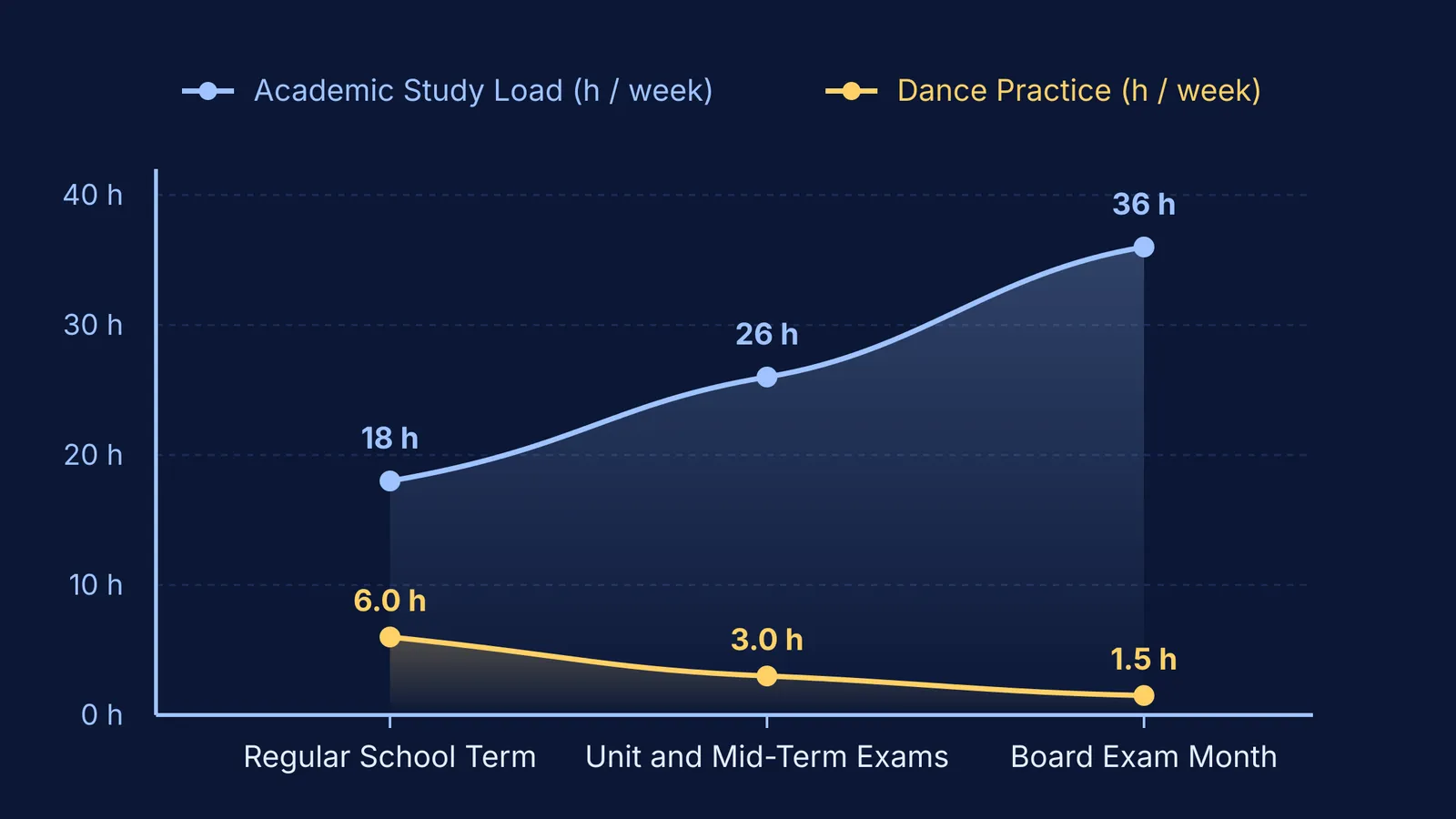
Instead of quitting, adopt a three-tier seasonal pacing plan:
Regular school term: Maintain 4 to 6 hours per week (two 90-minute classes plus one weekend home review). Focus on new choreography, stamina, and detailed technique.
Unit tests and mid-terms: Reduce to 2.5 to 3 hours per week (one studio class and two 20-minute home sessions). Consolidate familiar items rather than taking on new repertoire.
Board exam month: Transition to twenty-minute daily maintenance at home, 4 days per week, skipping studio commutes. Spend 5 minutes warming up, 10 minutes drilling basic *adavus* to stay limber, and 5 minutes stretching.
Helping your child implement this seasonal dial teaches realistic time budgeting, as detailed in our guide on teaching children time-planning skills.
How do you prevent dance fatigue after a long school day?
Bharatanatyam demands sustained isometric contraction in the half-sit (*araimandi*) posture alongside explosive jumps. Expecting a teenager to step off the dance floor and immediately tackle dense numerical problems causes mental exhaustion.
Protect their energy with a 45-minute transition buffer between dance and evening study:
Refuel within thirty minutes: Provide a light snack combining complex carbohydrates and protein, such as bananas with peanut butter, roasted chickpeas, or warm milk.
Warm shower: Eases muscular tension while signalling a clean boundary between physical exertion and desk work.
Passive rest: Ten minutes of quiet breathing or resting flat on the floor (*shavasana*) before opening textbooks.
When fatigue makes starting evening study difficult, Fermi's AI tutor can work out what a student already knows and build a plan for the session, giving them a clear next step instead of a blank page. For more on pacing, consult our overview of effective study breaks.
How do you keep the art form joyful instead of another chore?
Classical dance loses its restorative value when parents treat it as another academic scorecard. Rushing a solo stage debut (*arangetram*), obsessing over exam ranks, or micromanaging practice creates resentment.
Approach the dance guru early in the academic year with a proactive conversation:
Acknowledge commitment: Confirm that your child loves dance and intends to train for years to come.
Propose the adjusted routine: Suggest attending one weekend class and maintaining basic footwork at home for twenty minutes daily rather than learning new stage items.
Commit to a return date: Reassure the teacher that full rehearsal hours will resume as soon as exam month finishes.
Most teachers appreciate early communication and respect families who balance discipline with health. At home, protect dance as an emotional sanctuary, celebrating a cultural discipline that enriches your child's entire school journey.


