On this page
Chapter 17 of *Madhurima*, the new NCERT arts textbook for Grade 9 (First Edition, April 2026), closes the Visual Arts section by asking which kind of visual artist someone means. Below: the branches, a test for telling them apart, and practice questions (NCERT Madhurima, Chapter 17).
What are the branches of Visual Arts in Class 9?
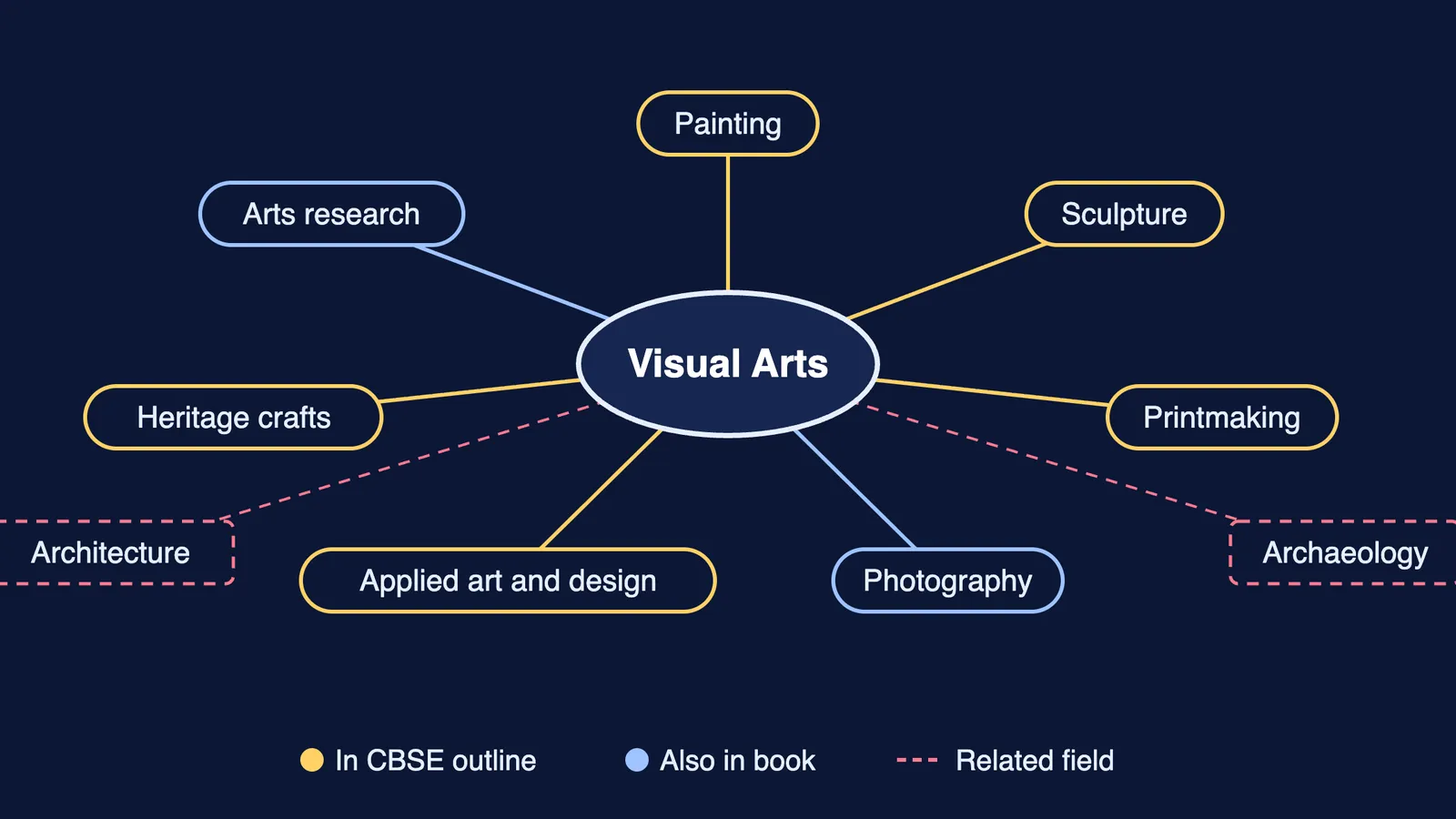
The chapter describes seven areas of practice and then names two neighbouring disciplines (NCERT Madhurima, Chapter 17).
Drawing and painting: pictures on flat, two-dimensional surfaces such as paper, cloth or walls using media from pencils and inks to oils, tempera and natural dyes. Artists named include Nandalal Bose and Ganga Devi.
Sculpture: three-dimensional work in materials such as clay, wood, stone, metal or recycled material. Ramkinkar Baij is one.
Printmaking: an image is carved or engraved into a block or plate, inked and pressed onto paper, so one design can be printed many times as an edition. Woodcut, lithography, etching and screen printing are the common processes; Krishna Reddy and Jyoti Bhatt appear here.
Photography: image-making with still or video cameras, digital tools and software. Fine art photography may explore effects and photo-montage; photojournalism mainly records events for reporting. Homai Vyarawala is one name given.
Applied arts and design: graphic, product, industrial, textile and fashion design, animation, and film and video. Designers solve everyday problems. Satyajit Ray is listed.
Heritage crafts: hand-made objects, fabrics, toys and artefacts for daily needs, sometimes made with simple machines. Kamaladevi Chattopadhyay and Pupul Jayakar are credited with crafts revival.
Arts research and management: art history, which studies how art changed across regions and periods, and museology, which covers museum management, museum education, and restoration and conservation.
Architecture and archaeology are related fields, not branches. The opening figure also shows digital art, which gets no section of its own.
What does the 2026-27 CBSE curriculum ask for?
The CBSE Class IX Art Education curriculum for 2026-27 gives this topic, Visual Arts Branches, 1.6 hours or 2 periods. Its outline names five branches: painting, sculpture, printmaking, applied art and design disciplines, and heritage crafts. As printed, heritage crafts shares a bullet with applied art and design, so it can read as four; we count five. The outline says painting where the book says drawing and painting. The book adds photography and arts research, so read the whole chapter.
Your school assesses Art Education entirely internally (100%), out of 100 marks: 40 theory and 60 practical, per the same curriculum document. In the theory part, Visual Arts carries 4 marks, and those 4 marks are shared by the whole Visual Arts section, so there is no separate figure for this chapter.
The book makes Chapter 1 and each section's first chapter compulsory for Learning Standards 1 and 2 (NCERT Madhurima prelims), so ask your teacher which other chapters your school covers.
How do you tell the branches apart?
Ask these four questions in order. This is our shortcut from the chapter's definitions, not the book's rule.
Was it made mainly to be used, like a poster, a chair or a fabric? Think applied arts and design, or heritage crafts if it is hand-made in a traditional process.
Does it occupy space, with a front, back and sides? Think sculpture.
Can identical copies be pulled from one carved or engraved surface? Think printmaking.
Was it captured with a camera? Think photography. If nothing above fits and the work sits on a flat surface, it is drawing or painting.
Worked example: a hand-block-printed cotton dupatta bought at a craft fair. Question 1 says it is made for use, by hand, in a traditional way: heritage crafts. Question 3 also fits, since one inked block is stamped repeatedly, and the chapter lists wood-block printing on textiles under printmaking. Name both. Branches overlap: the book notes that many craft traditions now feed into design fields.
Practice questions
Marks are our suggestion.
Sort these into branches: a lino print, a bronze figure, a brand logo, and a terracotta toy made by a potter family. (2 marks)
State one way fine art photography differs from photojournalism. (1 mark)
Why can a printmaker share the same artwork with many people, while a painter usually cannot? (2 marks)
A town museum plans to repair a faded mural and run guided visits for schools. Which discipline from the chapter covers this, and which three areas does it include? (3 marks)
Pick an everyday object at home. Use the four-question test to place it in a branch and justify your choice. (4 marks)
How can you revise this chapter quickly?
Session 1 (30 minutes): redraw the concept map above, adding one material and one artist per branch.
Session 2 (30 minutes): answer the practice questions without the book, then check them against the chapter.
For more on painting, read how the Ajanta cave paintings were made. Design students later meet elements and principles of fabric and apparel design in Class 12. For another new Class 9 textbook, see our guide to Early Humans and Beginning of Civilisation.
Revising on your own? Fermi's AI tutor works out what you already know and builds a plan for the session.