On this page
The Ajanta site is thirty caves cut into a cliff above a bend of the Waghora River in Maharashtra, according to the ICOMOS evaluation for the World Heritage List. The same document dates a first group of caves to the second century BC and a second group to the fifth and sixth centuries AD, and calls the wall painting the most striking artistic achievement of Ajanta. Reading how those paintings were built takes school chemistry.
How were the Ajanta paintings made, layer by layer?
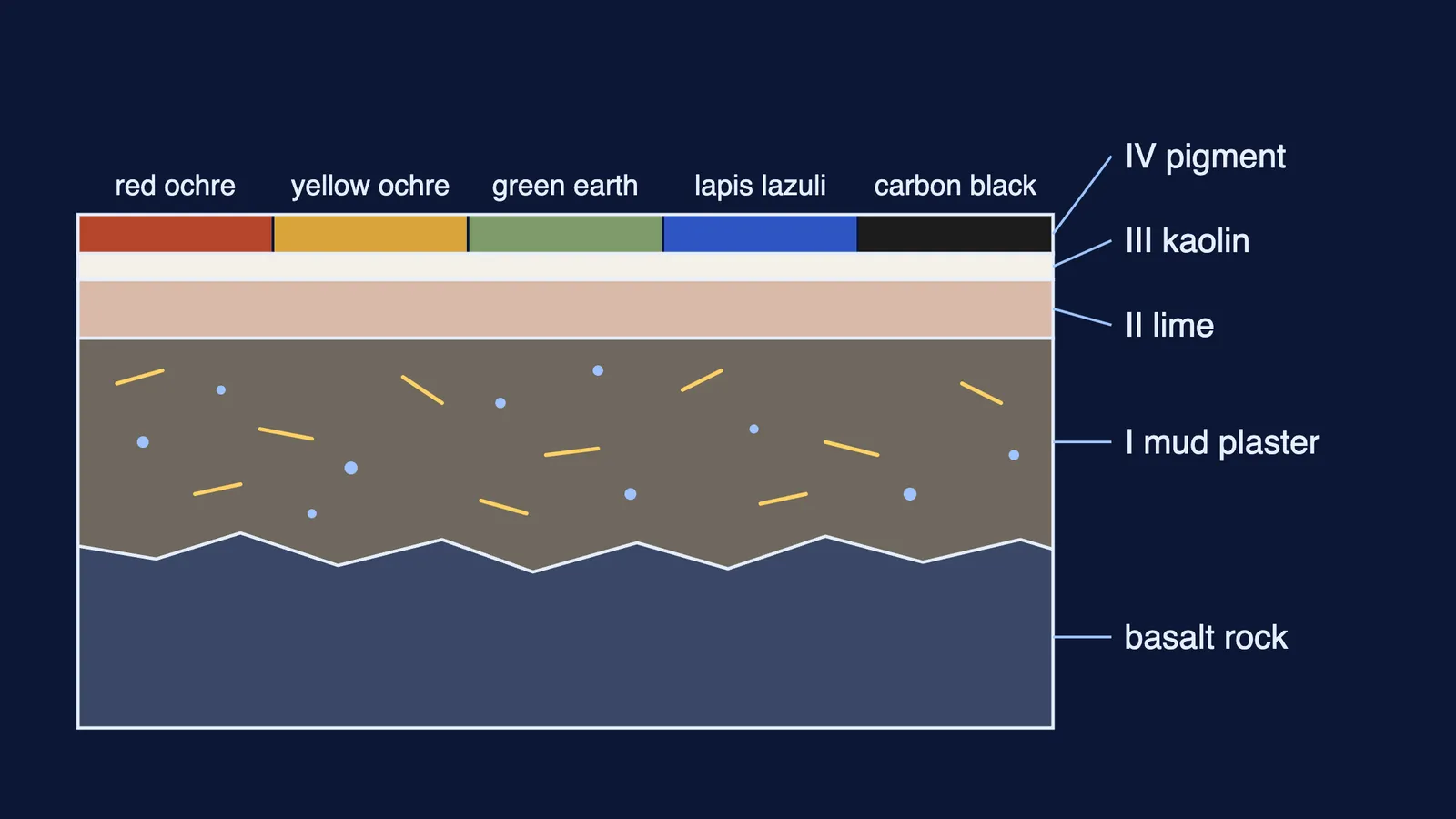
In 2014, Manager Singh of the Archaeological Survey of India (ASI) and Balasaheb Ramrao Arbad of Dr. Babasaheb Ambedkar Marathwada University studied mud plaster from caves 1, 15 and 17, and paint from caves 1 and 15, with FTIR, XRF, SEM-EDX and stereomicroscopy (Singh and Arbad, International Journal of Conservation Science, 2014). They found four layers on the basalt:
Mud plaster. A grey layer of low-clay soil, mixed with grit from weathered basalt (quartz, zeolites and the green mineral celadonite) and plant matter such as rice husk, seeds and fibres.
Levelling coat. A pinkish-white layer, mainly calcium carbonate and silicates, that smooths the rough mud.
Ground. A thin white coat of kaolin, a clay, to receive the colour.
Paint. Mineral pigments bound with an organic glue, now oxidised to calcium oxalate.
Particle-size analysis put the mud at about 70-75% silt, 9-14% sand and 12-15% clay (Singh and Arbad, 2014). Soil this silty is found on the bank of the Waghora, so the authors think the painters probably dug it there. It also reports 8-10% lime and organic additives in the mud, which is a few millimetres to about an inch thick.
The painting itself is tempera or secco, bound with animal glue, unlike true fresco painted into wet lime, the paper reports.
What pigments were used in the Ajanta paintings?
Singh and Arbad list red ochre, yellow ochre, green earth, lapis lazuli, carbon black and shell or kaolin lime white (2014 study). Iron pigment always turned up with silicon and aluminium, which the authors read as a sign of added kaolin. In cave 1, two or three pigment layers were laid on top of each other in places, probably for depth.
Every pigment was local except the blue. A 2025 study led by the ASI's Conservation Research Laboratory at Ajanta examined six lapis lazuli samples from murals of the second century BCE with micro-Raman spectroscopy, XRD and other methods (Kumar and colleagues, Journal of Raman Spectroscopy, 2025). Using diopside and trace-element proportions as markers, it concluded the blue may have been imported from the Badakhshan mines in Afghanistan, which have been worked for over 6,000 years.
How do you read a paint sample like a chemist?
That acid test, from the 2014 paper, shows how to identify compounds from what you see:
Fizzing. A gas means a carbonate: CaCO3 + 2HCl → CaCl2 + H2O + CO2. So layer II is largely calcium carbonate.
Colour disappears. The acid broke the blue layer down completely, which the authors read as lazurite, the blue mineral of lapis lazuli.
No change. The ochre paint and the kaolin ground did not react, so neither is a carbonate.
The mud crumbles but does not dissolve. It lost cohesion as acid attacked the traces of lime in it; the silicate grains stayed.
If carbonates, acids or silicates feel shaky, the Fermi Concept Library covers every concept in chemistry, so you can fill the gap before the next practical. Lime turns up in everyday places too; see why tree trunks are painted white.
Why did the Ajanta paintings survive so long?
The paper does not rank reasons, but two of its findings help explain it (Singh and Arbad, 2014):
Stable caves. Inside, the temperature varies only between 27 °C and 30 °C.
Mineral colours. All the pigments are natural minerals. The iron in ochre is already oxidised, the state rusting heads towards, so air has little left to do to it; for iron that resists rusting another way, read why the Delhi iron pillar doesn't rust.
The same paper lists the threats. Humidity reaches 80% in the rainy season and drops to 40% in summer, so the paint and mud swell and shrink, then flake. Silverfish feed on the rice husk, seeds and fibres in the mud. Unbleached shellac varnish brushed on by Italian conservators in 1920 has oxidised to a reddish orange and hinders the mortar and paint from breathing.
The ASI's answer is to repair with a recipe drawn from ancient texts. Its team mixed river-bank soil from the Waghora with about 15% lime, 10% sand and 15% aggregate, plus a soaked plant extract. Mortar used to consolidate paintings about 15 years before the study had integrated with the original (Singh and Arbad, 2014).
Next time you see a fading wall, ask: what is the support, what is the binder, and what will acid, water or insects do to each layer?