On this page
Drive past a mango orchard, a cantonment road or a school compound in India and you will see it: tree trunks painted white up to about knee or waist height. Here is what the white coat does, what the evidence says, and how to write it up in a Class 10 answer.
Why are tree trunks painted white?
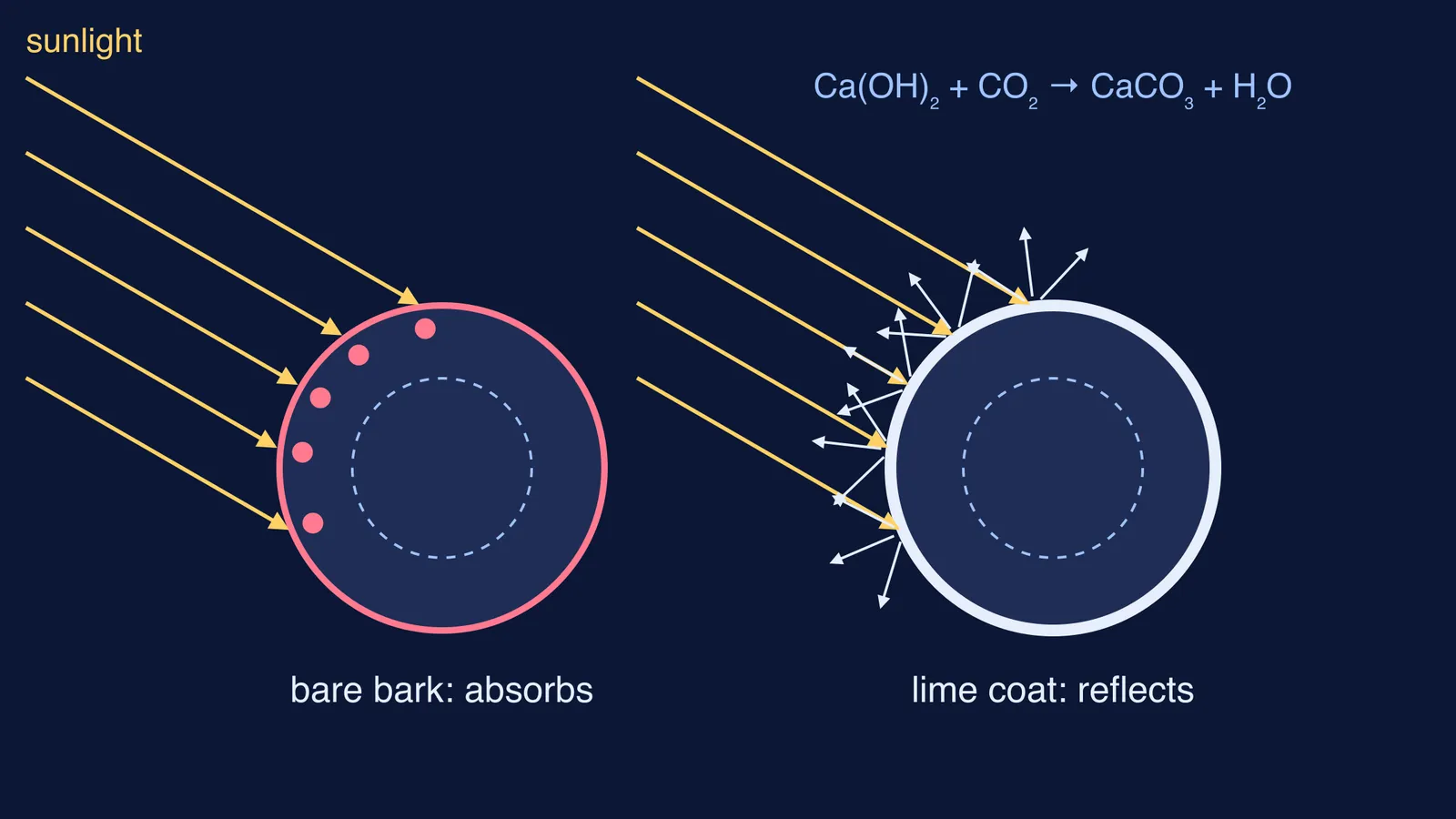
The main reason is heat. Dark bark absorbs much of the sunlight that falls on it, while a white surface reflects much of it back. The same idea keeps astronauts cool, as we explain in why space suits are white.
The living layers of a trunk sit just under the bark. Utah State University Extension explains that these cells, mostly phloem and cambium, are damaged by swings between day and night temperatures in winter, an injury called sunscald. The same page notes that the south side of a tree can be as much as 77 °F warmer than the north side on a cold winter day, a difference of about 43 °C.
Painting changes that. In a 1975 study by Martsolf, Ritter and Hatch at Penn State, stone fruit trunks painted on the sunlit side with white latex paint were 30 °C cooler than unpainted trunks in midwinter. Young trees with thin bark, and older trees whose bark is suddenly exposed after pruning, are especially vulnerable to sunburn, according to the University of California IPM programme.
Does lime on tree trunks keep pests away?
Partly, and mostly indirectly. The UC IPM page says wood-boring pests, especially flatheaded borers, are frequently a problem on trees whose limbs or trunks have been sunburned, so preventing sunburn may also mean fewer borers.
Some trunk coatings go further and add copper. Tamil Nadu Agricultural University's citrus disease guide recommends coating trunk bark with Bordeaux paste against gummosis, a Phytophthora disease that makes bark crack and ooze gum. TNAU's coconut disease page gives the recipe: 200 g of copper sulphate and 200 g of lime, each dissolved in one litre of water, then mixed into a paste.
What is the chemistry of slaked lime in Class 10?
In Chapter 1 of the NCERT Class 10 Science textbook, quicklime (calcium oxide) reacts vigorously with water to form slaked lime (calcium hydroxide) and releases a large amount of heat: CaO + H₂O → Ca(OH)₂ + heat. NCERT uses it as an example of a combination reaction that is also exothermic. We walk through that step in how quicklime and water make whitewash.
After the coat goes on, a second reaction starts. NCERT's "Do You Know?" box, written about whitewashed walls, says calcium hydroxide reacts slowly with carbon dioxide in the air to form a thin layer of calcium carbonate, which forms after two to three days and gives a shiny finish: Ca(OH)₂ + CO₂ → CaCO₃ + H₂O. It is the same reaction that turns limewater milky, covered in why limewater turns milky, then clear. NCERT also notes that marble has the same formula, CaCO₃, so a whitewashed trunk ends up with a thin, chalky mineral skin.
Does whitewashing actually work?
Not every study agrees. In a 2025 trial by Donyo Ganchev at the Agricultural University in Plovdiv, Bulgaria, apple trunks were left bare, coated with a white 20% lime solution or with a blue copper paste, and bark temperature was measured by infrared thermometer every month for four seasons. The study found that paste colour played an insignificant role in bark surface temperature, while wind and cloud cover could change it within seconds.
The two studies are not directly comparable. The Penn State team used white latex paint, not lime, and argued from theory that the cooling depends on wind speed and trunk diameter, and may exceed 30 °C for trunks thicker than 10 cm or in air moving slower than 30 cm per second. So the white coat probably helps most in strong sun and still air, and least where wind already cools the bark. Treat it as cheap insurance, not a guarantee.
How do you write this in an exam answer?
Here is a three-part structure for a 3-mark "why are tree trunks whitewashed?" question.
Physics: the white coat reflects sunlight, so the bark absorbs less heat and does not overheat or crack.
Biology: undamaged bark protects the living cambium, and sunburned trunks are more often attacked by borers.
Chemistry: slaked lime, Ca(OH)₂, reacts with CO₂ in air to form a thin layer of calcium carbonate. Write the balanced equation with state symbols.
Then check:
Did you name both compounds, calcium hydroxide and calcium carbonate?
Is the equation balanced, with (aq), (g), (s) and (l) marked?
Did you say why white matters, not just that trees are painted?
If combination and exothermic reactions still feel shaky, the Fermi Concept Library has a lesson for every concept in chemistry, physics and biology, showing where each one fits in the map. To practise problems step by step, try the Fermi Problem Library, whose solver explains the reasoning rather than printing an answer.
Next time you pass a row of white trunks, try explaining all three reasons out loud.