On this page
Stand at a window at noon and you see the street. Stand at the same window at 9 pm with the tubelight on and you see yourself, the sofa and the TV. The glass has not changed; the light on each side has, and one switch turns the effect on and off.
Does glass reflect light during the day too?
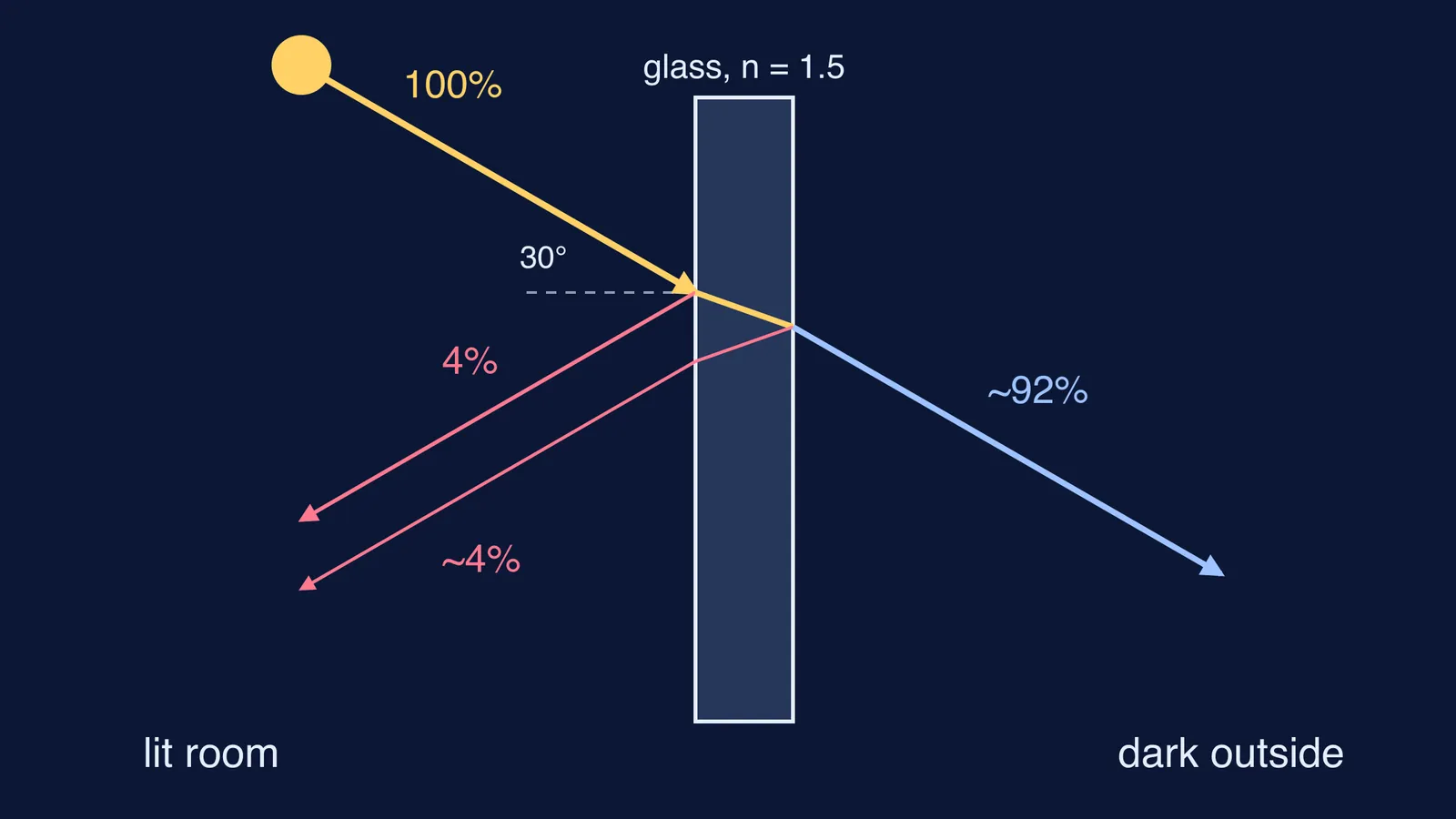
Yes. Whenever light crosses from one material into another with a different refractive index, part of it bounces back. This is called partial reflection, and it happens at every air-glass surface, day or night.
For ordinary glass with a refractive index of about 1.5, roughly 4% of the light is reflected at each surface, or about 8% for both sides of a pane, according to the Fresnel equations.
You can check the 4% yourself. For light hitting the glass straight on, the fraction reflected is R = ((n1 - n2)/(n1 + n2))². Put n1 = 1 for air and n2 = 1.5 for glass: (-0.5/2.5)² = 0.2² = 0.04. A pane has two surfaces, so a little over 90% gets through. Your reflection is always on the glass; the question is whether anything brighter sits on top of it.
Why can't you see your reflection in daylight?
Two images reach your eye from the same patch of glass: the faint reflection of your room, and the view from outside shining through. You notice whichever one is much brighter.
The gap between outdoor and indoor light is huge. Typical values listed in the lux illuminance table are:
Direct sunlight: 32,000 to 100,000 lux
Full daylight, not direct sun: 10,000 to 25,000 lux
Office lighting: 320 to 500 lux
A family living room (one Australian measurement): 50 lux
Full moon on a clear night: 0.05 to 0.3 lux
Here is a rough worked example using these numbers and the 8% pane reflection from the Fresnel equations. It treats the room and street as equally good at bouncing light back, so read the answers as "how many times brighter", not exact values.
Daytime. Light from outside: about 10,000 lux, and about 92% passes through, so roughly 9,200. Reflection of your room: 50 lux x 8% = 4. The view outside is more than 2,000 times brighter. Your reflection is there, but it is buried.
Night, room lights on, moonlit garden. Outside: 0.3 lux x 92%, about 0.3. Reflection: still about 4. Now the reflection is more than 10 times brighter than the view, so you see yourself.
Night, room lights off. The room has almost no light to reflect, so the reflection nearly vanishes and the dim street shows through again.
The glass reflects the same 8% in all three cases. Only the competition changes.
The one-way mirror article describes this effect. The practical lesson: at night, with your lights on, people outside can see into your room while you see only yourself. Draw the curtains.
How can you switch the reflection on and off at home?
You need one window, one room light and about ten minutes after sunset. Write down a prediction before each step, then check it.
Stand about a metre from the window with the room lights on. Note how clearly you see your face, and whether you see anything outside.
Switch the room light off and wait a minute. Your reflection fades and the street, sky or building opposite appears.
Switch the light back on. The reflection comes back the instant the light does, which shows it depends on room light, not on the glass.
With the light on, cup your hands around your eyes and press them to the glass. You block the reflected room light and can see outside again.
Ask someone outside to look in. They see you clearly; you see only your reflection.
Tomorrow at dusk, check every five minutes and note when your reflection first beats the view.
If step 2 looks completely black at first, give it time. Your eyes take a while to adjust to darkness, which we explain in why you can't see when the lights go off.
Why does partial reflection matter beyond windows?
Most ray optics questions treat glass as perfectly transparent; this is the small part they leave out. Camera lenses and spectacles use thin coatings to reduce that reflection, which you can work out in minimum thickness of an anti-reflection coating. The physicist whose equations give the reflection figure has his own story in Augustin Fresnel and the lighthouse lens.
If refractive index still feels like just a word, the Fermi Concept Library gives each physics concept its own lesson and its place in the map. Because light at a boundary is easier to see than to read about, the Fermi Simulation Lab has interactive simulations for ideas like this one.
Tonight, try step 2 at your own window and time how long it takes the street to appear.