On this page
Thomas Young showed that light can interfere. Augustin Fresnel, working in France a few years later, turned that idea into a theory precise enough to predict exactly where light would fall behind an obstacle. One prediction from his theory looked so strange that it could easily have sunk it. It did not. This post gives the verified story of Fresnel's work, explains single-slit diffraction with a worked example, and shows the physics behind the lens that changed lighthouses.
Who was Augustin Fresnel?
The MacTutor biography from the University of St Andrews gives his birth as 10 May 1788 in Broglie, France, and his death as 14 July 1827 in Ville-d'Avray. He entered the École Polytechnique in Paris in 1804, went on to the École des Ponts et Chaussées and qualified as a civil engineer. His first job was building roads in the Vendée region. Optics was a spare-time interest: he began experiments on light in the middle of 1814 and published his first paper on the wave theory, with a first attempt to explain diffraction, in October 1815.
How did Fresnel win the 1819 prize?
The Académie des Sciences announced that its Grand Prix for 1819 would be awarded for work on diffraction. MacTutor describes how Fresnel finished his mathematics just before the deadline, calculating the intensity of light at every point behind an obstacle using what were later called Fresnel's integrals.
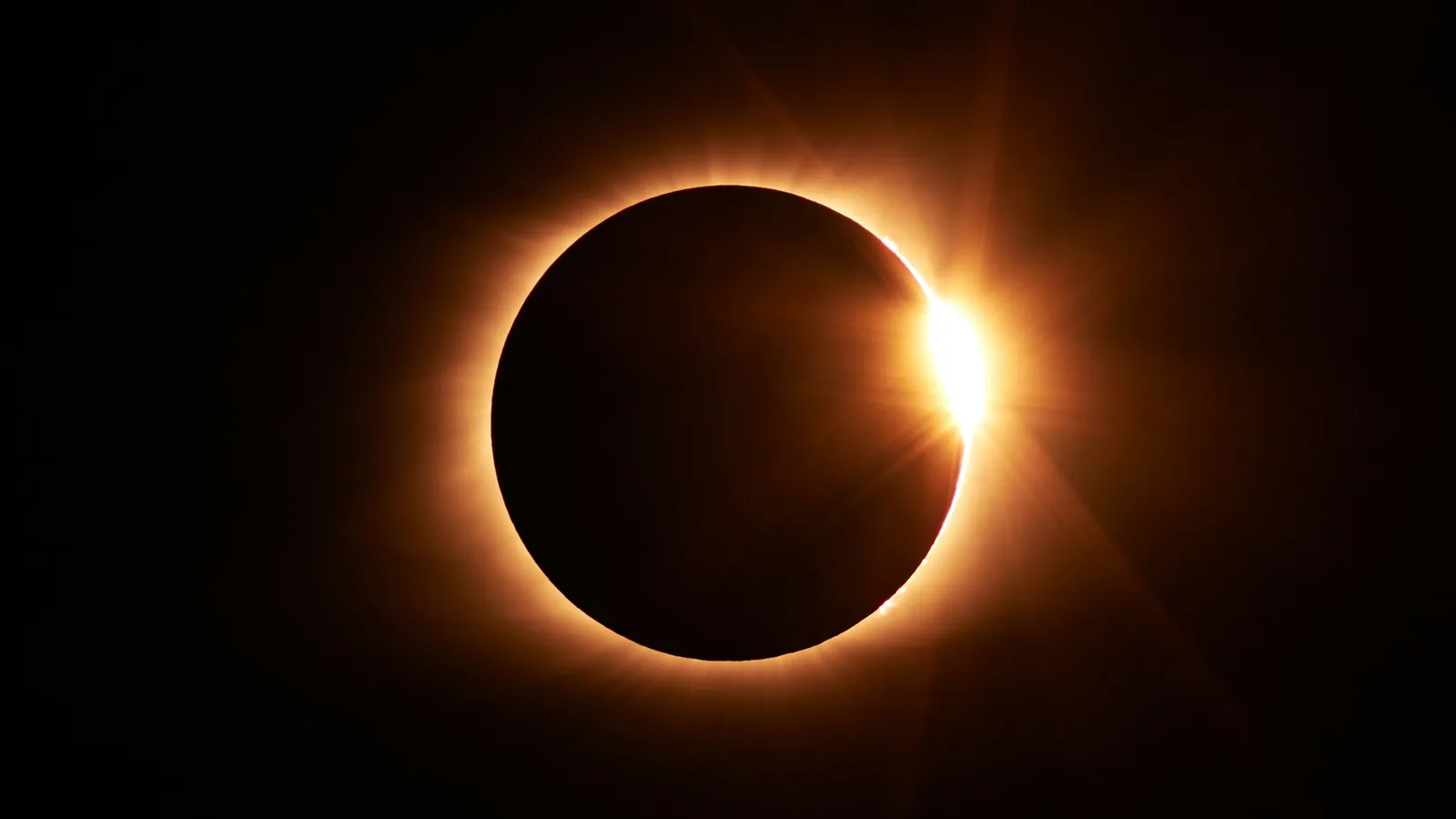
The judging committee, chaired by François Arago and including Poisson, Biot and Laplace, was not well disposed to waves; most of its members favoured the particle model of light. Poisson worked through Fresnel's integrals and found a strange consequence: behind an opaque disc in parallel light, the very centre of the shadow should be bright. Arago asked for the prediction to be tested, and the bright spot was there, as the theory said. Fresnel was awarded the Grand Prix.
MacTutor adds that in 1821 Fresnel published a paper claiming that light is a transverse wave, a step many of his supporters, Arago included, did not accept at first. He was elected to the Académie des Sciences in 1823, became a Fellow of the Royal Society of London and received its Rumford Medal in 1827. He died of tuberculosis that year, aged 39.
What is the Huygens-Fresnel principle?
NCERT's wave optics chapter explains diffraction using what it calls the Huygens-Fresnel principle. Huygens said each point on a wavefront acts as a source of secondary wavelets. In the Huygens-Fresnel picture, these wavelets also interfere with each other, with the right phase differences. To find the light at a point on the screen, you divide the wavefront into small parts and add their contributions with their phases.
For a single slit of width a, NCERT gives the result: a central maximum at θ = 0, and minima at θ ≈ nλ/a, where n = ±1, ±2, ±3 and so on. Single-slit diffraction is in the JEE (Advanced) 2026 syllabus, and the CBSE Class 12 syllabus covers the width of the central maximum qualitatively.
Worked example: how wide is the central bright band?
Light of wavelength 500 nm passes through a slit 0.10 mm wide onto a screen 1.0 m away. Find the width of the central maximum.
Angle of the first minimum: θ = λ/a = (5.0 × 10^-7 m) / (1.0 × 10^-4 m) = 5.0 × 10^-3 rad.
Position on the screen: y = Dθ = 1.0 m × 5.0 × 10^-3 = 5.0 × 10^-3 m = 5.0 mm from the centre.
Width of the central maximum: there is a minimum on each side, so the width is 2 × 5.0 = 10 mm.
Sense check: halve the slit width to 0.050 mm and the central band doubles to 20 mm. A narrower opening spreads light more, the opposite of what ray optics would suggest.
Two common errors: using the double-slit formula for a single slit, and forgetting the factor of 2 for the full width of the central band. Our guide to single-slit diffraction and polarisation has more practice.
What did Fresnel change about lighthouses?
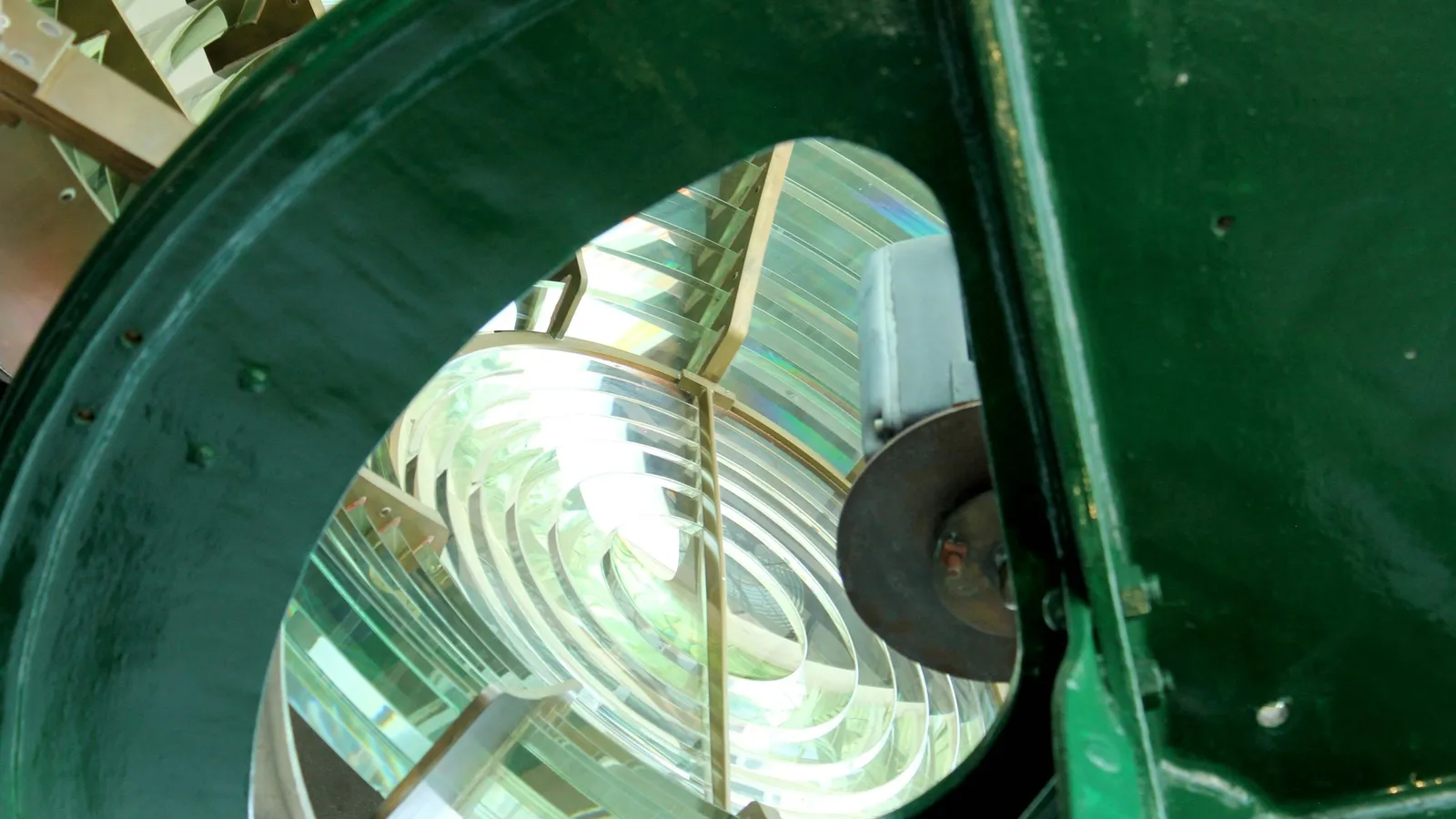
After 1824, MacTutor notes, Fresnel spent less time on research. Working for the Lighthouse Commission, he developed compound lenses to replace mirrors in lighthouses. The International Association of Marine Aids to Navigation and Lighthouse Authorities (IALA) marks 25 July 1823 as the day Fresnel first tested his stepped lens at the Cordouan lighthouse.
The physics behind a stepped lens is simple. A lens bends light at its surfaces; the glass inside only adds weight and absorbs light. A large ordinary lens must be very thick. For a plano-convex lens with a curved face of radius R = 1.0 m and a radius of aperture r = 0.30 m, the thickness of the bulge is s = R − √(R² − r²) = 1.0 − √0.91 ≈ 1.0 − 0.954 = 0.046 m, about 4.6 cm of solid glass at the centre. A stepped lens keeps the angle of each part of the surface but drops it down in concentric rings, so the same bending is done with much thinner glass.
What can a student take from Fresnel's way of working?
Make your theory precise. Fresnel's integrals turned a picture into numbers that could be checked at every point.
Welcome the hard test. The bright spot was a prediction that could have proved him wrong.
Use theory for practical problems. The same understanding of light became an engineering design for safer coasts.
If the idea of wavelets adding with different phases is hard to picture, look at it one concept at a time. The Fermi Concept Library covers every concept in physics, each with its own lesson, so you can move from Huygens' principle to single-slit diffraction in order. For the earlier part of the story, read about Thomas Young and the wave theory of light.
Redo the worked example for red light of 700 nm with the same slit, and predict whether the central band gets wider or narrower before you calculate.