

On this page
Look at a coated spectacle lens and the reflections are faint and slightly tinted. That coating is a film about a quarter of a wavelength of light thick (Wikipedia), and its thickness comes from a one-line interference condition that is a classic thin-film question in physics exams. Below: where t = λ/4n comes from, the full calculation, and a checklist for the trick version of the question.
Why does an anti-reflection coating need a minimum thickness?
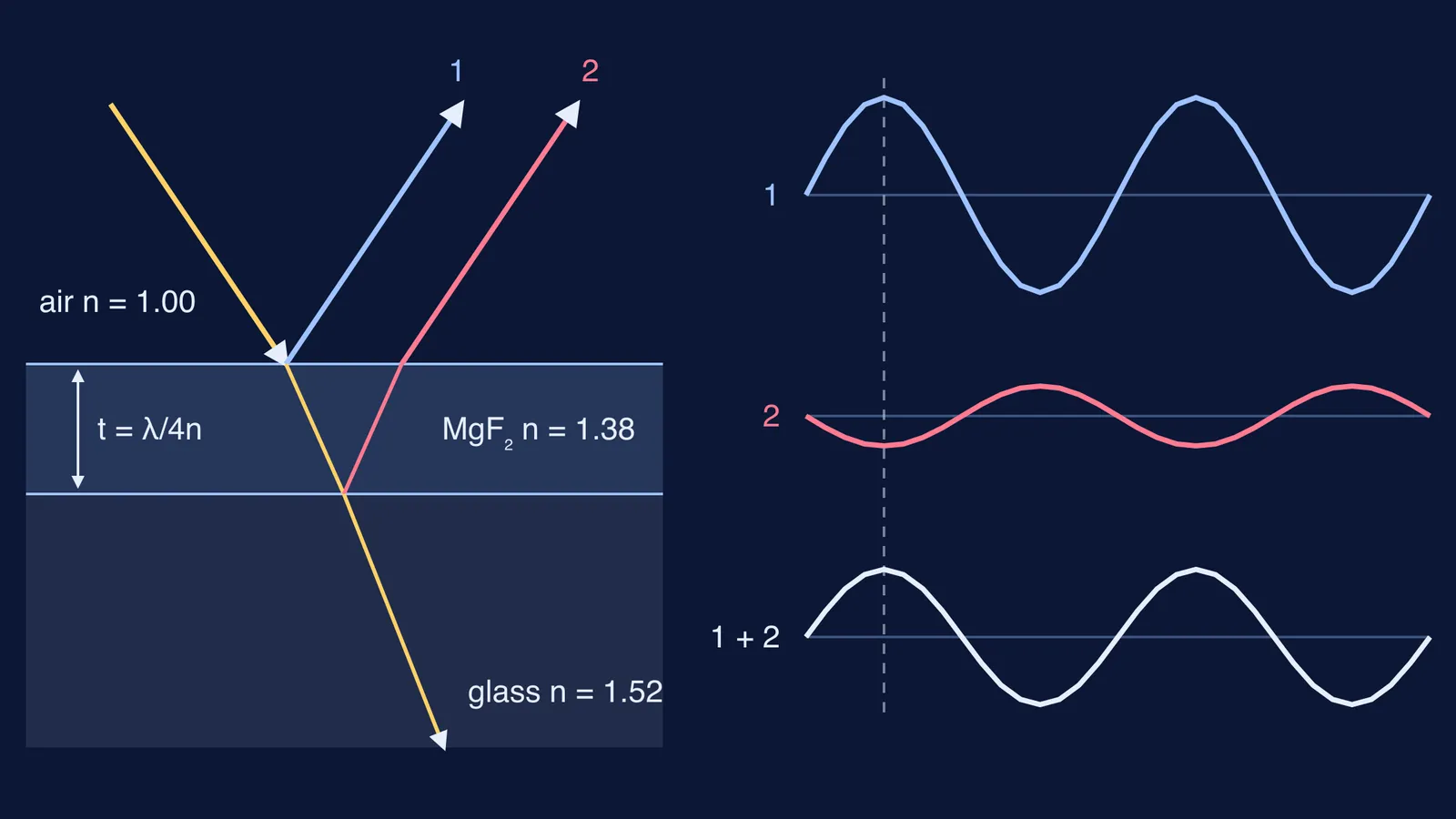
When light hits a coated lens, some of it reflects from the top of the coating (air to coating) and some from the bottom (coating to glass). HyperPhysics explains that if the coating is a quarter wavelength thick and has a lower refractive index than the glass, "the two reflections are 180 degrees out of phase", so they partly or totally cancel.
Two things decide the phase difference:
Path: wave 2 goes down through the film and back up, an extra distance 2t at normal incidence. Inside a medium of index n the wavelength shrinks to λ/n, so the extra optical path is 2nt.
Reflection flips: a wave reflecting off a medium of higher index is flipped by half a wavelength. With air (1.00) above MgF2 (1.38) above glass (1.52), both reflections flip, so the two flips cancel each other.
That leaves only the path. For destructive interference the extra optical path must be half a wavelength: 2nt = λ/2, so t = λ/4n. This is the minimum thickness. Thicker films also work whenever 2nt = (m + ½)λ, giving 3λ/4n, 5λ/4n and so on.
What is the minimum thickness of an MgF2 coating at 550 nm?
A layer a quarter of a design wavelength thick is called a quarter-wave layer, and magnesium fluoride, with an index of about 1.38, is a common choice (Wikipedia: Anti-reflective coating). Single-layer coatings are generally designed for a mid-visible wavelength such as 550 nm, green light (HyperPhysics).
The worked example:
Data: λ = 550 nm in air. MgF2 has n = 1.378 at 550 nm, from Dodge's measurements in Applied Optics (1984), as tabulated by refractiveindex.info. Round it to 1.38. For the glass, SCHOTT N-BK7 crown glass has n = 1.519 at 550 nm (refractiveindex.info, SCHOTT catalogue data).
Check the order: 1.00 < 1.38 < 1.52. Both reflections flip, so the condition is 2nt = λ/2.
Wavelength inside the film: 550 / 1.38 = 398.6 nm.
Minimum thickness: t = 398.6 / 4 = 99.6 nm, about 100 nm or 0.1 µm.
The next thickness that works is 3 × 99.6 = 299 nm.
How much reflection does the coating actually remove?
Not all of it. The cancellation is complete only when the two reflected waves are equally strong. That needs a coating index equal to the square root of the glass index, about 1.225 for glass of index 1.5 in air (Wikipedia). MgF2 sits above that, so some reflection remains.
You can check this with the normal-incidence reflectance formula R = ((n₀ − nₛ)/(n₀ + nₛ))², given on the same Wikipedia page, and the N-BK7 index from refractiveindex.info:
Bare N-BK7: R = (0.519 / 2.519)² ≈ 4.2%.
With a quarter-wave MgF2 layer (n = 1.378), the coated surface acts like one surface of effective index n_c²/n_glass = 1.899 / 1.519 ≈ 1.25, so R = (0.25 / 2.25)² ≈ 1.2%.
That matches the published figure: MgF2 on crown glass gives "a reflectance of about 1%, compared to 4% for bare glass" (Wikipedia). The coating is a perfect quarter wave only at its design wavelength. Tuned for green, it reflects relatively more red and blue, which HyperPhysics says gives camera lenses a purplish tint.
What changes if the film's index is higher than the glass?
If the film has a higher index than the media on both sides, as with a soap film in air, only the top reflection flips. The flips no longer cancel, so destructive reflection needs 2nt = mλ, and the minimum non-zero thickness becomes λ/2n.
Use this checklist on any thin-film question:
Write the indices in order from top to bottom.
Count the flips: one for each reflection off a higher index.
Zero or two flips: reflection is weakest when 2nt = (m + ½)λ, so the minimum is λ/4n.
One flip: reflection is weakest when 2nt = mλ, so the minimum is λ/2n.
Sanity check: for visible light the answer should be tens to a few hundred nanometres.
If you keep mixing up which case gives λ/4n and which gives λ/2n, the idea underneath is phase on reflection, and the Fermi Concept Library has a lesson on each concept in physics, with its place in the map. For practice, the Fermi Problem Library has worked problems with a step-by-step solver that explains the reasoning rather than printing an answer.
Next time you see the tint on a pair of glasses, run the five steps in your head.


