

On this page
You bubble carbon dioxide into a test tube of limewater and it turns milky. Your teacher keeps the gas going, and soon the liquid is clear again. Nothing went wrong. Two reactions happened one after the other, and the second undoes the part of the first that you could see. This is Activity 2.5 in the NCERT Class 10 Science chapter on acids, bases and salts, and a common exam question asks what happens when CO2 is passed through lime water for a long time.
Why does limewater turn milky with CO2?
Limewater is a solution of calcium hydroxide, Ca(OH)2, in water; the NCERT textbook calls it "lime water (calcium hydroxide solution)". Calcium hydroxide dissolves only about 1.73 g per litre of water at 20 °C, according to PubChem's calcium hydroxide record.
When carbon dioxide passes through, NCERT writes the reaction as:
Ca(OH)2(aq) + CO2(g) → CaCO3(s) + H2O(l)
Calcium carbonate does not dissolve in water, so it forms a fine white solid that NCERT labels "white precipitate". Tiny particles hanging in the liquid scatter light, and you see that as milkiness. Limestone, chalk and marble are all forms of calcium carbonate, the textbook notes.
Why does it turn clear again with excess CO2?
Keep passing the gas and a second reaction takes over. NCERT gives it as:
CaCO3(s) + H2O(l) + CO2(g) → Ca(HCO3)2(aq)
The product, calcium hydrogencarbonate, is labelled "soluble in water". The particles dissolve, nothing is left to scatter light, and the liquid clears.
A Purdue University chemistry demonstration explains the same step through carbonic acid: CO2 dissolves in water to form H2CO3, and the extra acid turns solid CaCO3 into calcium ions and hydrogencarbonate ions, because calcium bicarbonate is soluble. Calcium hydrogencarbonate and calcium bicarbonate are two names for the same compound.
How much CO2 does it take? A worked example
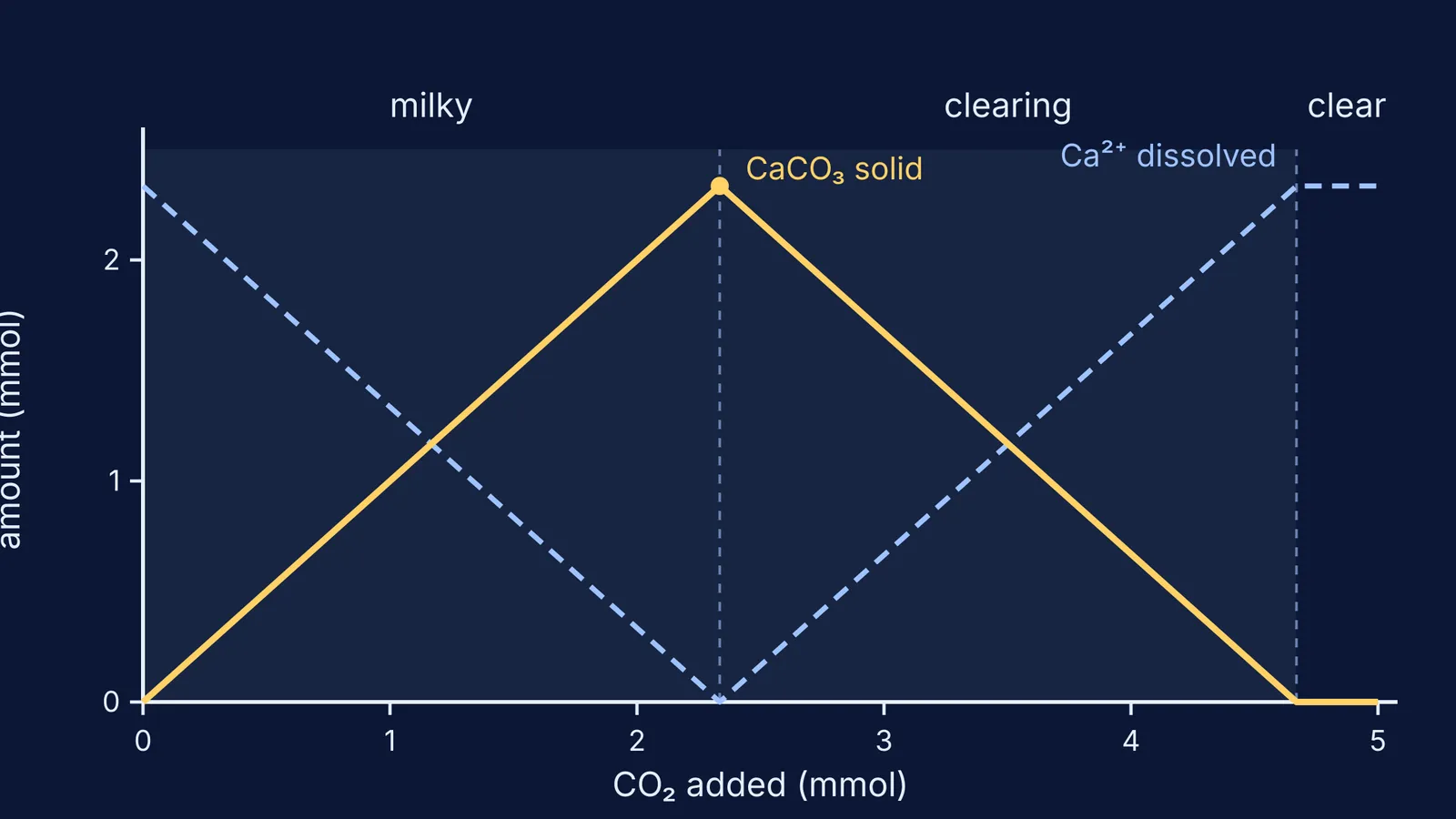
Putting numbers on the equations shows that, on paper, clearing the solution takes as much CO2 again as making it milky. Take 100 mL of limewater saturated at 20 °C, using the 1.73 g/L figure from PubChem.
Mass of Ca(OH)2 dissolved: 1.73 g/L × 0.100 L = 0.173 g.
Moles of Ca(OH)2: 0.173 g ÷ 74.09 g/mol = 2.34 mmol.
The first equation is 1 : 1. Turning all of it into CaCO3 uses 2.34 mmol of CO2 (about 0.103 g) and gives the most precipitate: 2.34 mmol × 100.09 g/mol = 0.234 g of CaCO3.
The second equation is also 1 : 1. Dissolving all 2.34 mmol of CaCO3 needs another 2.34 mmol of CO2.
Total CO2 for a clear solution: 4.67 mmol, twice the amount at peak milkiness.
The chart at the top of this post plots this ideal case: solid calcium carbonate rises in a straight line to its peak, then falls to zero over the same amount of added gas. A real test tube is messier. Many bubbles escape before reacting, so it takes longer than the arithmetic says. The Purdue sheet also writes the redissolving step with a two-way arrow, so the liquid stays clear only while enough CO2 stays dissolved.
If you follow each step here but go blank when the numbers change, practise similar questions in the Fermi Problem Library, where a step-by-step solver explains the reasoning rather than printing an answer.
Where else does this reaction show up?
The second reaction runs backwards whenever CO2 leaves the water, and in caves that builds stalactites. On its page about the formations in Lehman Caves, the National Park Service explains that the carbon dioxide content of groundwater entering the cave is about 250 times higher than that of the air. When the water meets air it "degasses just like a soda pop does when you open it", and calcite (calcium carbonate) comes out of solution as rock. "Without the carbon dioxide, the calcite cannot stay in solution," the page says.
So the limewater test and a stalactite are the same chemistry in opposite directions: adding CO2 dissolves calcium carbonate, losing CO2 brings it back.
What mistakes cost marks on this question?
Check your answer against this list:
Writing CaCO3 as (aq). It is a solid, (s), which is why the liquid turns milky.
Saying the milkiness is calcium hydroxide. The Ca(OH)2 was dissolved all along; the white solid is the carbonate.
Leaving H2O out of the second equation. Without it, Ca(HCO3)2 does not balance.
Writing "excess CO2 dissolves the precipitate" without naming calcium hydrogencarbonate. Examiners look for the product.
Treating a milky result as proof the gas is CO2. Read how to tell CO2 and SO2 apart beyond the limewater test first.
To see where the gas in this activity comes from, read how to prepare carbon dioxide with marble and hydrochloric acid, and revise the other lab gas tests with how to test for hydrogen, oxygen and carbon dioxide. If precipitation or solubility still feels shaky, the Fermi Concept Library gives each chemistry concept its own lesson.


