

On this page
When carbon dioxide (CO₂) or sulphur dioxide (SO₂) is bubbled through limewater—a dilute, colourless solution of calcium hydroxide—the solution rapidly turns milky due to the formation of a white, insoluble precipitate. For carbon dioxide, the precipitate is calcium carbonate. For sulphur dioxide, the precipitate is calcium sulphite. If you continue to pass either of these gases in excess, the milkiness completely disappears because the insoluble salts convert into their respective soluble bicarbonates and bisulphites. Because their physical and chemical behaviour with limewater is identical, this specific test alone cannot confirm which gas is present in your test tube. To accurately identify the gas, you must rely on secondary tests that exploit the reducing nature of sulphur dioxide.
How do you test with potassium dichromate?
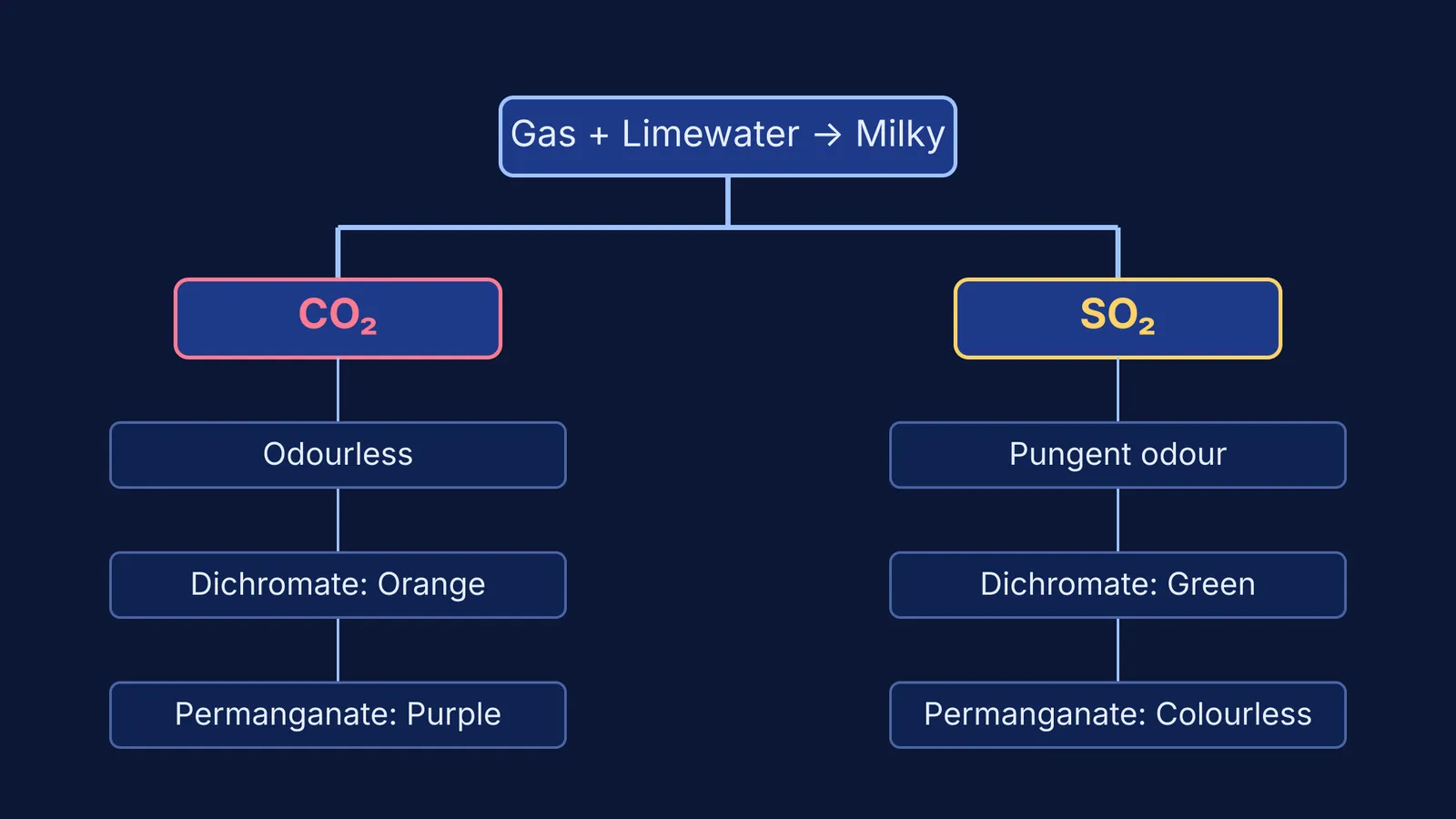
The standard laboratory method to distinguish these two gases is to use filter paper soaked in acidified potassium dichromate (K₂Cr₂O₇), or to pass the gas directly into the dichromate solution. Sulphur dioxide acts as a strong reducing agent and turns acidified potassium dichromate from orange to green 1.
During this chemical reaction, the sulphur dioxide reduces the chromium present in the dichromate ion from an oxidation state of +6 down to +3. This reaction forms chromium(III) sulphate, which is responsible for the distinct green colour of the final solution. At the exact same time, the sulphur dioxide itself is oxidised to sulphate. Carbon dioxide, on the other hand, is already fully oxidised (its carbon is in the maximum +4 state) and is not a reducing agent. Therefore, it has absolutely no effect on the orange dichromate solution.
Understanding oxidation states is a fundamental part of chemistry. The Fermi Concept Library holds every concept in physics, chemistry, biology, mathematics and computing, each with its own lesson and its place in the map. This helps you trace exactly why some molecules act as reducing agents while others remain chemically inert.
What is the potassium permanganate test?
Acidified potassium permanganate (KMnO₄) offers another distinct and highly visual chemical test for distinguishing the gases. Sulphur dioxide dissolved in water acts as a reducing agent and decolourises acidified potassium permanganate, turning it from a deep purple to colourless 2.
In this redox reaction, the purple permanganate ion (MnO₄⁻), in which the central manganese atom has a high oxidation state of +7, is reduced by the sulphur dioxide. The manganese is reduced to the colourless manganese(II) ion (Mn²⁺), and the sulphur dioxide is simultaneously oxidised to sulphate. As with the previous dichromate test, carbon dioxide cannot act as a reducing agent and causes no colour change whatsoever, leaving the test solution completely purple.
Tackling qualitative analysis questions in exams often requires you to systematically combine several of these chemical observations. The Fermi Problem Library provides worked problems with a step-by-step solver that explains the reasoning rather than printing an answer, making it much easier to build the logic necessary for identifying unknown compounds. For other common identification tests used in organic chemistry, you can review how to use Tollens' and Fehling's tests to identify aldehydes, or the iodoform test to accurately spot specific ketone structures.
How do you distinguish CO₂ and SO₂ by smell?
Beyond specific chemical reagents, you can also easily distinguish the two gases by their basic physical properties. Sulphur dioxide has a characteristic, pungent smell of burning sulphur 3.
Carbon dioxide, by contrast, is completely odourless at normally-encountered concentrations 4. Because sulphur dioxide is highly irritating, this odour test should only be done cautiously in a well-ventilated laboratory setting. You should never inhale the gas directly from the source; instead, use your hand to gently waft a small amount of the gas towards your nose.
In some cases, you might also be asked to test the unknown gas with moist litmus paper. Both gases easily dissolve in water to form weak acids—carbonic acid and sulphurous acid—which will immediately turn blue litmus paper red. However, sulphur dioxide's strong reducing properties mean it will eventually bleach the litmus paper completely, whereas carbon dioxide will merely leave the paper red.


