

On this page
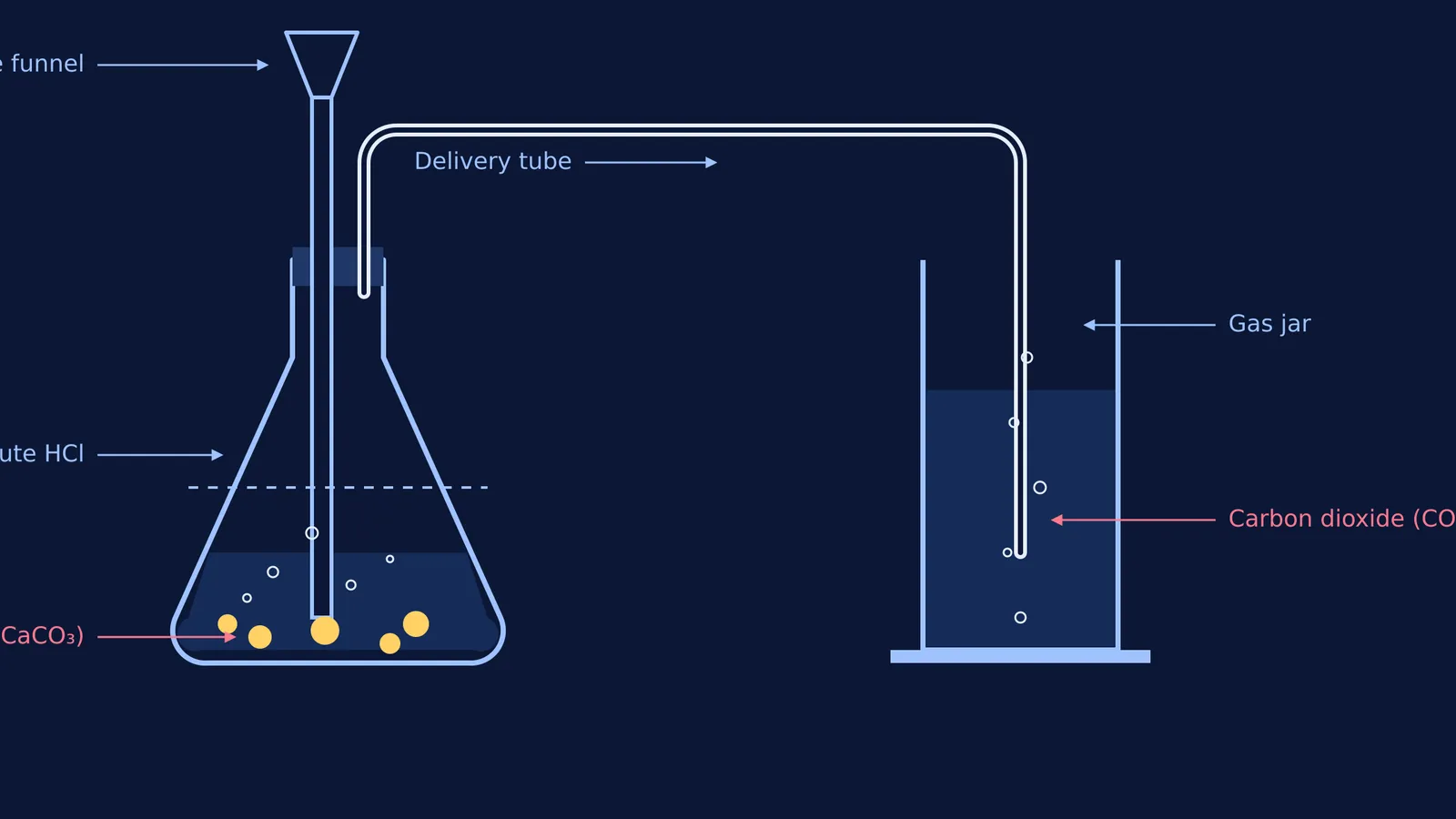
Marble chips are a naturally occurring, crystalline form of calcium carbonate (CaCO₃), heavily mined for construction and often used in chemical demonstrations. When placed in a laboratory flask with dilute hydrochloric acid (HCl), a brisk effervescence—or fizzing—immediately occurs as bubbles of carbon dioxide gas are rapidly released from the solid surface.
What is the chemical equation for the preparation of CO₂?
The reaction between the solid carbonate and the aqueous acid produces an aqueous solution of calcium chloride, liquid water, and carbon dioxide gas:
CaCO₃(s) + 2HCl(aq) → CaCl₂(aq) + H₂O(l) + CO₂(g)
The rate of this chemical reaction depends critically on the surface area of the solid calcium carbonate. Large marble chips react at a steady, manageable pace, making them ideal for laboratory preparations where you need to collect the gas safely over a longer period of time. If you were to use finely powdered calcium carbonate instead, the increased surface area would make the reaction violently fast, potentially causing the mixture to froth over the flask. For more on the factors affecting reaction rates and how to construct such balanced equations, see Balancing chemical equations in Class 10: a method that always works.
Why is sulfuric acid not used with marble chips?
A common mistake in laboratory planning is substituting hydrochloric acid with dilute sulfuric acid (H₂SO₄).
If you add sulfuric acid to marble chips, the reaction starts with some initial fizzing but stops almost immediately. The sulfuric acid reacts with the calcium carbonate to form calcium sulfate (CaSO₄). Unlike the highly soluble calcium chloride produced earlier, calcium sulfate is only sparingly soluble in water, a phenomenon commonly documented by the U.S. Geological Survey in their weathering studies. It immediately precipitates out of the solution and forms a hard, impervious crystalline coating over the unreacted marble chips. This physical barrier stops the remaining acid from reaching the fresh carbonate underneath, bringing the entire gas preparation to a sudden halt.
How is the carbon dioxide gas collected?
Once the carbon dioxide is produced in the flask, it travels through a sealed delivery tube and is collected in an upright gas jar using a straightforward method called the upward displacement of air.
This method is chosen by chemists for two specific physical reasons:
Density: Carbon dioxide is approximately 1.5 times denser than average air, as noted by the CK-12 Foundation. When delivered to the bottom of the gas jar, the heavy CO₂ stays low and forces the lighter air upwards and out of the open top.
Solubility: While gases like oxygen or hydrogen are often collected by bubbling them through a trough of water, carbon dioxide dissolves in water to form a weak solution of carbonic acid (H₂CO₃). Collecting it over water would result in a wet, impure sample and a significant loss of yield.
You can learn more about the everyday applications of these acid and salt properties in Acids, bases and salts in Class 10: indicators, pH and common salts.
How does the limewater test work?
To confirm that the collected, colourless gas is indeed carbon dioxide, it is bubbled through limewater—a clear, dilute aqueous solution of calcium hydroxide, Ca(OH)₂.
When carbon dioxide meets the clear limewater, it undergoes a precipitation reaction to form calcium carbonate:
Ca(OH)₂(aq) + CO₂(g) → CaCO₃(s) + H₂O(l)
The newly formed calcium carbonate is insoluble and immediately precipitates as a suspension of fine white particles, turning the previously clear limewater milky or cloudy.
If you continue to bubble excess CO₂ through the milky solution for a prolonged period, the milkiness eventually disappears. The excess carbon dioxide reacts with the suspended calcium carbonate and water to form calcium hydrogencarbonate, Ca(HCO₃)₂, which is fully soluble in water, returning the solution to a clear, colourless state. These unique, reversible reactions are a cornerstone of understanding Carbon compounds in Class 10: homologous series and functional groups.
Studying chemistry with Fermi
Understanding chemical preparations requires picturing both the macroscopic laboratory apparatus and the microscopic atomic reactions taking place inside the flask. If you are struggling to connect theoretical equations to their real-world observations, the Fermi Concept Library has a dedicated lesson for every concept in chemistry to help you connect the dots.
Rather than just printing an answer, Fermi's AI tutor holds a continuous line of reasoning across a session to teach you the underlying principles—like how solubility rules dictate which acid to choose, or how gas density determines the collection method. The tutor works out what you already know and builds a plan for the session, helping you establish a lasting foundation for both practical experiments and theory exams.


