

On this page
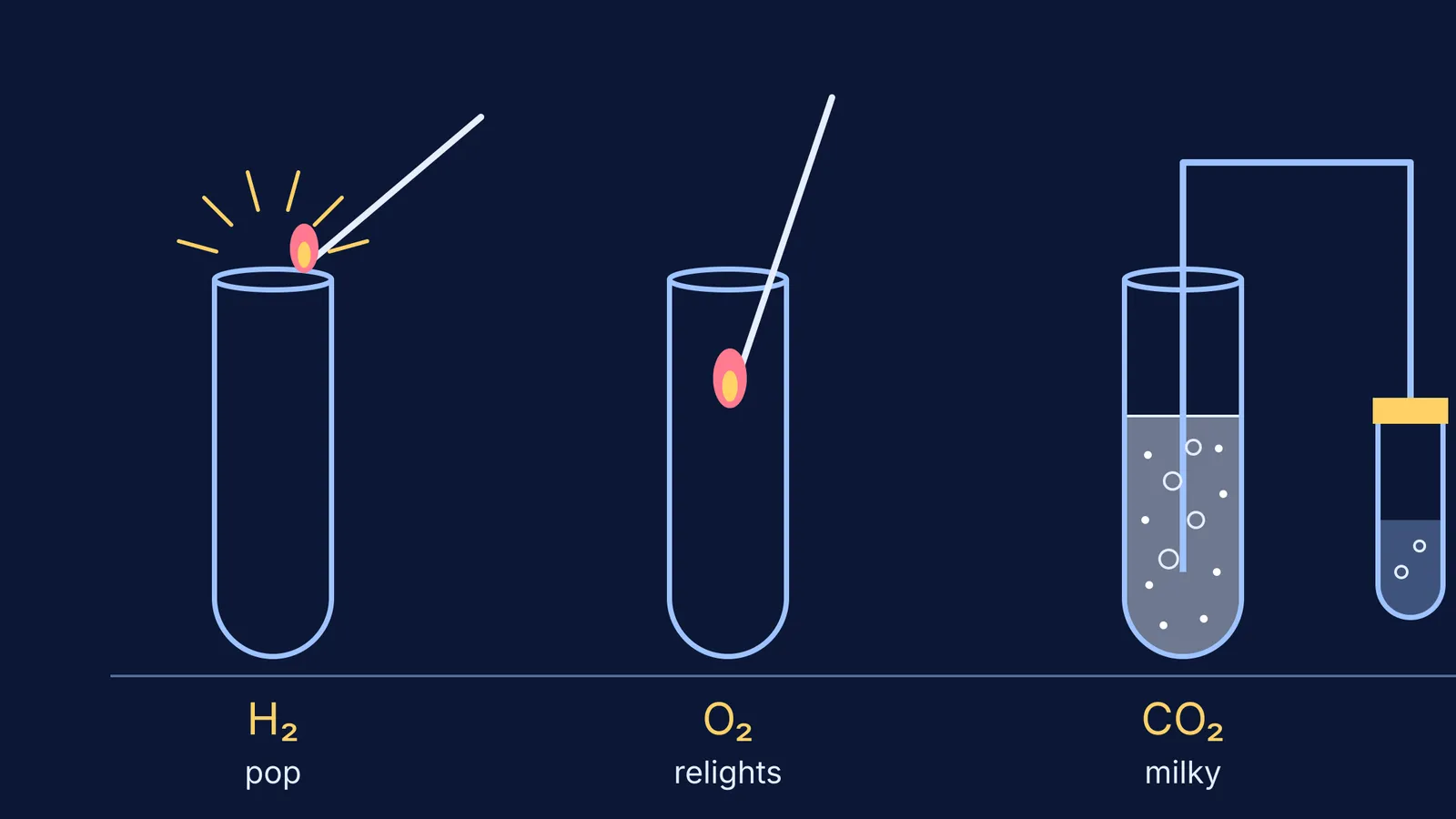
If you are handed a tube of colourless gas, three quick tests cover most school questions. The Royal Society of Chemistry's gas-test worksheet lists them: a lit splint for hydrogen ("burns with a pop"), a glowing splint for oxygen ("relights") and limewater for carbon dioxide ("turns cloudy"). Here are the equations, and why each result points to one gas.
How do you test for hydrogen gas?
Hold a lit splint at the mouth of the tube, not inside it. Hydrogen burns with a pop. NCERT's Class 10 science textbook makes hydrogen from zinc granules and dilute sulphuric acid, fills soap bubbles with it and brings a burning candle near; the figure reads "Burning of hydrogen gas with a pop sound" (NCERT Class 10 Science, Chapter 2).
The equations:
Making the gas: Zn + H₂SO₄ → ZnSO₄ + H₂
The pop: 2H₂ + O₂ → 2H₂O (NCERT Class 10 Science, Chapter 1, equation 1.16)
Why a pop? At the mouth of the tube, hydrogen mixes with air, and the flame burns the whole mixture almost at once. That sudden burn is the sound.
How do you test for oxygen gas?
Light a wooden splint, blow it out so the tip just glows, then put the glowing tip into the tube. If the gas is oxygen, the splint relights and bursts back into flame (RSC worksheet).
The reason is concentration. A glowing splint is wood burning slowly in air, and dry air is 20.95% oxygen by volume (NASA Earth Fact Sheet). In a tube of nearly pure oxygen, the slow burning speeds up until there is enough heat for a flame again.
Hydrogen is a fuel: it burns. Oxygen does not burn itself; it makes other things burn faster. That is why hydrogen gets a lit splint and oxygen a glowing one. NCERT's electrolysis of water activity collects both gases and has the teacher bring a burning candle to each tube (NCERT Class 10 Science, Chapter 1, Activity 1.7).
How do you test for carbon dioxide with limewater?
Bubble the gas through limewater, a clear solution of calcium hydroxide. If the gas is carbon dioxide, the limewater turns milky. NCERT Activity 2.5 makes the gas from dilute hydrochloric acid and two sodium salts (NCERT Class 10 Science, Chapter 2):
Na₂CO₃ + 2HCl → 2NaCl + H₂O + CO₂
NaHCO₃ + HCl → NaCl + H₂O + CO₂
Ca(OH)₂ + CO₂ → CaCO₃ + H₂O (white precipitate)
The milkiness is tiny grains of calcium carbonate, the compound in limestone, chalk and marble, which does not dissolve in water. Keep bubbling and it clears, because extra CO₂ forms soluble calcium hydrogencarbonate: CaCO₃ + H₂O + CO₂ → Ca(HCO₃)₂ (same NCERT chapter).
How reliable is each gas test?
Each test checks one property, which is evidence for the gas, not proof of its name.
Pop with a lit splint: the gas burns fast in air. In the school syllabus, that is hydrogen.
Glowing splint relights: the gas helps burning more than air does, so it is richer in oxygen than air.
Limewater turns milky: the gas is acidic and forms an insoluble calcium salt.
The limewater test has one known look-alike. NCERT's chemistry lab manual says: "Like CO₂ sulphur dioxide also turns lime water milky. But CO₂ is odourless gas and SO₂ has a characteristic smell." The same manual separates the two with a second test: SO₂ turns acidified potassium dichromate solution green (NCERT Class 11 Chemistry Lab Manual, Unit 7). The same logic runs through salt analysis, as in our guide to ICSE NaOH and NH₄OH tests for metal ions.
Worked example: which gas, which compound?
NCERT's Class 10 chapter asks this: metal compound A reacts with dilute hydrochloric acid and fizzes. The gas puts out a burning candle, and one product is calcium chloride. Find A and write the equation (NCERT Class 10 Science, Chapter 2).
Fizzing with acid means a gas is being made.
The gas puts out a flame, so it is not hydrogen (it would pop) or oxygen (the flame would brighten).
In school questions, a metal compound that fizzes with acid and gives a gas that puts out a flame is usually a carbonate, and the gas is CO₂. Confirm with limewater.
Calcium chloride as a product means A is calcium carbonate.
Equation: CaCO₃ + 2HCl → CaCl₂ + H₂O + CO₂
Putting out a flame only tells you the gas does not burn or help burning; limewater is what confirms carbon dioxide. The same reasoning applies when ethanoic acid meets sodium carbonate (see ethanol and ethanoic acid for Class 10), and our guide to give-reasons questions in CBSE chemistry shows how to set out the "why" questions.
If one step keeps tripping you up, like why the milkiness clears, the Fermi Concept Library gives every chemistry concept its own lesson. The Fermi Problem Library has worked problems with a step-by-step solver that explains the reasoning rather than printing an answer.


