On this page
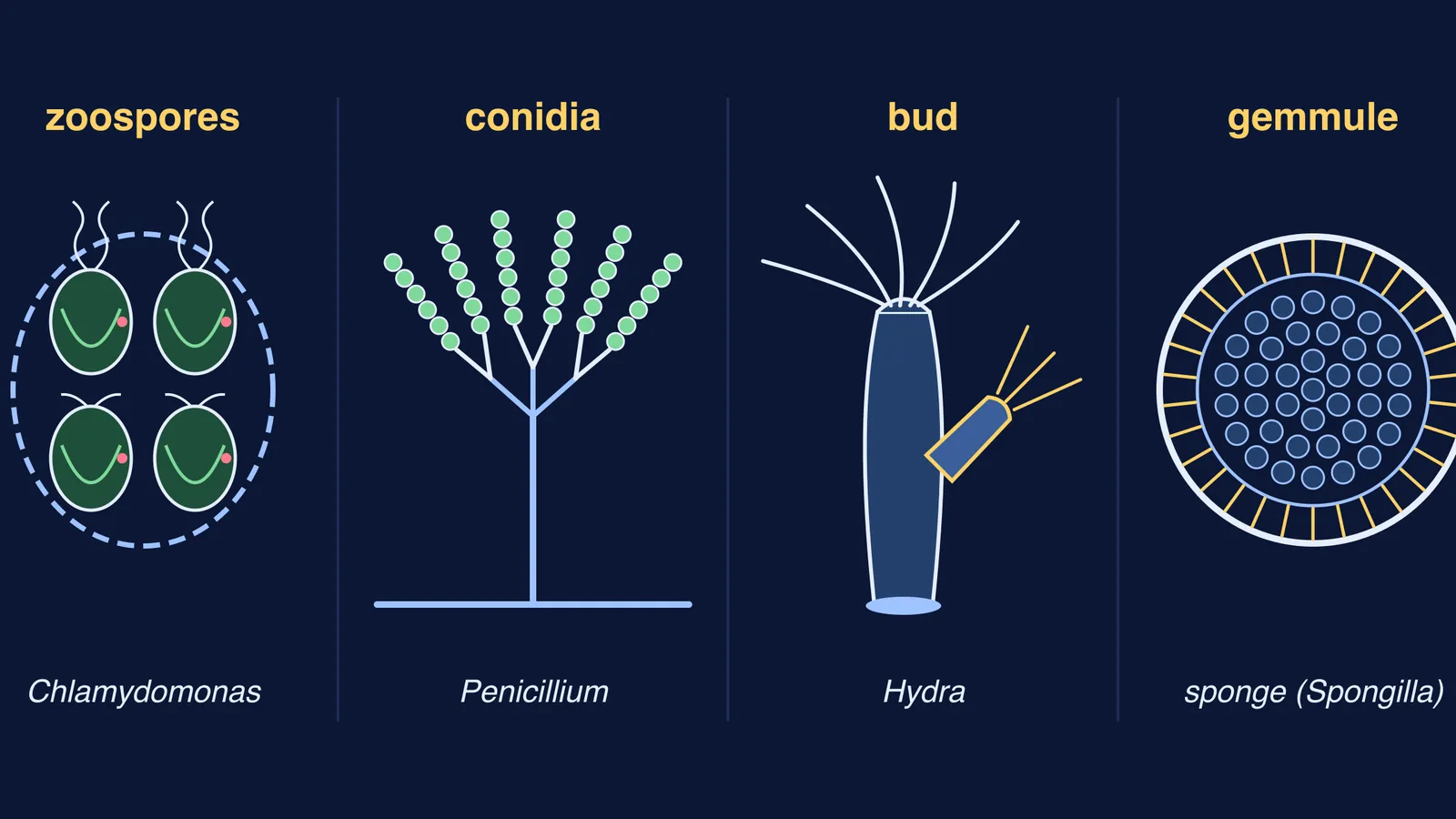
If a match-the-column question gives you zoospores, conidia, buds and gemmules, the answers are Chlamydomonas, Penicillium, Hydra and sponge. All four are asexual: one parent, no gametes, and offspring that are copies of the parent. Students mix them up because the names sound alike. The fix is to tie each word to a picture of what the structure looks like and what it does. Below you'll find one sourced fact for each pair, a two-minute sketch for each and a short quiz.
Which organism makes zoospores, conidia, buds and gemmules?
Zoospores: Chlamydomonas. Chlamydomonas is a single-celled green alga with a pair of flagella and a large cup-shaped chloroplast, according to a review of its cell cycle by Frederick Cross and James Umen (The Plant Journal, 2015). The same review reports that a mother cell divides into 2, 4, 8, 16 or 32 daughters, depending on growth conditions. These daughters, also called zoospores, then hatch out of the mother cell. Zoo means animal, so a zoospore is a spore that swims.
Conidia: Penicillium. OpenStax Biology 2e defines conidiospores as spores "released directly from the tip or side of the hypha", unlike sporangiospores, which are produced in a sporangium (OpenStax, Characteristics of Fungi). In Penicillium, chains of single-celled conidia grow from flask-shaped cells called phialides. The branched stalk that carries them looks like a brush, which is why it is called a penicillus (University of Adelaide, Mycology Online). The same page notes that Penicillium colonies are usually in shades of green.
Buds: Hydra. Hydra is a cnidarian that lives only in the polyp form (OpenStax, Phylum Cnidaria). A 2017 study in Developmental Dynamics opens with the key fact: Hydra "propagates asexually by exporting tissue into a bud, which detaches 4 days later as a fully differentiated young polyp" (Holz and colleagues, 2017).
Gemmules: sponges. OpenStax notes that gemmule formation is "found only in freshwater sponges", such as Spongilla (OpenStax, Phylum Porifera). A gemmule is an inner mass of archaeocytes (amoebocytes) wrapped in a protective layer, which may be strengthened with spicules. Gemmules resist drying out and can stay dormant for long periods. When conditions improve, a fully developed miniature sponge can be re-established from a gemmule in about 1 week, depending on conditions, according to a 2019 lab study of the freshwater sponge Ephydatia fluviatilis (Bart and colleagues, PeerJ).
How do you tell the four structures apart?
Ask these questions in order and stop at the first yes:
Does it swim with flagella? Zoospore, so Chlamydomonas.
Is it a dry spore in a chain at the tip of a branched stalk? Conidium, so Penicillium.
Is it a small copy of the parent growing out of its body? Bud, so Hydra.
Is it a resting ball of cells inside a tough coat? Gemmule, so a freshwater sponge.
Watch for one trap. Hydra isn't the only organism that buds. OpenStax lists fragmentation and budding as the usual ways sponges reproduce asexually, and gemmules as the unusual one. Yeast buds too, in its own way. Our post on how budding in Hydra differs from budding in yeast shows the difference. If a question offers both bud and gemmule for a sponge, match the other pairs first. The option left over is your answer.
How do you draw each one in two minutes?
Draw large, label with straight lines and use these labels:
Chlamydomonas: mother cell wall, four daughter zoospores inside it, two flagella on each, cup-shaped chloroplast.
Penicillium: hypha, conidiophore (the stalk), metulae, phialides, chains of conidia.
Hydra: parent body, tentacles, bud.
Sponge gemmule: archaeocytes in the centre, protective coat, spicules in the coat.
The diagram at the top of this post shows all four in this layout. To see where Penicillium sits among the fungi, read our guide to the classes of Kingdom Fungi and how fungi reproduce.
Quick quiz: can you match them?
Match each organism to its structure. The options are (a) bud, (b) zoospores, (c) gemmule and (d) conidia.
Penicillium
Spongilla
Chlamydomonas
Hydra
Now try two harder ones:
A single cell divides inside its own wall, and the daughters hatch out and swim away. Which structure is this?
A pond dries up for the summer. Which structure lets a freshwater sponge grow back?
If you got one wrong, write the reason next to it as well as the right letter. The Fermi Concept Library gives every concept in biology its own lesson and its place in the map, so you can see asexual reproduction alongside the groups these four organisms belong to. When a question trips you up, the Fermi Problem Library has worked problems with a step-by-step solver that explains the reasoning rather than just printing an answer.
For the bigger picture, revise sexual and asexual reproduction side by side.