

On this page
Asexual reproduction allows organisms to create new individuals without the need for a mate or fertilisation. Budding is one of the most common and fascinating methods, relying on a simple outgrowth from the parent to form the next generation.
While the basic idea is the same, budding in yeast and budding in Hydra look entirely different under a microscope. Yeast is a unicellular fungus, while a Hydra is a complex, multicellular freshwater animal. Because of this structural difference, the way they build a bud is fundamentally distinct.
How does budding in yeast work?
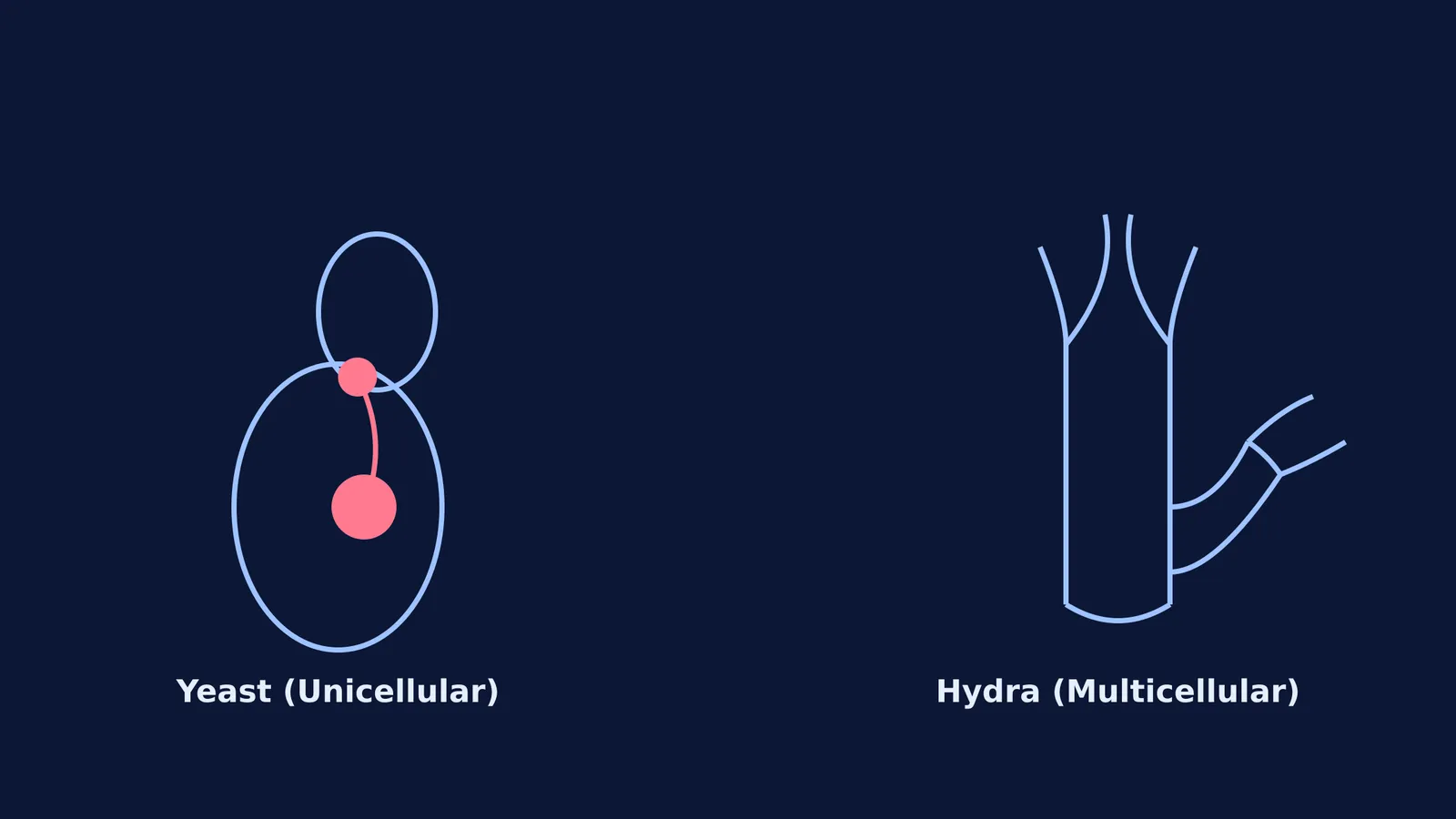
Yeast cells reproduce through a form of asymmetric cell division. The process begins when a small, bulb-like projection appears on the side of the parent cell, pushing outward through the cell wall.
Inside the parent cell, the nucleus divides into two identical daughter nuclei. One of these nuclei migrates into the growing bud, bringing a full copy of the genetic material. Once the bud reaches a certain size, it pinches off at the base to become a new, independent yeast cell.
This single-celled process is rapid under ideal, nutrient-rich conditions. Yeast cells often form a chain of buds because they reproduce so quickly that a new bud forms before the previous one detaches. This creates a temporary structure known as a pseudomycelium, as detailed in a 2001 review by Gancedo.
How does budding in Hydra work?
A Hydra is a much larger, multicellular animal with distinct tissue layers, including an epidermis and a gastrodermis. Because of this, it cannot simply divide a single cell to reproduce. Instead, it relies on specialised regenerative cells, known as interstitial cells.
In a Hydra, a bud develops as a noticeable outgrowth due to repeated cell division at one specific site on its tubular body. This is a highly coordinated process. As the bud grows, it elongates and begins to differentiate. It develops its own mouth and a ring of tentacles at its free end, all while remaining attached to the parent and sharing its food supply.
It is only when the bud is a fully formed, miniature Hydra—consisting of roughly 10,000 to 20,000 cells out of the parent's 50,000 to 100,000 (Tomczyk et al., 2015)—that it constricts at the base, detaches, and floats away to live on its own.
What triggers budding in these organisms?
The environment plays a crucial role in deciding when these organisms reproduce asexually. For yeast, budding is primarily driven by the availability of food. When placed in a warm environment with plenty of sugars—such as fruit juices or bread dough—yeast cells have the abundant energy required to replicate their DNA and push out a new bud. If conditions turn harsh or nutrients run out, they stop budding and may instead form protective spores to survive.
A Hydra, living in freshwater ponds and streams, also requires a steady food supply to bud. When a Hydra is well-fed, capturing enough water fleas (Daphnia) with its stinging tentacles, it uses the surplus energy to fuel the rapid division of its interstitial cells. These interstitial cells act as powerful stem cells, constantly dividing and differentiating into the various tissues the bud needs, including the specialised stinging cells called cnidocytes. However, if the water turns too cold or food becomes scarce in the winter, a Hydra will shift away from asexual budding and reproduce sexually by forming eggs and sperm, ensuring the next generation can wait out the difficult season.
What are the main differences between budding in yeast and Hydra?
When learning these biological processes, it helps to contrast their core features directly:
Complexity: A yeast bud is a single cell formed by stretching the cell membrane and wall. A Hydra bud is a complex structure made of numerous cells organised into specific tissues.
Detachment: Yeast buds frequently stay attached long enough to form branching chains. A Hydra bud always detaches as a single, independent organism once it matures.
Structures: A yeast bud is simply a spherical compartment containing a nucleus and cytoplasm. A Hydra bud grows specialised organs, like a mouth and tentacles, before it leaves the parent.
If you are trying to map out how these different systems function and relate to each other, the Fermi Concept Library contains lessons that break down every concept in biology and its place in the wider map of reproduction.
A checklist for comparing budding in exams
If you are answering a long-form question on this topic for Class 10 Boards or a school biology exam, use this practical framework to ensure you cover all the necessary points for full marks:
Organism type: State clearly that yeast is a unicellular fungus and Hydra is a multicellular animal.
The outgrowth: Describe a yeast bud as a single bulbous projection of the cell, and a Hydra bud as a multicellular outgrowth formed by regenerative cells.
Nuclear vs cellular division: Mention that yeast involves the parent nucleus dividing and moving into the bud, whereas Hydra involves repeated mitotic cell divisions of tissue layers at a specific site.
Final form: Note that yeast often forms chains of connected cells due to rapid growth, while the Hydra bud must develop complex features like tentacles and a mouth before detaching.
If you find yourself stuck on tricky assertion-reasoning questions about these biological differences, Fermi's AI tutor can work out what you already know and build a plan for the session, guiding you to the right answer rather than just handing it to you.
Understanding how different organisms tackle the exact same biological goal helps you see the broader evolutionary patterns in nature. This comparative approach is just as useful when studying apomixis and polyembryony or when examining phototropism and other tropic movements in plants.


