On this page
You step out of the shower onto the tiles and your foot shoots forward. The same floor felt safe when dry; all that changed is a thin layer of water.
Why are wet floor tiles so slippery?
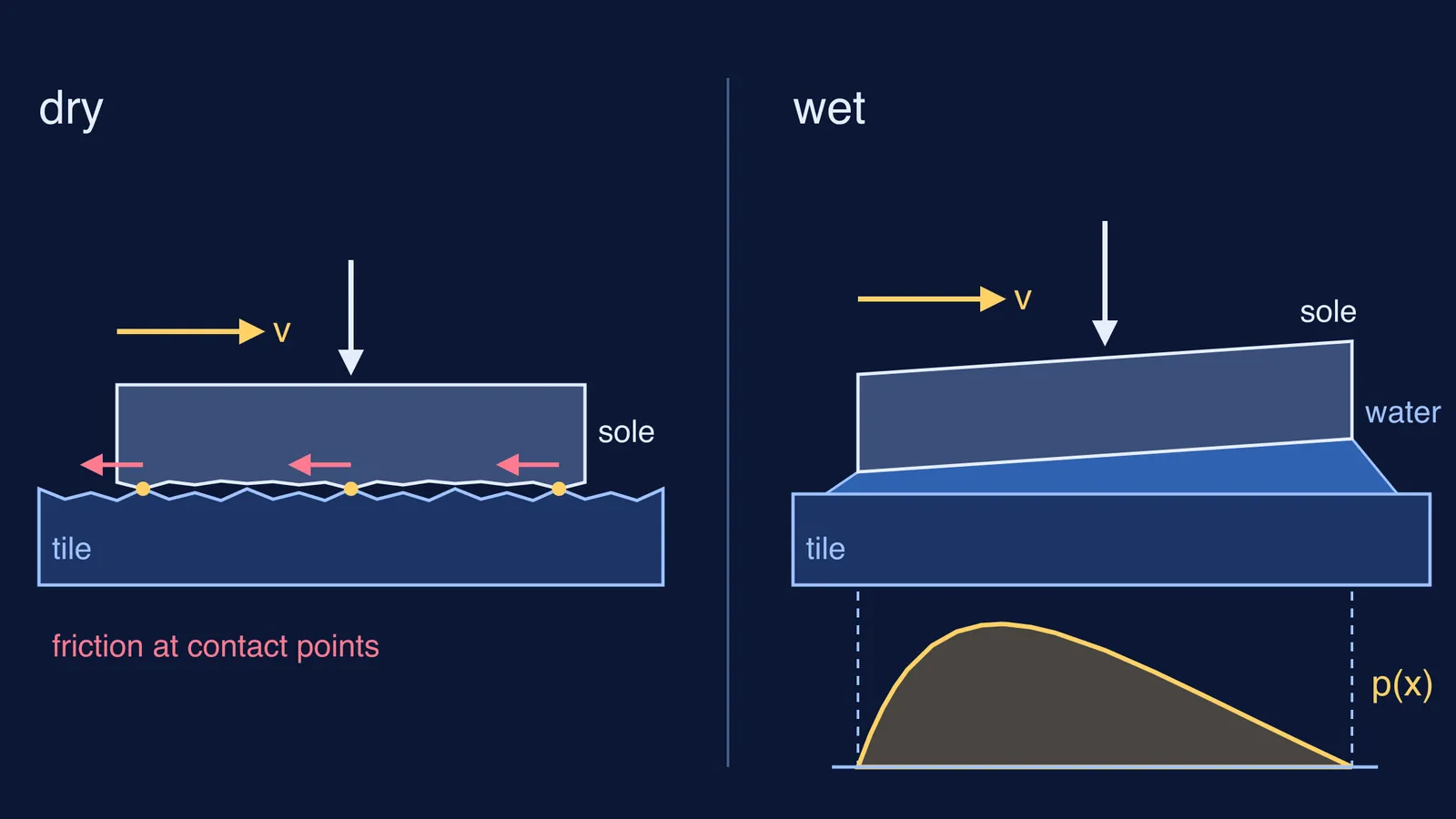
Friction comes from tiny irregularities on two surfaces locking into each other, as the NCERT Class 8 science textbook explains (NCERT Class 8 Science, Chapter 9: Friction). The chapter even asks you to recall how difficult it is to move on a wet marble floor.
Water does two things. First, it acts like a lubricant: the chapter describes how a thin layer of oil or grease means the moving surfaces "do not directly rub against each other". Second, when your heel lands and starts to slide, the water cannot escape fast enough. It is squeezed into a wedge under the sole and pushes back up. Any weight the water carries is weight not pressing rubber onto tile, so there is less grip.
In a study of 18 people walking onto unexpectedly slippery floors, sensors in the floor recorded maximum fluid pressures averaging about 124 kPa under untreaded shoes and about 1.1 kPa under treaded shoes (Beschorner and colleagues, Journal of Biomechanics, 2014). Higher fluid pressures went with faster, more severe slips. The authors concluded that shoes and floors that lower underfoot fluid pressure could make slips rarer and less severe.
Slips often happen when the grip your step needs is more than the floor can give (Burnfield and Powers, Journal of Forensic Sciences, 2007). In that study, forward speed of the body's centre of mass and its angle to the centre of pressure under the foot together predicted 62% of the variation in the peak grip people needed as the foot took their weight. How you move matters, not just the floor.
How much weight can a film of water carry?
Here is a rough worked example using the 2014 study's number (Beschorner and colleagues, 2014).
Maximum fluid pressure under an untreaded sole: about 124 kPa, or 124,000 newtons per square metre.
Suppose, generously, that this peak acts evenly over a heel patch of just 10 cm² (0.001 m²).
Force from the water = pressure × area = 124,000 × 0.001 = 124 N.
A 50 kg student weighs about 50 × 9.8 = 490 N.
So under that one small patch, water could hold up roughly a quarter of the student's weight. Real pressure is lower away from the peak, so treat this as an upper-end sketch. With a treaded sole (about 1.1 kPa), the same patch carries about 1.1 N. Grooves give water a channel to escape, so rubber meets tile again. Our post on why tyres have treads to stop aquaplaning shows the same idea on a wet road.
Which tiles and slippers are safer when wet?
The UK Health and Safety Executive (HSE) says its statistics suggest most workplace slips happen when floors are contaminated with things like water, talc or grease (HSE, Assessing the slip resistance of flooring). Its guidance uses two measures you can ask a tile seller about:
Pendulum test value (PTV): 0 to 24 means high slip potential, 25 to 35 moderate, 36 or more low.
Surface roughness (Rz) on water-wet floors: below 10 µm means high slip potential, 10 to 20 µm moderate, 20 µm or more low.
HSE also warns that floors rated R9 on the German DIN 51130 ramp scale will be slippery in wet or greasy conditions, and that contaminants thicker than water need rougher surfaces. For slippers, check the sole: once the grooves wear smooth, water under the heel has nowhere to go. Our explainer on ways to increase and reduce friction has more everyday examples.
If interlocking bumps still feel fuzzy, the Fermi Concept Library has a lesson for each physics concept, and the Fermi Simulation Lab has interactive simulations for ideas easier to see than to read.
How do you make a bathroom and staircase safer?
WHO estimated about 842,000 deaths from falls worldwide in 2023, about 71% of them among adults aged 60 and older, and lists targeted home-hazard reduction among effective measures (WHO, Falls fact sheet).
In the bathroom:
Squeegee the floor dry after every bath, especially near the door.
Rinse away soap and shampoo films, which are thicker than water.
Keep bathroom slippers with deep grooves, and replace them when the grooves wear flat.
Use only mats with a rubber non-slip backing.
Fit a grab bar near the toilet and bath if a grandparent lives with you.
On the staircase:
Never mop stairs while people are using them; dry each step straight after.
Check the handrail is firm and runs the full length.
Add anti-slip strips to smooth stone or tile steps, especially near entrances in the monsoon.
Keep stairs well lit and clear of slippers and bags.
For the dry-floor side of the story, read why friction points forward when you walk.