On this page
The enzymes that digest the protein in your dal and paneer would also digest your stomach and pancreas, because those organs are made of protein too. The body gets around this by making these enzymes in a locked form, and unlocking them only where the food is. Here is how each lock is opened, in the order it happens.
What is a zymogen?
A zymogen, also called a proenzyme, is an inactive precursor of an enzyme (Biology LibreTexts/02%3A_Unit_2_-_Enzymes/2.02%3A_Enzyme_Kinetics/2.2.11%3A_Zymogen_Activation)). The chain carries an extra stretch, called the activation peptide, that keeps the enzyme switched off. Cutting the chain at one specific bond, which usually releases this stretch, switches the enzyme on.
Why are digestive enzymes secreted in inactive form?
The short answer is self-protection. A review in Gastroenterology by Mayerle and colleagues states that premature, intrapancreatic activation of digestive proteases is critical in pancreatitis onset (Mayerle et al., 2019). The same review describes a backup lock: the pancreas makes SPINK1, a protein that inhibits trypsin if some switches on too early.
So the inactive form does three jobs:
Safety: the cells that make and store the enzyme are not digested by it.
Place: the enzyme switches on only in the stomach or the intestine, where the food is.
Timing: one trigger at the right moment starts a chain, so the gut does not need a separate signal for every enzyme.
For the cell-level picture of who secretes what in the stomach, see our guide to gastric gland cells and their secretions.
How does HCl activate pepsinogen?
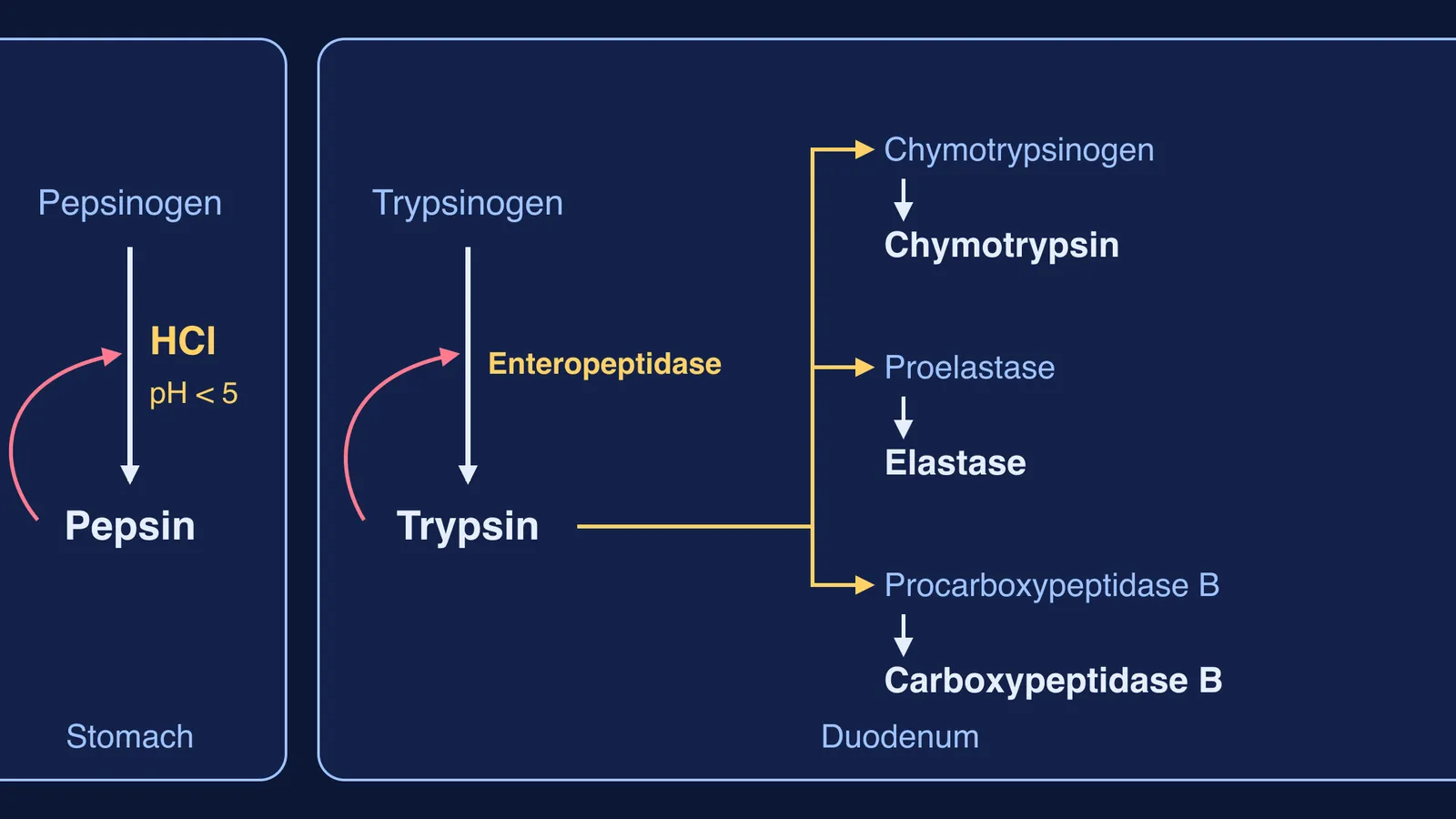
Chief cells of the gastric glands secrete pepsinogen, and when it meets a pH below 5 an auto-catalytic activation occurs (Stanforth et al., 2022, Annals of Esophagus). In human pepsin, the piece cut off is 47 amino acids long, according to the same review.
HCl does not cut the chain itself. The low pH sets off what the review calls autocatalysis: pepsinogen cuts itself, and the pepsin that forms helps activate more pepsinogen. That is why the stomach diagram has a loop from pepsin back to the arrow.
The off switch matters too: the review reports that pepsin is irreversibly denatured at a pH between 7.0 and 8.0. How the stomach lining survives the acid and pepsin in the meantime is covered in our post on why the stomach does not digest itself.
How does enterokinase activate trypsinogen?
Enterokinase is the old name; the enzyme database ExPASy lists it as enteropeptidase, and its reaction as the activation of trypsinogen by selective cleavage of one Lys-Ile bond (ExPASy ENZYME, EC 3.4.21.9). In human cationic trypsinogen, that bond is Lys23-Ile24, sitting just after four aspartate residues (Nemoda and Sahin-Tóth, 2005, Journal of Biological Chemistry).
Trypsinogen is activated by enteropeptidase in the duodenum, and trypsin then activates chymotrypsinogens, proelastases and procarboxypeptidase B1 (Mayerle et al., 2019). Trypsin can also activate trypsinogen itself, which Nemoda and Sahin-Tóth write as Trypsin + Trypsinogen → 2 Trypsin. They note that inherited mutations that moderately increase this autoactivation cause hereditary pancreatitis.
Which activator switches on which enzyme?
Use this as your revision list, drawn from Stanforth et al., Mayerle et al. and ExPASy. Each line reads zymogen, active enzyme, activator, place.
Pepsinogen → pepsin; HCl (pH below 5), then pepsin itself; stomach
Trypsinogen → trypsin; enteropeptidase (enterokinase), then trypsin itself; duodenum
Chymotrypsinogen → chymotrypsin; trypsin; duodenum
Proelastase → elastase; trypsin; duodenum
Procarboxypeptidase B → carboxypeptidase B; trypsin; duodenum
Procarboxypeptidases A1 and A2 → carboxypeptidase A; trypsin together with chymotrypsin C; duodenum
For where each enzyme acts and what it breaks down, pair this with our digestive enzymes guide for Class 10.
What happens if enteropeptidase is missing?
Question: Suppose enteropeptidase were missing. Which protein-digesting enzymes would be affected?
Find the first lock. Enteropeptidase opens trypsinogen, so trypsin would not be made in the normal way.
Follow the arrows. Chymotrypsin, elastase and carboxypeptidase all need trypsin, so they would largely stay inactive too.
Check the other branch. Pepsin is switched on by acid in the stomach and does not depend on trypsin, so it would still work.
One missing enzyme at the top of the cascade stalls most of the pancreatic branch.
If you keep mixing up which enzyme activates which, the Fermi Concept Library gives every biology concept its own lesson and its place in the map. For practice, the Fermi Problem Library has worked problems with a step-by-step solver that explains the reasoning rather than printing an answer.