

On this page
What happens when quicklime reacts with water?
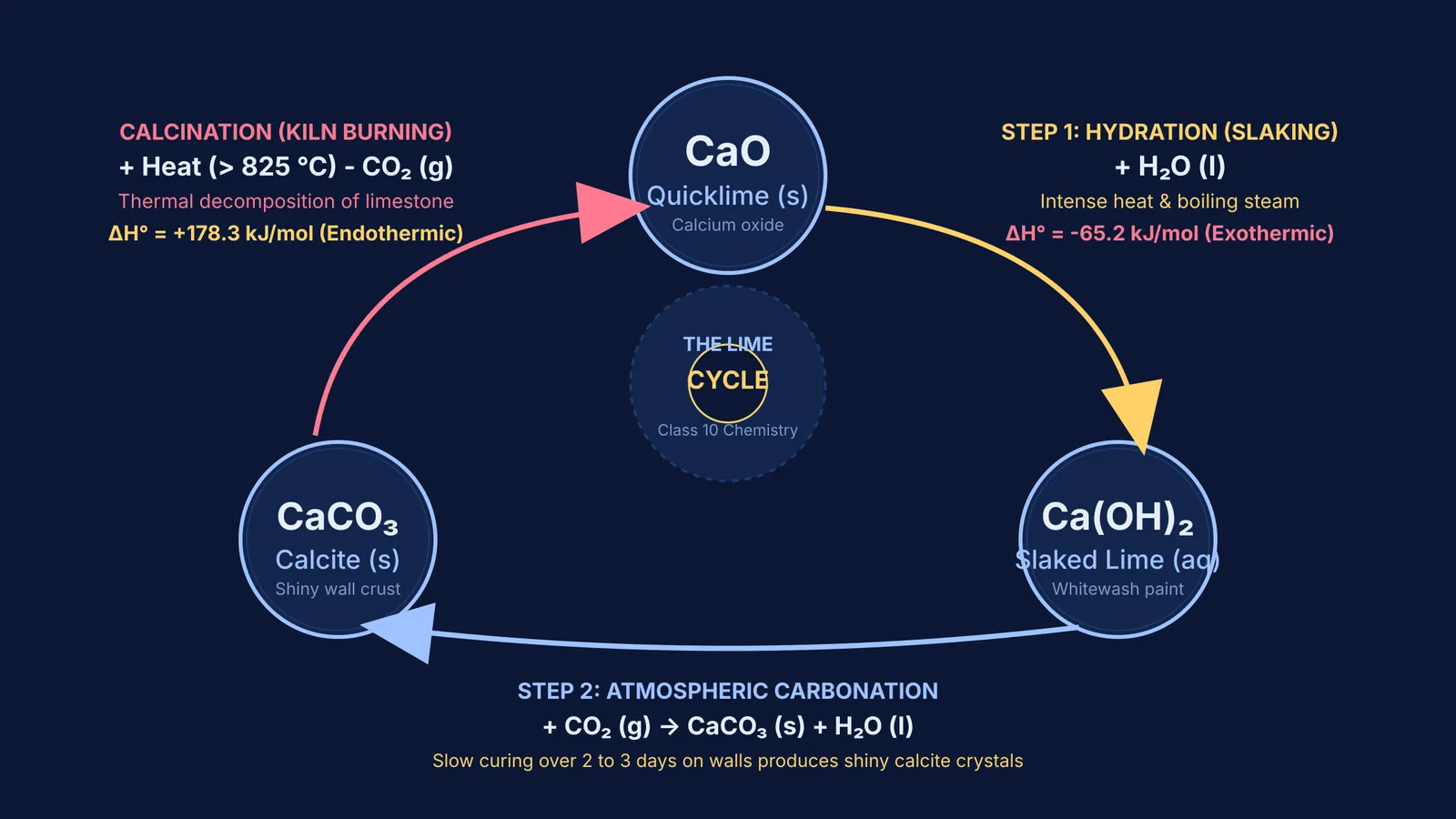
When water is added to quicklime (calcium oxide, CaO), the two substances react vigorously to form slaked lime (calcium hydroxide, Ca(OH)₂). In chemical classification, this is a classic combination reaction because two separate reactants join to yield a single chemical compound:
CaO(s) + H₂O(l) → Ca(OH)₂(aq) + Heat
The reaction is intensely exothermic. According to the NIST Chemistry WebBook, solid calcium oxide has a standard enthalpy of formation of -635.09 kJ/mol, while liquid water has a standard enthalpy of formation of -285.83 kJ/mol. Solid calcium hydroxide has a standard enthalpy of formation of -985.2 kJ/mol, and the NIST Chemistry WebBook catalogues a standard reaction enthalpy of -65.2 kJ/mol for this hydration.
In a laboratory beaker, this energy output is immediately noticeable. The mixture hisses, crackles, and releases clouds of steam as the water temperature climbs toward boiling point. In school chemistry, Activity 1.4 of the Class 10 curriculum uses this experiment to show how a chemical change can alter temperature, contrasting it with other types of chemical reactions in Class 10.
Why does whitewash take two to three days to turn shiny?
Freshly applied whitewash does not shine immediately. When painters brush a suspension of slaked lime onto a wall, the surface initially appears dull, translucent, and damp. The brilliant white gloss develops only after two to three days, as recorded in NCERT Class 10 Science, driven by a second chemical reaction with ambient air:
Ca(OH)₂(aq) + CO₂(g) → CaCO₃(s) + H₂O(l)
For the reaction to occur, ambient gaseous carbon dioxide must diffuse into the thin aqueous film on the wall, dissolve, and react with dissolved calcium and hydroxide ions. As water evaporates and carbon dioxide penetrates deeper, insoluble calcium carbonate precipitates across the surface, gradually building a durable protective layer.
This transformation is more than a simple chemical switch; it reorganises the physical structure of the wall coating. In a study published in the Journal of Materials Science, Özlem Cizer and colleagues demonstrated that carbonation begins with amorphous calcium carbonate, passes through metastable scalenohedral calcite, and ultimately crystallises into dense, interlocking rhombohedral calcite plates as calcium hydroxide is consumed. Because calcite crystals possess high optical birefringence and strong light scattering, this tight crystalline crust reflects ambient light evenly, producing the characteristic hard, luminous sheen.
What is the difference between lime water and milk of lime?
Class 10 examination papers frequently test whether students understand the physical states of calcium compounds:
Quicklime refers strictly to solid calcium oxide (CaO), an unslaked white powder produced by heating limestone in kilns.
Slaked lime refers to dry calcium hydroxide powder (Ca(OH)₂), obtained by adding a measured volume of water to quicklime.
Milk of lime is a thick, white suspension of slaked lime particles in excess water, used directly for whitewashing walls and ceilings.
Lime water is the clear, transparent liquid obtained by filtering or decanting the undissolved solid particles from milk of lime.
This distinction is crucial for understanding the standard laboratory test for carbon dioxide. When carbon dioxide is bubbled through clear lime water, insoluble calcium carbonate precipitates, turning the solution milky:
Ca(OH)₂(aq) + CO₂(g) → CaCO₃(s)↓ + H₂O(l)
If carbon dioxide is bubbled continuously through the turbid solution, the milkiness disappears. The excess carbon dioxide converts insoluble calcium carbonate into soluble calcium hydrogen carbonate (calcium bicarbonate):
CaCO₃(s) + H₂O(l) + CO₂(g) → Ca(HCO₃)₂(aq)
This sequence links directly with concepts covered under balancing chemical equations in Class 10 and the study of acids, bases and salts in Class 10.
How should you write this reaction sequence in board exams?
To secure full marks on lime-cycle questions in CBSE examinations, based on the NCERT Class 10 Science syllabus, structure your written answers around four essential points:
Identify substance X without hesitation: questions often begin with "A substance X is used for whitewashing." Name X as calcium oxide (quicklime, CaO), and name the solution formed with water as calcium hydroxide (slaked lime, Ca(OH)₂).
Include state symbols on every equation: write CaO(s) + H₂O(l) → Ca(OH)₂(aq) rather than bare symbols, as marking schemes deduct marks for missing phases.
Classify the reaction under both headings: state explicitly that the reaction of quicklime with water is both a combination reaction (two reactants form one product) and an exothermic reaction (heat is liberated).
Explain the delay in sheen chemically: clarify that whitewash does not turn shiny merely because it dries, but because atmospheric carbonation produces an insoluble, crystalline calcium carbonate crust over two to three days.
When students struggle to connect multi-step inorganic sequences across chapters, the Fermi Concept Library covers every concept in physics, chemistry, biology, mathematics and computing, each with its own lesson and its place in the map. For students who need structured practice balancing chemical changes and predicting reaction products, the Fermi Problem Library provides worked problems with a step-by-step solver that explains the reasoning rather than printing an answer. For hard-to-picture thermal processes like hydration, the Fermi Simulation Lab offers interactive simulations for ideas that are easier to see than to read.


