

On this page
Chew a mint or a spoon of pudina chutney and breathe in: your mouth feels icy. Bite a green chilli and it burns, even though it came out of a basket at room temperature. Both foods are working the same trick. Each contains a molecule that flips a switch your nerves normally use to measure temperature.
Why does mint feel cold?
Nerve endings in your skin and mouth carry tiny protein gates called ion channels. When one opens, charged particles flow into the nerve cell and it can send an electrical signal to the brain.
In 2002 two labs, led by David Julius and Ardem Patapoutian, independently identified the channel that menthol acts on. Julius's team cloned a menthol receptor from sensory neurons of the face and found it was also activated by temperatures in the cool to cold range (McKemy, Neuhausser and Julius, Nature 2002). Patapoutian's team described the same channel, TRPM8, and showed that cells carrying it are activated both by cold and by menthol (Peier and colleagues, Cell 2002).
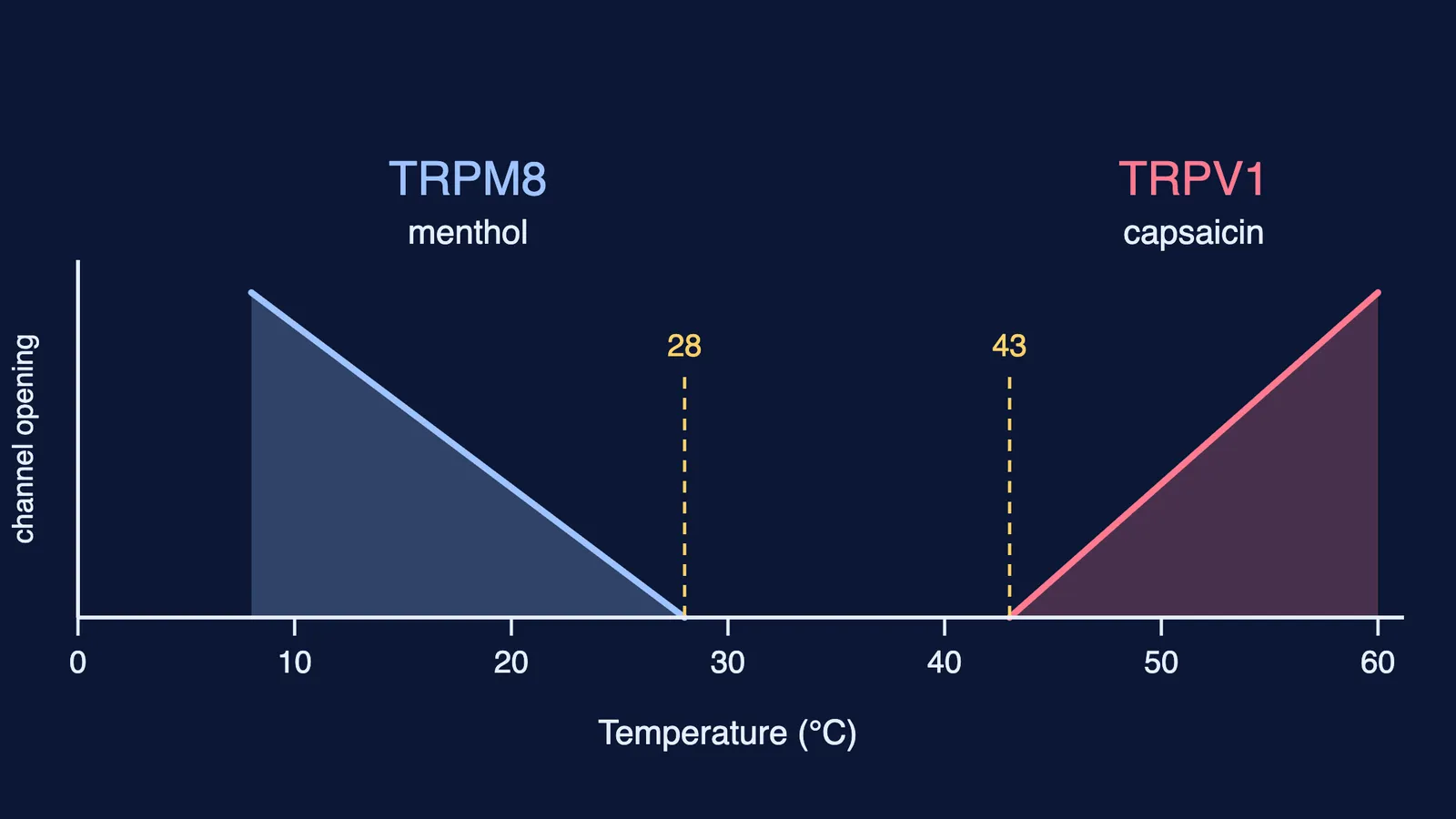
TRPM8 starts to open at about 28°C, and its current keeps growing as the temperature falls to 8°C, according to a 2005 review by David McKemy in Molecular Pain.
So when menthol binds TRPM8, the nerve fires the same way it fires on a cold winter morning. The signal reaching your brain does not say what opened the gate, only that the cold-sensing nerves are active. You feel cold.
That difference is worth keeping straight. For the physics of genuine cooling, read why you feel cold after a bath.
Why does chilli feel hot?
Capsaicin, the main pungent ingredient in chillies, causes burning pain by activating sensory neurons that carry information about harmful stimuli (Caterina and colleagues, Nature 1997).
To find its target, Julius's team built a library of millions of DNA fragments from sensory neurons and expressed them in cultured cells that normally do not react to capsaicin, as the Nobel Assembly's 2021 press release describes. After a laborious search, a single gene made the cells respond. It coded for an ion channel, now called TRPV1, which turned out to be opened by painful heat as well. In 2021 Julius and Patapoutian shared the Nobel Prize in Physiology or Medicine for their discoveries of receptors for temperature and touch.
TRPV1 responds in the moderate heat range, whose threshold is about 43°C, according to McKemy's review.
Heat is not its only trigger. A follow-up study found that moderately acidic conditions, pH 5.9 or lower, can open TRPV1 at room temperature, and the authors described the channel as a molecular integrator of chemical and physical stimuli that elicit pain (Tominaga and colleagues, Neuron 1998).
Why do mint and chilli feel so different?
Because they report through different nerves. McKemy's review notes that the neurons carrying TRPM8 do not carry the markers of classic pain nerves, TRPV1 among them, so cool and burning arrive at the brain largely on separate lines (Molecular Pain review).
The same review describes a third channel, TRPA1, which is activated by the pungent ingredients in mustard and cinnamon and is found only in some of the nerves that carry TRPV1. If you have wondered why mustard oil is so pungent, that is where the bite lands.
How do you explain any "molecule fools a sensor" question?
Use four steps. They work in a biology answer, a viva or a dinner-table argument.
Name the sensor: which receptor protein, and in which cells.
Name its normal trigger: a temperature, a pressure, light.
Name the molecule that also opens it.
Predict the feeling: the brain reports the normal trigger.
Worked example, mint:
TRPM8, in sensory nerve endings of the mouth and face.
Cooling below about 28°C (McKemy's review).
Menthol.
Your mouth feels cold.
Now try chilli yourself before reading on. Answer: TRPV1 in pain-sensing nerves; heat from about 43°C; capsaicin; burning.
Then try mustard. Steps 1 and 3 are known: TRPA1 and the pungent compounds in mustard. Step 2 was not settled when McKemy wrote his review in 2005: he said TRPA1's role in sensing cold still needed to be confirmed, so you cannot finish the prediction with confidence from that source. That is a useful lesson in itself: the method is only as good as what is known about the sensor.
If step 1 trips you up because ion channels and nerve impulses still feel fuzzy, the Fermi Concept Library gives every concept in biology, chemistry and physics its own lesson and its place in the map. And Fermi's AI tutor decides whether to explain, ask or show, checking your understanding as it goes.
Next time someone says mint is cooling, you can tell them precisely what it cools: the message, not the mouth.


