

On this page
If you have eaten food dressed with raw mustard oil, you know the sting that climbs from your tongue into your nose. That kick is not ready-made inside the seed. An enzyme makes it the moment the seed is crushed.
What makes mustard oil taste so pungent?
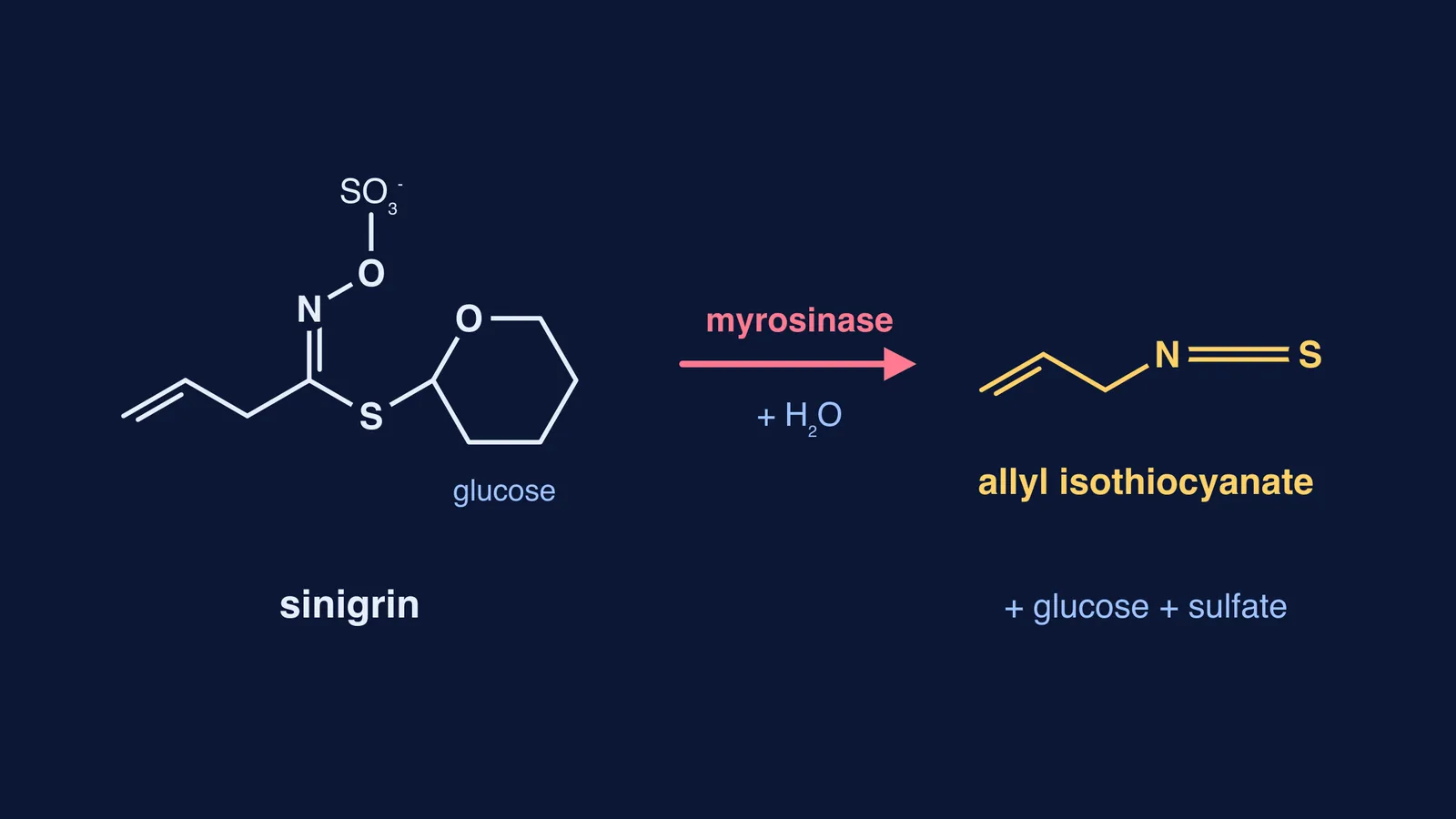
The sharp compound is allyl isothiocyanate, usually shortened to AITC. It is a small molecule with the formula C4H5NS, and PubChem lists its smell as "very pungent" (PubChem: allyl isothiocyanate).
India's food regulator writes this compound into the rules. Under FSSAI's food product standards, mustard oil may be labelled kachi ghani or cold pressed if it contains at least 0.20% natural allyl isothiocyanate by weight (FSSAI standards for oils). A study of Indian mustard (*Brassica juncea*) calls its pungent isothiocyanates the primary purpose of growing the crop (Gerendás et al., 2009).
Why do crushed mustard seeds become pungent?
A mustard plant keeps two ingredients apart. One is sinigrin, a sulphur-containing compound that is chemically quiet. The other is myrosinase, an enzyme. A 2022 review describes how, in many of these plants, the two are stored in different cells to keep them stable (Lv et al., 2022). When tissue is crushed, myrosinase reaches sinigrin and turns it into AITC (Tarar et al., 2022), releasing glucose and sulfate on the way (myrosinase reference).
Water matters. Researchers at Agriculture and Agri-Food Canada found that sinigrin dissolved out of ground mustard seed into water very quickly and was converted to AITC by the myrosinase dissolved alongside it (Tsao et al., 2000).
Plant biologists call this two-part system the "mustard oil bomb". Sinigrin belongs to the glucosinolates, defence chemicals that stay inactive until myrosinase breaks them into compounds toxic to plant-eaters and pathogens (Lv et al., 2022). The flavour you enjoy is the plant's defence against being eaten.
Why does mustard sting your nose like wasabi?
Wasabi, horseradish and mustard all owe their pungency to isothiocyanates. In 2004 a University of California, San Francisco team found the sensor these compounds hit: mustard oil activated a channel on sensory nerve fibres, then called ANKTM1 and now known as TRPA1, and excited a group of sensory neurons that also respond to capsaicin from chillies (Jordt et al., Nature, 2004). A Neuron paper from another team the same year showed that mustard oil, ginger and clove oil all switch on TRPA1, and concluded that its activation produces a painful sensation (Bandell et al., 2004).
So the burn is not a taste like sweet or salty but your nerves' alarm for an irritant. Chilli heat has its own story: why chillies feel hot on your tongue and why milk helps.
Why does heated mustard oil taste milder?
Two things work against pungency in a hot kitchen. First, heat damages myrosinase. In a University of Reading study, heating myrosinase extracted from brown mustard seeds to 70 °C for 10 minutes left 35% of its activity, and yellow mustard's enzyme lost all of it (Okunade et al., 2015). Second, AITC boils at about 152 °C (PubChem), so heat can drive off what has already formed.
Try it: the three-bowl mustard test
AITC is an irritant (Tarar et al., 2022), so treat this as a smell test done carefully, not a taste test.
Bowl A: 1 teaspoon ground mustard seed (rai) and 1 tablespoon cool tap water. Stir.
Bowl B: the same powder with 1 tablespoon freshly boiled water, poured by an adult. Stir.
Bowl C: 1 teaspoon ground mustard, kept dry.
Wait 10 minutes. Wave the air above each bowl towards your nose with your hand; do not put your face over the bowl.
Rank them sharpest to mildest, then compare with the predictions below.
What the chemistry predicts:
A should be sharpest: water lets sinigrin and myrosinase meet.
B should be milder: very hot water damages the enzyme before it finishes.
C should be faint: with no water, little reaction happens.
If your result disagrees, ask what else changed: powder fineness, amount of water, waiting time.
How does this help with biology and chemistry exams?
Mustard packs a whole enzyme chapter into one seed. Sinigrin is the substrate, myrosinase the catalyst, separate storage is how the plant controls the reaction, and heat shows denaturation. TRPA1 links it all to the nervous system. If you can explain the three bowls in those words, you understand the topic.
Temperature and enzyme activity is the kind of idea that is easier to see than to read, which is what the Fermi Simulation Lab is built for. For definitions such as enzymes and plant secondary chemicals, the Fermi Concept Library has a lesson for every concept in chemistry and biology.
The same crush-to-activate idea turns up elsewhere in your kitchen: read why crushed garlic smells stronger than a whole clove and why onions make your eyes water when you cut them.


