

On this page
Have you ever wondered why a simple vegetable can leave you crying over the cutting board? The answer lies in a sophisticated chemical defense mechanism. The eye-watering effect of onions is not just a nuisance for cooks; it is an evolutionary adaptation designed to deter hungry animals from eating the plant's bulbs.
Why do onions make your eyes water when cutting?
When an onion is whole and undisturbed, its volatile sulfur compounds and enzymes are safely separated into different microscopic compartments within the plant's cells. However, the moment you slice into the bulb with a kitchen knife, you violently rupture these cell walls, causing the previously separated chemicals to mix.
This physical damage triggers a rapid, two-step enzymatic cascade. First, an enzyme called alliinase reacts with a sulfur-rich precursor stored in the onion's cytoplasm, known as *S*-1-propenyl-L-cysteine sulfoxide (or isoalliin). This initial reaction produces an intermediate compound called 1-propenesulfenic acid.
For decades, biologists and food scientists believed this newly formed acid spontaneously transformed into the irritant that makes us cry. However, a landmark 2002 study published in *Nature* by researchers at House Foods Corporation in Japan discovered a second, previously unknown enzyme at work (DOI: 10.1038/419685a). They named it lachrymatory factor synthase (LFS). The researchers proved that this specific enzyme rapidly converts the unstable 1-propenesulfenic acid into *syn*-propanethial-*S*-oxide.
What happens when the gas reaches your eye?
*syn*-Propanethial-*S*-oxide is the true culprit behind your tears. It is a volatile organosulfur molecule, meaning it easily turns into a gas at room temperature. As it evaporates from the moisture on the cutting board, it floats upward toward your face.
When this invisible gas makes contact with the watery tear film covering your cornea, a rapid chemical reaction occurs, forming tiny amounts of sulfuric acid. The trigeminal nerve endings in your eye instantly detect this harsh electrophilic irritant. Your brain interprets the nerve signal as a stinging, burning sensation and reflexively triggers your lacrimal glands to produce a flood of tears. This biological response is designed to physically dilute and wash the acidic irritant away from the delicate surface of the eye.
Like many complex biochemical processes, this tear-producing pathway depends entirely on specific catalysts to function. For a broader look at how living organisms utilize different types of biological catalysts, you can read our guide to The six enzyme classes: oxidoreductases to ligases, with examples.
Why does chilling an onion stop the tears?
Many home cooks swear by putting their onions in the fridge before preparing dinner, and physical chemistry supports this strategy.
Lowering the temperature of the onion disrupts the tear-inducing process in two distinct, measurable ways:
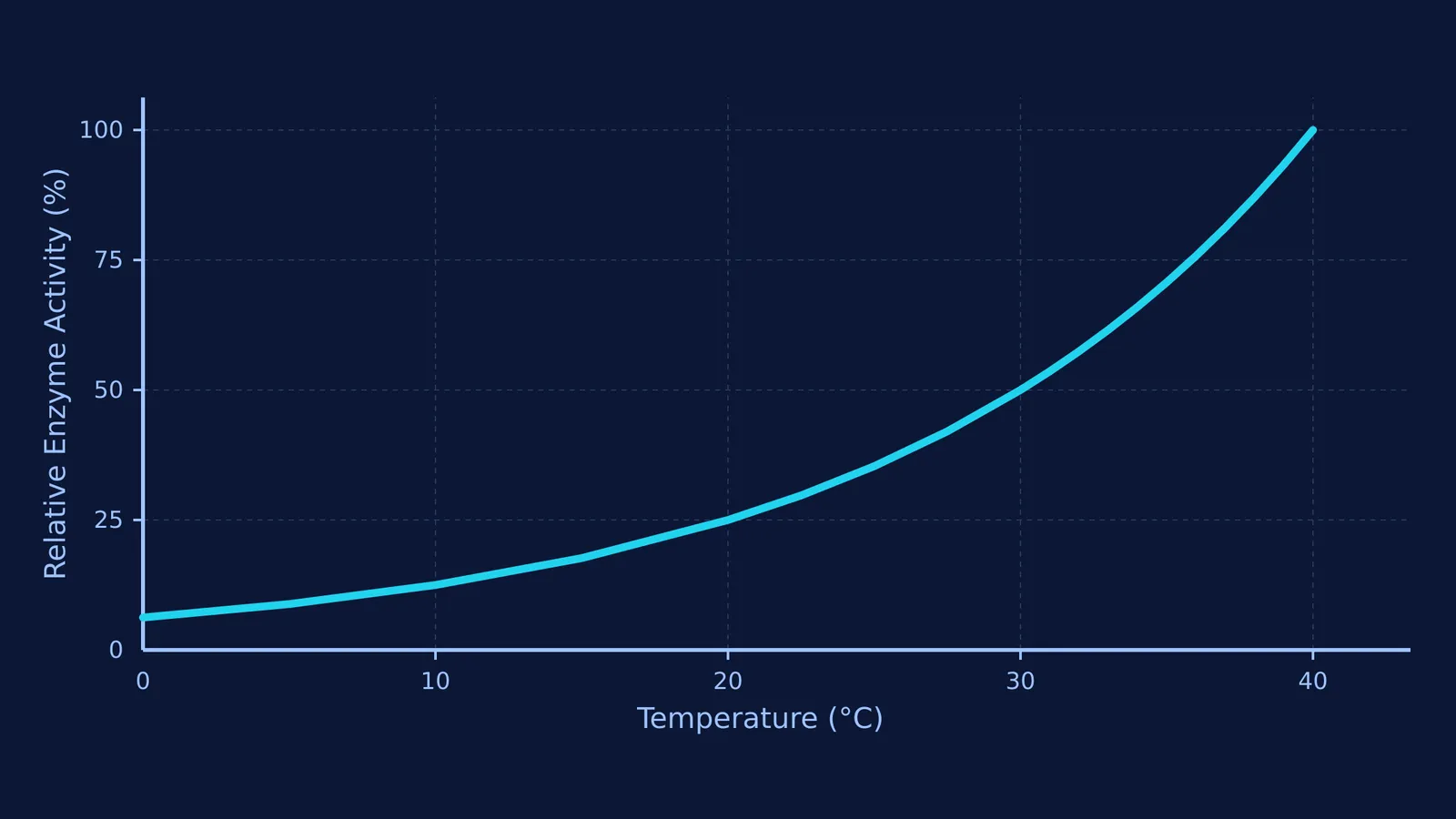
It slows the enzymes: Enzymatic reactions are highly temperature-dependent. By cooling the onion down to refrigerator temperatures, you reduce the kinetic energy of the molecules, drastically slowing the rate at which alliinase and LFS can produce the irritant gas. Because this is a chemical kinetic effect, it behaves similarly to the principles covered in Temperature coefficient of rate: why rates double every 10 °C. You can model how heat affects the frequency of molecular collisions directly in the Fermi Simulation Lab.
It lowers vapor pressure: Even if some *syn*-propanethial-*S*-oxide is produced by the slowed enzymes, its volatility drops significantly in the cold. Fewer molecules have the required energy to escape the liquid phase and turn into a gas, meaning the irritant stays trapped in the onion juice on the cutting board rather than wafting into the air.
A chemist's checklist for tear-free chopping
Understanding the underlying chemical mechanism allows you to bypass the plant's defenses entirely. Use this practical checklist the next time you cook:
Chill it thoroughly: Place the onion in the refrigerator before cutting to suppress both the enzyme activity and the compound's vapor pressure.
Use a razor-sharp knife: A dull blade crushes the plant tissue, bursting a much wider swath of cells and releasing far more enzymes into the juice. A sharp knife slices cleanly through, minimizing cellular damage.
Cut near an exhaust fan: Moving air physically blows the volatile *syn*-propanethial-*S*-oxide away from your face before it can ever reach your cornea.
Leave the root for last: The root end (the basal plate) contains the highest concentration of sulfur compounds and enzymes in the entire bulb. Leave it intact while you chop the rest of the onion to minimize exposure.
If you are studying biological defense mechanisms, enzyme kinetics, or molecular volatility for an upcoming exam, Fermi's AI tutor can work out what you already know and build a plan for the session, guiding you through the chemical principles step by step until you have mastered them.


