

On this page
When you bite into a fiery green chilli, your tongue instantly feels like it is on fire. Your forehead sweats, your eyes water, and your pulse quickens. Yet if you placed a digital thermometer on your tongue, its temperature would register completely normal.
The burn is an elaborate neurochemical illusion. Chillies in the genus *Capsicum* contain pungent compounds known as capsaicinoids, dominated by capsaicin. In 1997, a research team led by David Julius at the University of California, San Francisco published a landmark paper in Nature identifying capsaicin's molecular receptor: an ion channel named TRPV1. In normal circumstances, TRPV1 acts as your body's physical heat alarm, activating only when temperatures exceed 43 °C. Julius's discovery of temperature receptors was recognized with the 2021 Nobel Prize in Physiology or Medicine. When capsaicin enters your mouth, it bypasses ordinary taste buds and binds directly to this thermal sensor.
How does capsaicin fool the TRPV1 heat receptor?
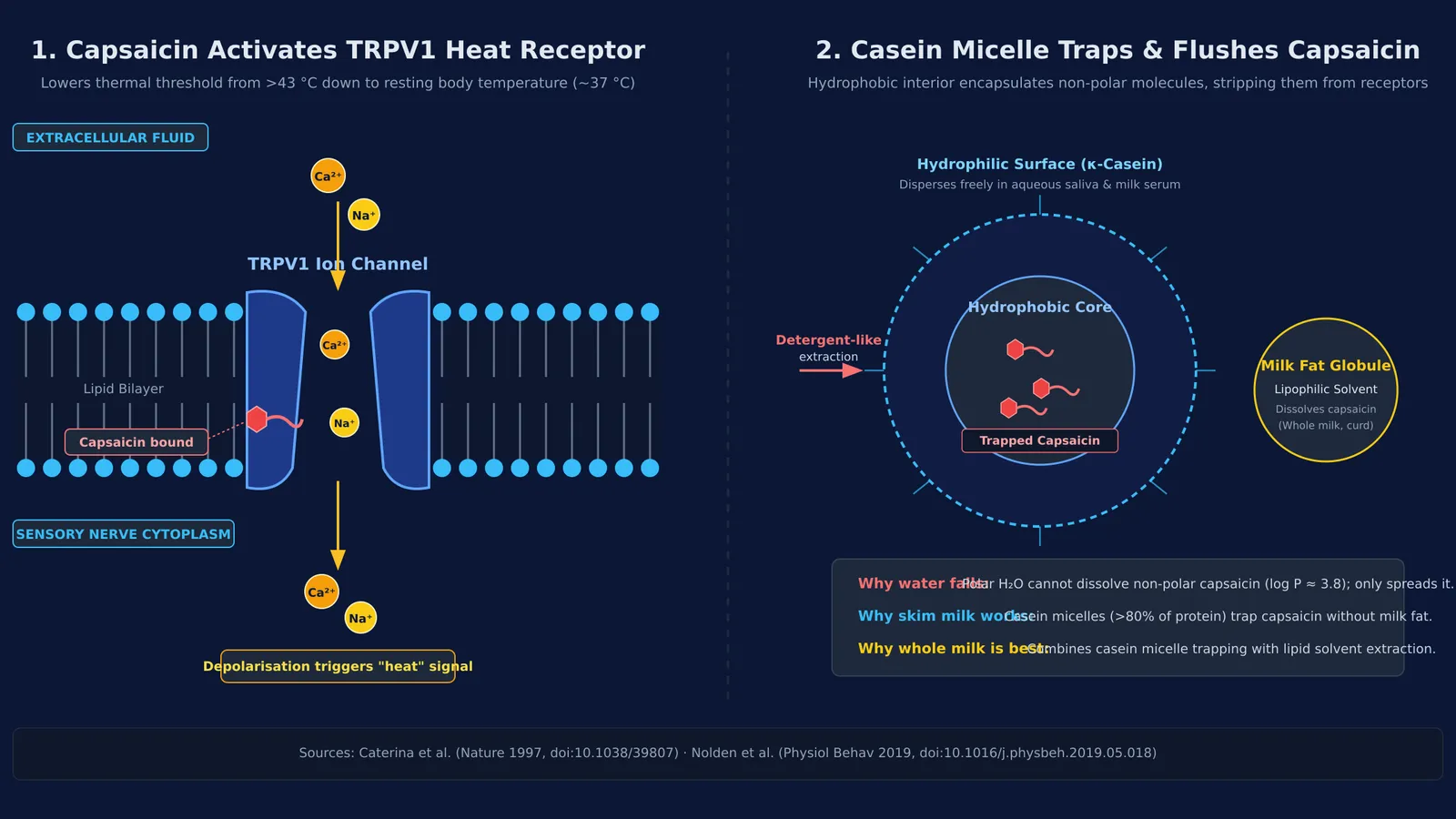
TRPV1 channels sit in the membranes of sensory nerve endings across your tongue and palate. Understanding how molecules cross and interact with membranes connects closely to cell membrane transport mechanisms. Capsaicin's lipophilic structure allows it to slip through the outer lipid bilayer and lodge into an intracellular binding pocket on the TRPV1 channel.
This binding locks the channel open and lowers its thermal activation threshold from 43 °C down below 37 °C, as demonstrated in Nature. Because human body temperature sits near 37 °C, your resting oral warmth is suddenly enough to trigger the channel. Calcium and sodium ions (Ca²⁺ and Na⁺) rush into the nerve cell, generating action potentials that travel along the trigeminal nerve to your brain. Because the neural wiring is identical to the one activated by scalding tea, your brain registers an emergency burn.
Why does drinking water make the chilli burn worse?
Gulping ice water provides a brief second of relief because it chills your tongue below the altered threshold. But once you swallow, the fire returns—often stronger and more widespread.
The reason comes down to solubility. As documented in PubChem, capsaicin (C₁₈H₂₇NO₃) has an octanol-water partition coefficient (log P) between 3.8 and 4.0 and an aqueous solubility of only 13 mg/L at room temperature. Just as in fat- and water-soluble vitamins, non-polar molecules cannot dissolve in polar solvents.
Water molecules cling tightly together with hydrogen bonds, completely excluding capsaicin's long hydrocarbon tail. Plain water cannot dissolve or wash away the capsaicin molecules lodged in your cell membranes. Swirling water merely shears the oily molecules into droplets and spreads them across your gums and throat. Pure capsaicin rates at 16 million Scoville Heat Units, an extract dilution scale established by Wilbur Scoville in the Journal of the American Pharmaceutical Association in 1912; even tiny amounts spread across more receptors amplify the burn.
Why does milk soothe the spice faster than water?
Milk provides rapid relief through lipid extraction and protein encapsulation. Being lipophilic, capsaicin readily dissolves into the non-polar fat globules of whole milk, dahi, or lassi. Yet fat is only part of the answer. In a trial published in Physiology & Behavior, researchers Alissa Nolden, Gabrielle Lenart, and John Hayes tested 72 participants across 7 beverages over 120 seconds. Remarkably, skim milk—with under 0.5% fat—quenched the oral burn as effectively as whole milk.
The key component is casein, a family of phosphoproteins comprising 80% of bovine milk protein, as evaluated in Physiology & Behavior. Casein forms spherical aggregates called micelles. Much like how soaps clean with micelles, casein's hydrophobic domains wrap around capsaicin's non-polar tail, trapping the molecule inside the micelle core and washing it off your tongue.
When students struggle to picture how ligands dock into ion channels or how thermal motion shifts equilibrium, interactive tools make the difference. The Fermi Simulation Lab offers interactive simulations for ideas that are easier to see than to read.
What should you drink when a dish is too spicy?
When an unexpected chilli overwhelms you, your choice of drink determines your recovery speed:
Cold whole milk or curd (dahi): The best remedy. Fat globules dissolve capsaicin, casein micelles encapsulate it, and low temperature cools the receptor.
Skim milk or buttermilk (chaas): Highly effective. Abundant casein micelles trap and flush capsaicin even without milk fat.
Sweetened drinks: Helpful alternative. As shown in the Physiology & Behavior trial, high-sucrose drinks substantially diminish burn intensity through central sweet-taste analgesia.
Avoid carbonated soda and beer: Carbon dioxide bubbles irritate trigeminal receptors via TRPA1 channels. In the Physiology & Behavior trial, carbonated beverages and non-alcoholic beer offered little relief, while alcoholic drinks can further sensitise TRPV1 and dissolve capsaicin without trapping it.
Connecting the principles of organic solubility with sensory neurophysiology builds lasting intuition across chemistry and biology. The Fermi Concept Library covers every concept in physics, chemistry, biology, mathematics and computing, each with its own lesson and its place in the map. Next time spicy food strikes, bypass the water tap and reach straight for cold milk or curd.


