On this page
Peel a garlic clove and sniff it: there is a faint smell, nothing more. Press it under the flat of a knife and within seconds the kitchen smells of garlic. You added nothing. You broke the cells, and that let a held-back reaction run.
Garlic is a clear everyday example of a plant keeping two reactants apart until damage brings them together. It links three ideas from Class 11 and 12 science: enzymes, cell compartments and the effect of temperature.
What happens when you crush garlic?
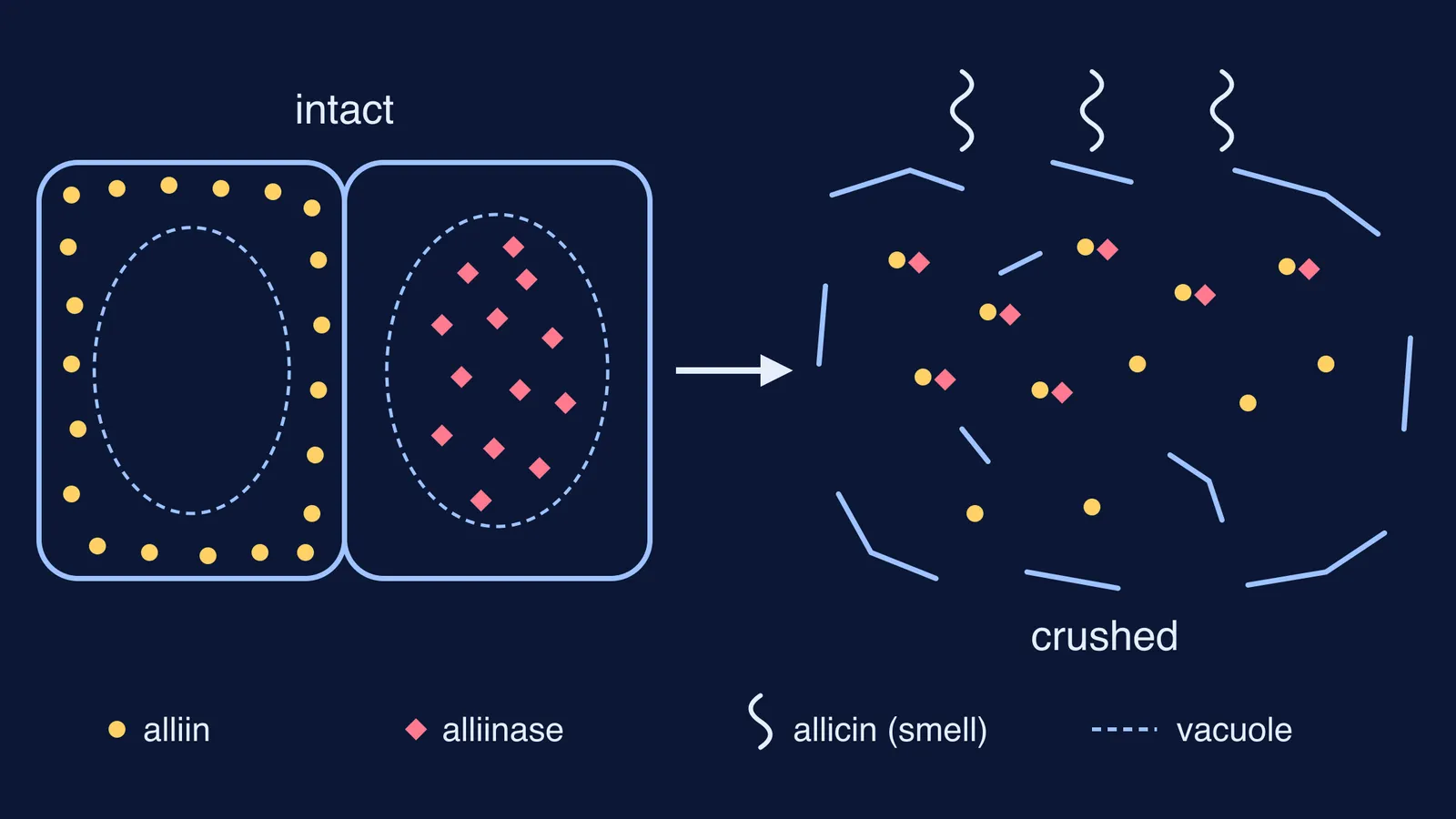
An intact clove stores a sulfur compound called alliin (S-allyl-L-cysteine sulfoxide). According to the Linus Pauling Institute at Oregon State University, alliin makes up about 80% of the cysteine sulfoxides in garlic.
The clove also makes alliinase, the enzyme that acts on alliin. A 2025 review by Seki and Hosono in Biomedical Reports describes the chain: alliinase cleaves the sulfur-carbon bond in alliin to give allyl sulfenic acid, which is "promptly converted" into allicin. In the review's words, this produces "the distinctive odor of crushed garlic."
Allicin (diallyl thiosulfinate) is the compound behind the sharp smell of freshly crushed garlic (Seki and Hosono, 2025). The reaction is fast: the Linus Pauling Institute notes that the formation of thiosulfinates such as allicin "has been found to be complete within 10 to 60 seconds of crushing garlic."
Why doesn't a whole garlic clove smell as strong?
Because the enzyme and its substrate are kept in different places. In garlic, alliin sits in the cytoplasm of storage cells, while alliinase is held inside the vacuoles of the sheath cells around the clove's veins (Seki and Hosono, 2025; a 2004 review in the Journal of Experimental Botany).
Membranes stand in between: the tonoplast around each vacuole (see our explainer on the tonoplast and the plant vacuole) and the membrane around each cell. While they are whole, alliinase and alliin rarely touch; the Linus Pauling Institute notes that intact cloves contain no thiosulfinates such as allicin.
Crushing tears those membranes, and wherever enzyme and substrate spill into the same mush, the reaction starts. Onions use a similar trick: the 2004 review describes onion alliinase in the vacuole and the flavour precursors in the cytoplasm. In onions a second enzyme then makes the compound that stings your eyes, as our post on why onions make your eyes water explains.
Why does cooking garlic first change the smell?
Alliinase is a protein, and like most enzymes it stops working when heated. Seki and Hosono write that heating non-crushed garlic "inactivates alliinase, preventing allicin formation." The Linus Pauling Institute reports a study in which microwave cooking of unpeeled, uncrushed garlic "totally destroyed alliinase enzyme activity."
Order matters. In a 2001 paper in The Journal of Nutrition, Song and Milner reported that 60 seconds of microwave heating blocked the garlic effect they were measuring in rats, while letting crushed garlic stand for 10 minutes first prevented its total loss, consistent with alliinase being inactivated. Crush first and the enzyme gets time to work; heat first and it is switched off before it meets its substrate. Our post on how temperature and pH change enzyme activity shows the same effect.
How can you test this at home?
You can detect compartmentalisation with your nose. Use four cloves of similar size, and ask an adult to handle the microwave.
Clove A: whole and peeled.
Clove B: cut in half.
Clove C: crushed to a paste.
Clove D: microwaved whole for a short burst, cooled fully, then crushed like C.
Wait one minute, then score each smell from 0 (none) to 5 (very strong). Write your predictions first:
A should be weakest, because almost no cells are broken.
B should be stronger, mainly at the cut face where cells were torn.
C should be strongest, because crushing breaks the most cells and mixes the most enzyme with substrate.
D should be weaker than C, because heat inactivated alliinase before it could meet alliin.
If a result surprises you, check your variables: clove size, heating time and waiting time.
How do you explain this in an exam answer?
A three-step answer keeps the logic clear:
Separation: in intact garlic, alliinase is kept in the vacuoles of some cells, away from its substrate alliin in the cytoplasm of others.
Damage: crushing ruptures the membranes, so enzyme and substrate mix.
Product: alliinase converts alliin into allicin, a volatile sulfur compound, within seconds; more broken cells means more allicin and a stronger smell.
If membranes and vacuoles stay abstract on the page, the Fermi Simulation Lab has interactive simulations for ideas that are easier to see than to read, and the Fermi Concept Library gives each biology and chemistry concept its own lesson.
Next time you crush garlic, count to 60 and notice the smell build: that is an enzyme reaction running in front of you.