On this page
Chapter 15 of Madhurima, NCERT's Class 9 arts textbook (First Edition, April 2026) is the second of four Visual Arts chapters. It covers mediums, materials care, Indian crafts, colour and depth.
How is Chapter 15 assessed in 2026-27?
The CBSE Art Education curriculum for Class 9 (2026-27) makes the subject a 100% school-based internal assessment out of 100 marks: 40 for theory and 60 for practical. In the 2-hour theory paper, Visual Arts carries 4 marks, as do Music, Theatre and Dance.
Those 4 Visual Arts marks are shared across Chapters 14 to 17, so this chapter has no mark figure of its own. Its topics sit under the curriculum unit Exploration of Materials and Methods (9 periods). The 60 practical marks average four art-form sections. In the 3-hour Visual Arts section, "Handling of colour" carries 10 marks and colour value with hatching carries 5, so this colour work feeds your practical too. See also where Class 9 marks matter.
What does "medium" mean in visual art?
In Madhurima Chapter 15, a medium means the materials, tools and processes used to make visual art. A student conversation names many:
Drawing: soft graphite pencils (2B to 8B), charcoal, inks, fountain and calligraphy pens.
Painting: watercolours, canvas, cloth, murals, oil paint thinned with turpentine, palette knives, oil and dry pastels.
3D work: clay fired in a kiln, wood, jute and wire.
Digital: digital painting and sculpture, photography, video and virtual-reality art.
Pencil "lead" is graphite, not lead (Pb). A student in the conversation adds that graphite turns into diamond under very high temperature and pressure; our guide to types of solids shows how both are carbon. Traditional artists also made black pigment from charcoal and oil-lamp soot; compare how the Ajanta paintings were made.
The care rules come in three groups:
Source consciously: non-toxic, sustainable materials; reuse paper.
Handle with care: wash brushes with soap straight after use, dry them flat or bristles up, cap tubes and markers, keep oily hands off artwork, dispose of turpentine and inks responsibly.
Store responsibly: paper and canvas dry and flat, sharp tools boxed away from children and animals, food and water away from artwork because fungi can damage it.
Which Indian sculptural crafts does the chapter describe?
The book's gallery includes Bidriware, brass work, basketry, marble inlay, Sikki grass and terracotta. It then studies two headgear traditions:
Sumok Thyaktuk: bamboo hats made by the Lepchas of Sikkim from cane and bamboo. One hat takes a month, woven in four layers that each carry a separate pattern and meaning.
Sholapith: carved objects from the white, spongy pith of the shola plant (Aeschynomene aspera), practised in West Bengal and Odisha, with a similar Tamil Nadu tradition called Netti. Its artisans are the malakars, or garland-makers.
How does the colour wheel work?
The chapter cites the Chitra-sutra of the Vishnu-dharmottara Purana, listing five basic colours (white, yellow, red, blue and black). Adding white gives tints; adding black gives shades.
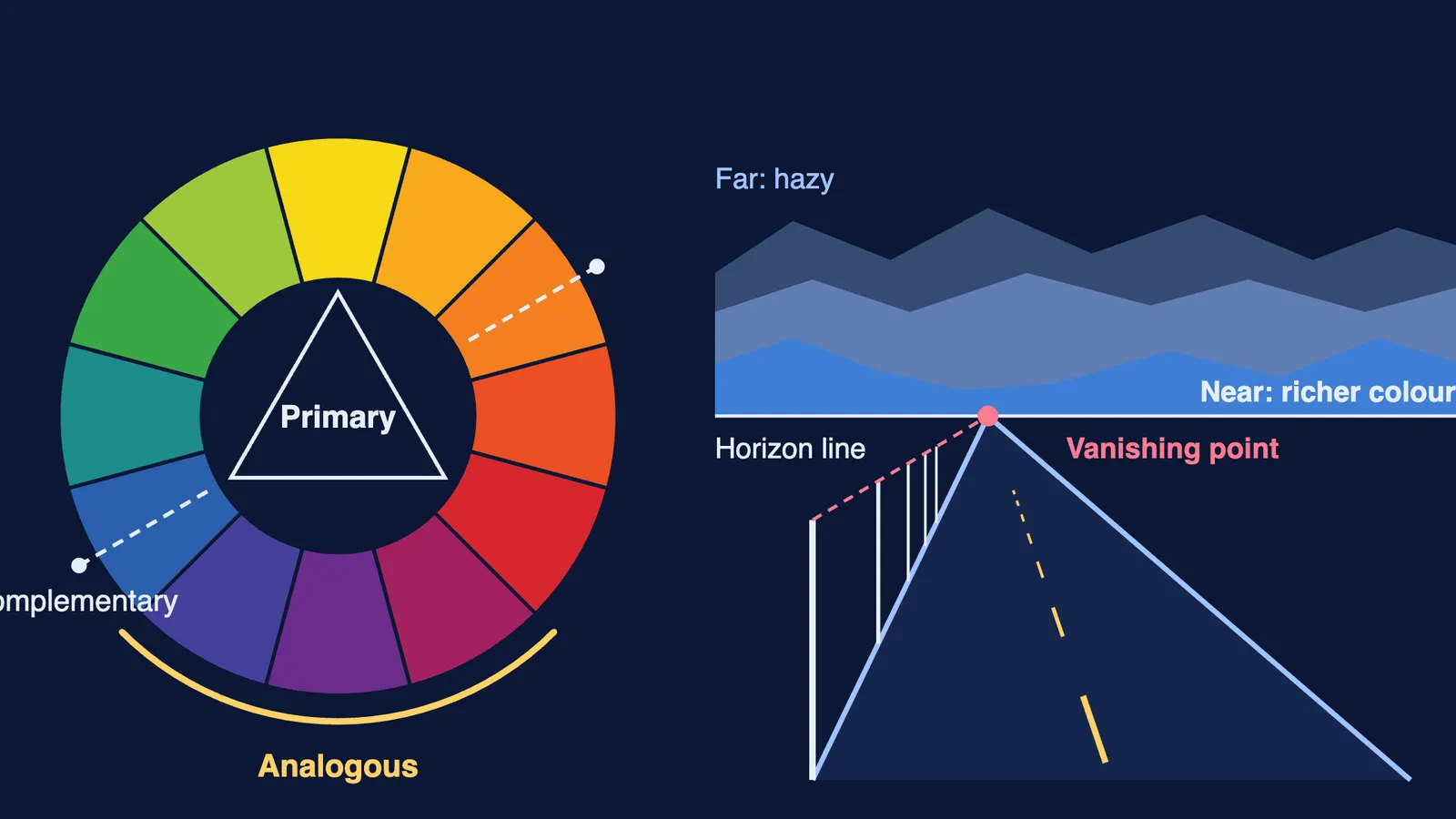
Fig. 15.7's first wheel marks yellow, red and blue as primary; its second names 12 hues. Orange, green and violet are the secondaries, and the six in-between hues are tertiaries. Complementary colours sit directly opposite each other; analogous colours sit side by side.
Worked example: a 12-part wheel has exactly six complementary pairs, because each hue has one opposite and each pair gets counted twice (12 / 2 = 6). In the book's names: yellow and violet, orange yellow and blue violet, orange and blue, red orange and blue green, red and green, and violet red and yellow green. The figure's analogous example is yellow, orange yellow and orange.
What is the difference between linear and aerial perspective?
The chapter teaches two ways to show depth on a flat surface.
Linear perspective: lines that are parallel in real life are drawn meeting at a vanishing point on the horizon, like the walls of a corridor. Example: Raphael's School of Athens.
Aerial (atmospheric) perspective: colour and tone show distance. Far mountains look pale and misty, near ones richer, and nearby plants get more detail. Example: a Kawabata Gyokusho landscape on silk.
A warm-up before Activity 15.7, an A4 dance scene using both techniques:
Rule a horizon and mark one vanishing point.
Draw road edges as straight lines running to it; line up pole tops and bases with it too, so they shrink.
Paint far hills pale and simple, and give the foreground the strongest colour and detail.
Practice questions
Original questions; marks are our suggestion.
(1 mark) Define a medium in visual art. Answer: the materials, tools and processes used to make an artwork.
(1 mark) Name red's complementary colour. Answer: green.
(2 marks) Give two ways to care for brushes. Answer: wash with soap after use; dry bristles up.
(2 marks) Name the plant and the artisans of Sholapith. Answer: the shola plant; the malakars.
(4 marks) Compare linear and aerial perspective, with one example of each.
Not sure which topic to revise first? Fermi's AI tutor works out what you already know and builds a plan for the session.