On this page
One question sorts the four types of crystalline solids: what holds the particles together? Answer that, and melting point, hardness and conductivity mostly follow. Below, we sort ice, table salt, copper, diamond and silica (sand and quartz), then give you five mystery samples to classify.
What are the four types of crystalline solids?
The OpenStax Chemistry 2e chapter on the solid state groups crystalline solids by the particles they are made of and the force between those particles.
Molecular solids are neutral molecules held together by intermolecular forces, which are weak compared with chemical bonds. Ice (H2O), dry ice (CO2) and iodine are examples.
Ionic solids are positive and negative ions held together by electrostatic attraction. Sodium chloride is the standard example.
Metallic solids are metal atoms sitting in a "sea" of delocalised electrons. Copper and iron are examples.
Covalent network solids are atoms joined to their neighbours by covalent bonds in one continuous network, so the crystal behaves like a single giant molecule. Diamond and silicon dioxide (SiO2) are examples.
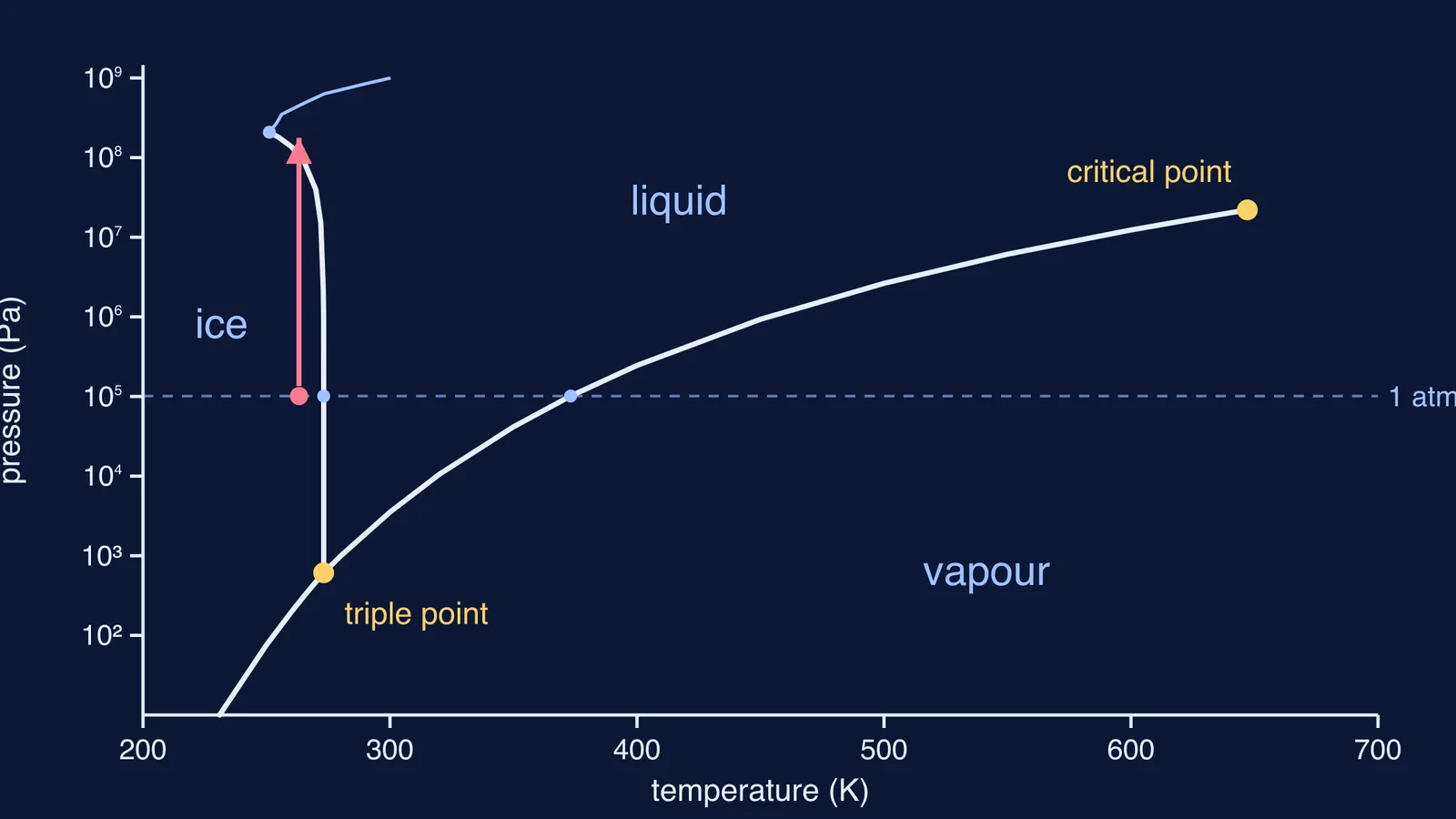
In ice, the molecules are held to each other by hydrogen bonds. When ice melts, those links between molecules give way; the O–H bonds inside each water molecule stay intact.
How do melting point and conductivity tell them apart?
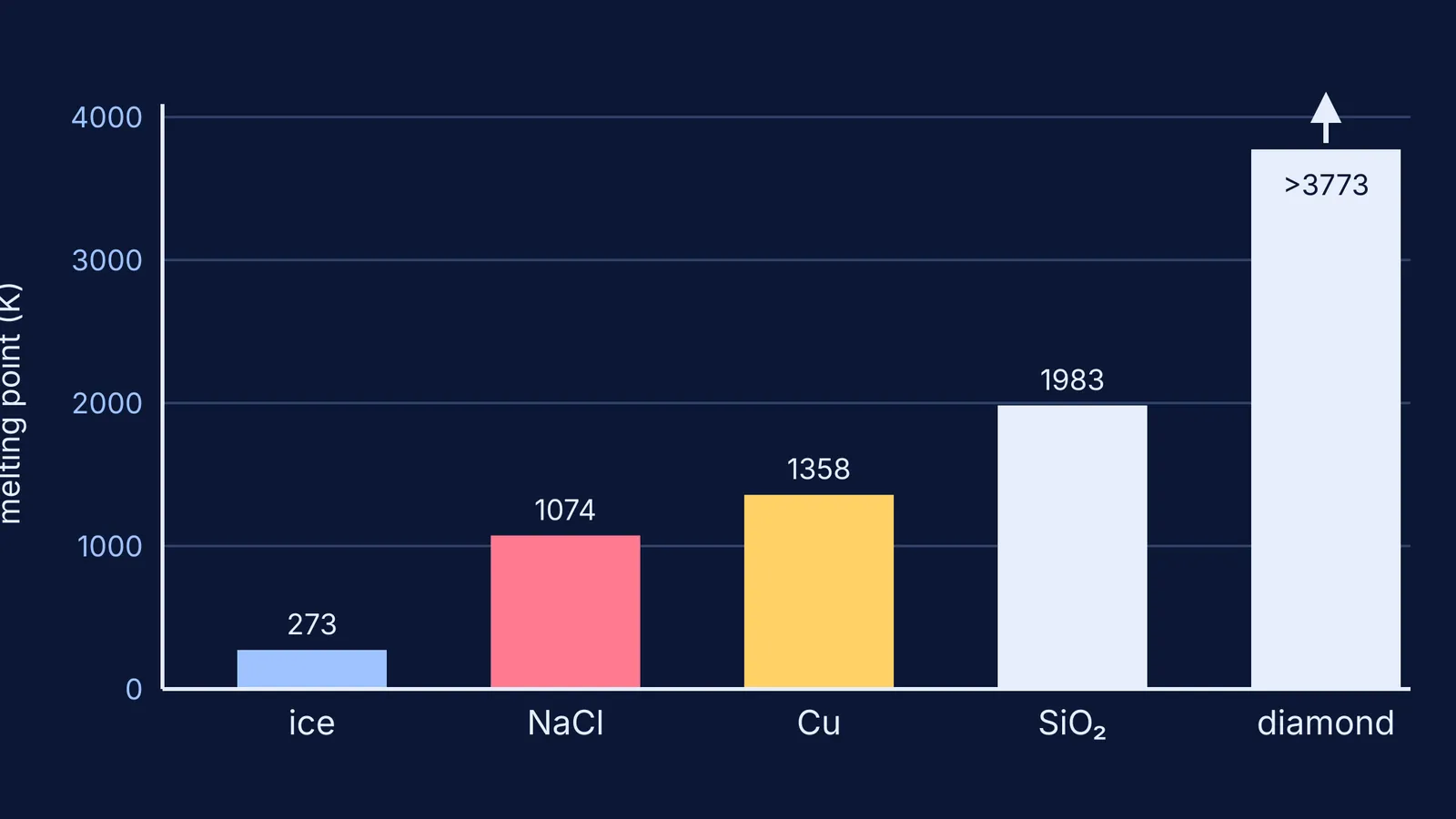
Melting means breaking whatever holds the particles in place, so the melting point is a rough gauge of the binding force. Here are our five solids, coldest first:
Ice melts at 0 °C, according to OpenStax.
Sodium chloride melts at 800.7 °C, the CRC Handbook value listed in PubChem's sodium chloride record.
Copper melts at 1,084.62 °C, the US Department of Energy value in PubChem's copper record.
Silica melts at roughly 1,710 to 1,736 °C depending on the source and crystal form, per PubChem's silicon dioxide record.
Diamond melts above 3,500 °C, according to OpenStax.
Melting point alone can mislead you: OpenStax notes that mercury is liquid at room temperature while transition metals melt above 1,000 °C.
Conductivity settles most cases, because electricity needs charged particles that can move. Metals have delocalised electrons, so they conduct as solids. Ionic solids conduct only when molten or dissolved, because only then can the ions move, according to the CK-12 chapter on classes of crystalline solids/13:_States_of_Matter/13.15:_Classes_of_Crystalline_Solids) (more in our post on why molten salt conducts but solid salt does not). The same chapter says covalent network solids do not conduct in any state and molecular solids are poor conductors. Graphite is the classic exception, which OpenStax describes as "very soft and electrically conductive".
Sorting exercise: can you classify these five mystery solids?
Each sample is one of our five solids, described only by its properties, using the figures from OpenStax and the PubChem records above. Cover the answer key and write down your answer and reason for each.
Sample A conducts electricity as a solid, melts at about 1,085 °C and can be hammered flat without shattering.
Sample B does not conduct, melts at 0 °C and is soft.
Sample C does not conduct as a solid, melts at about 801 °C, conducts once molten and shatters when struck.
Sample D does not conduct, is extremely hard and melts only above 3,500 °C.
Sample E does not conduct and melts at around 1,710 °C.
Answer key. A is copper (metallic): it conducts as a solid, and OpenStax explains that metals are malleable and do not shatter (see why metals bend while ionic crystals shatter). B is ice (molecular). C is sodium chloride (ionic): hard but brittle, conducting only once molten. D is diamond and E is silica, both covalent network. If you put D or E with the ionic solids, the test you skipped was "does it conduct once molten?"
Where do students usually slip up?
Thinking melting ice breaks water molecules apart. Melting a molecular solid only overcomes the forces between molecules.
Calling SiO2 molecular because CO2 is. The formulas look alike, but the solids are not; see why carbon dioxide is a gas but silicon dioxide is a solid.
Saying solid salt conducts. It has ions, but they cannot move until it melts or dissolves.
Using melting point alone. Salt and copper both melt only when very hot; conductivity separates them.
If a step still feels shaky, the Fermi Concept Library gives every chemistry concept its own lesson, so you can revisit intermolecular forces or metallic bonding. To practise, the Fermi Problem Library has worked problems with a step-by-step solver that explains the reasoning rather than printing an answer.
Tonight, try the sort on three solids from your kitchen, saying the reason for each out loud.