

On this page
Carbon and silicon sit right next to each other in Group 14 of the periodic table. They both react with oxygen to form dioxides. Yet, the physical states of these two compounds could not be more different.
Carbon dioxide (CO₂) is the invisible gas you breathe out, and it only becomes a solid (dry ice) at extremely low temperatures, subliming at −78.5 °C. Silicon dioxide (SiO₂), on the other hand, is the main component of sand and quartz. It is a hard, crystalline rock that melts at a blistering 1,713 °C.
To understand this dramatic difference, we have to look closely at how these elements bond.
Why does carbon form double bonds?
Carbon atoms are small. Because carbon is in the second period of the periodic table, its outermost valence electrons are in the 2p orbitals. Oxygen is also in the second period, with its own 2p orbitals of a similar size.
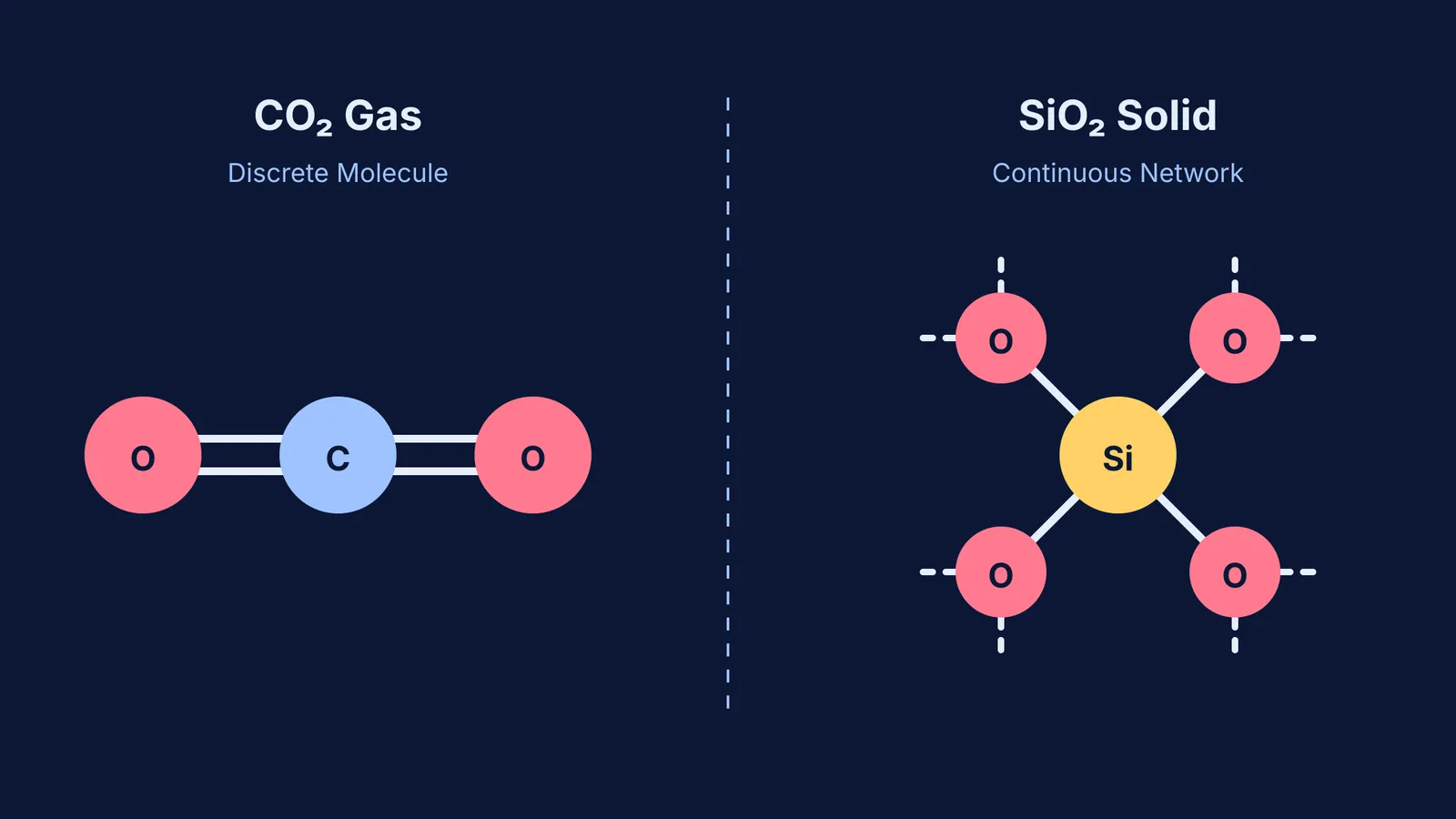
When a carbon atom bonds with two oxygen atoms, their small 2p orbitals align perfectly side-by-side. This geometry allows them to overlap and form strong pπ-pπ double bonds. The result is a discrete, individual molecule of CO₂ (O=C=O).
Carbon's ability to form multiple bonds is a cornerstone of its chemistry. In the case of carbon dioxide, the double bonds perfectly satisfy carbon's need for four electrons (tetravalency) without requiring it to bond to any additional atoms. Because the resulting CO₂ molecule is completely symmetrical and linear, there is no permanent dipole moment. It is non-polar, meaning the molecules do not attract each other very strongly.
Within the molecule, the sigma and pi bonds holding the carbon and oxygen together are very strong. However, the forces between the individual CO₂ molecules—known as London dispersion forces—are extremely weak. Because these intermolecular forces are so easily broken by normal thermal energy, carbon dioxide exists as a gas at room temperature.
Why is SiO₂ a continuous network?
Silicon is in the third period of the periodic table. Its atom is larger, and its 3p orbitals are more spread out. Because of this diffuse shape, a silicon 3p orbital cannot overlap effectively sideways with oxygen's much smaller 2p orbital. As a result, silicon cannot form stable pπ-pπ double bonds with oxygen.
This size mismatch is critical. Thermodynamically, silicon strongly prefers to form four separate, highly stable single bonds rather than forcing an awkward, unstable double bond. Instead of double bonds, silicon satisfies its valency by forming four single bonds with four separate oxygen atoms.
Each of those oxygen atoms acts as a bridge, linking one silicon atom to the next. If you follow the bonds from atom to atom, the network stretches outwards indefinitely in all directions, limited only by the physical edges of the crystal. This creates a massive, endless structure where no discrete "SiO₂ molecule" actually exists.
Instead, the entire grain of sand or crystal of quartz is essentially one giant molecule—a continuous three-dimensional covalent network. To melt or vaporize silicon dioxide, you cannot just separate loose molecules. You have to break millions of strong covalent bonds simultaneously, which requires an enormous amount of heat.
How is this topic tested in exams?
Questions about the physical states of Group 14 oxides appear constantly in chemistry exams. To secure full marks on long-answer questions, use this simple framework:
State the bond type: Mention that carbon forms pπ-pπ double bonds, while silicon forms single sigma bonds.
Describe the structure: Clarify that CO₂ exists as discrete molecules, whereas SiO₂ forms a giant 3D covalent lattice.
Identify the forces to overcome: Point out the weak London dispersion forces in CO₂ versus the strong covalent bonds in SiO₂.
Compare the energy required: Conclude your answer by stating that overcoming weak intermolecular forces requires very little thermal energy, while breaking millions of covalent bonds requires extreme heat.
Exam questions often test how well you understand the underlying connections between topics. The Concept Library maps out every concept in chemistry, so you can see exactly how the rules of hydrogen bonding and intermolecular forces connect to physical properties.
If you struggle to picture how these tetrahedral atoms lock together into a massive solid, you are not alone. The Fermi Simulation Lab provides interactive simulations for the ideas that are easier to see than to read, allowing you to rotate and explore three-dimensional crystal lattices. And if you are stuck on a past paper, Fermi's AI tutor can work out what you already know and build a plan for the session, teaching through it step by step.


