On this page
*Visual Composition* is Chapter 16 of *Madhurima*, NCERT's new arts textbook for Grade 9 (First Edition, April 2026). It sits in the Visual Arts section (Chapters 14 to 17).
What is visual composition in Class 9 art?
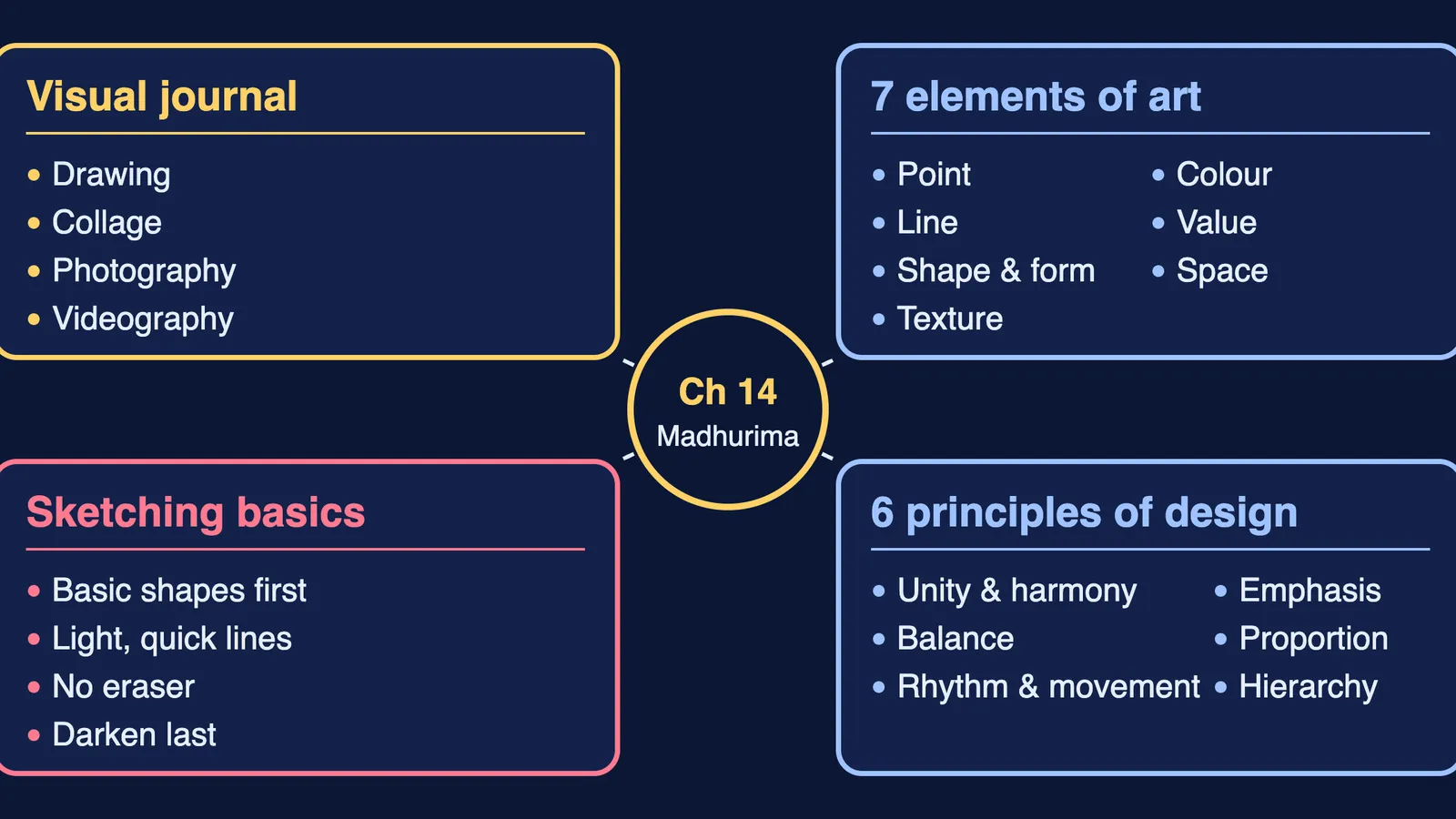
In the chapter, a composition is good when the elements of art are arranged using the principles of visual design. Chapter 14 lists seven elements (point, line, shape and form, texture, colour, value, space) and six principles (unity and harmony, balance, rhythm and movement, emphasis, proportion, hierarchy).
It can be flat, like a painting or textile, or three-dimensional, like a free-standing sculpture, installation or relief.
What is the difference between realistic and abstract art?
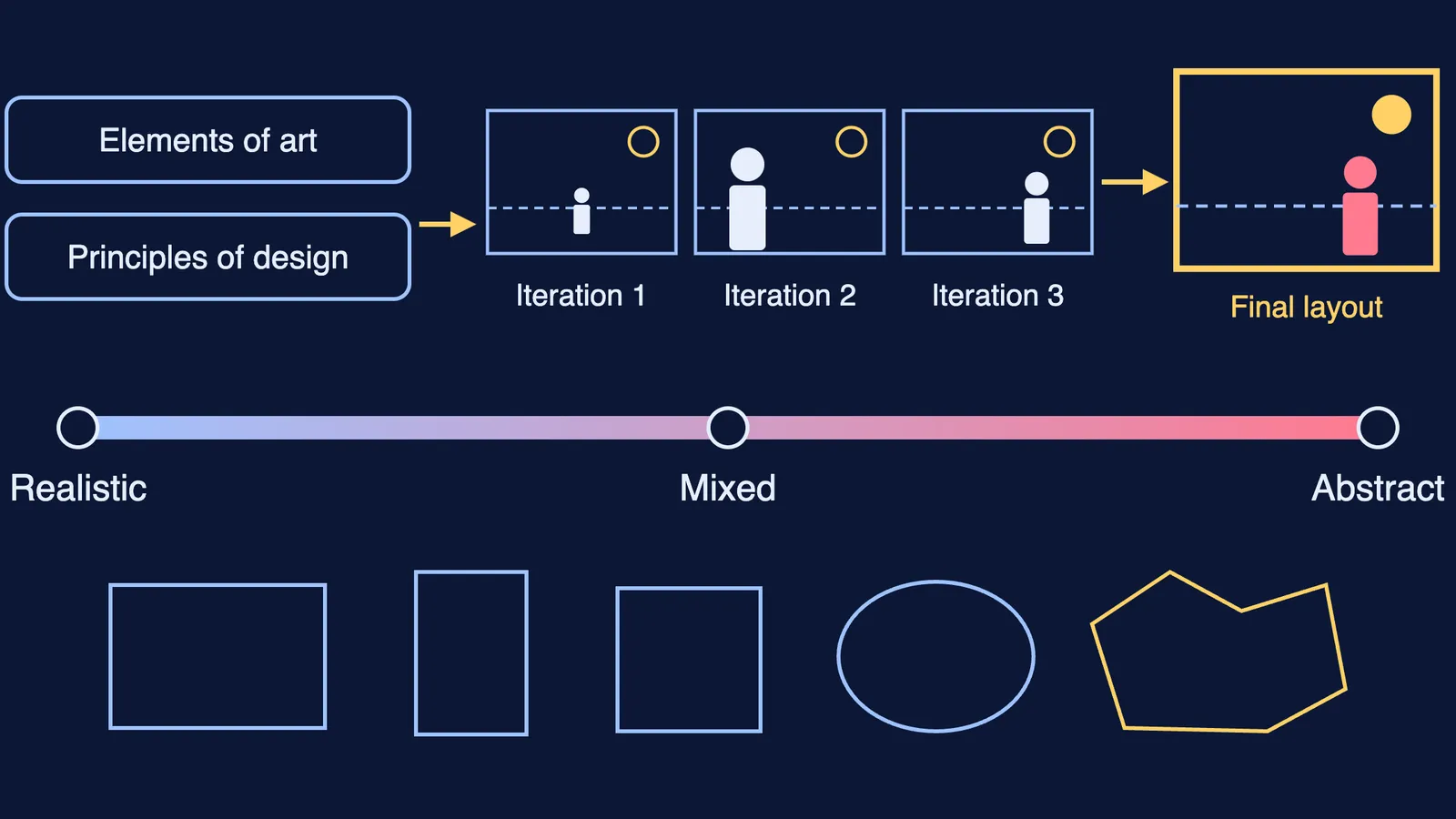
Realistic (or naturalistic): the images look like people, objects and nature as we actually see them.
Abstract: imagined images that need not resemble anything real.
Mixed: some works combine both kinds of imagery.
The book asks you to match works by Raja Ravi Varma, Akbar Padamsee and Mrinalini Mukherjee to these terms; use the figures in your copy.
What is a compositional layout, and why make iterations?
A compositional layout is how every visual part of an artwork is arranged, so that each part's size, position, alignment, colour and proportion work with the rest. The book's everyday example is a newspaper advertisement, where text of different sizes and colours sits beside pictures to carry one message.
Each arrangement changes the impact and feeling, so try several before you commit. Each version is an iteration.
Our worked example, for a painting titled *Waiting for the School Bus*:
Iteration 1: a small figure in the centre of a wide, empty street. It feels calm, perhaps lonely.
Iteration 2: the face fills the left half and the bus is a dot far away. It feels impatient.
Iteration 3: the figure stands on the right, the bus enters from the left and a sun sits high. The eye travels across, suggesting movement.
If your theme is the bus arriving, pick iteration 3. The curriculum's learning outcome for this unit is to compare iterations and explain how arrangement changes meaning and emotion.
How do you do Activity 16.1?
You pick one of three options and make a 2D composition.
A note on numbering: the curriculum lists "two options" (a comic strip, or a thematic painting or collage), while the book gives the collage its own option, C, as group work. Check with your teacher.
Option A: a four-part comic strip. It needs at least two characters you invent, a setting (indoor, outdoor or imaginary) and continuity between scenes. Divide an A4 sheet into four panels, equal or mixed in size. Keep repeating characters simple, match each speech-balloon shape to the voice (thinking, whispering, shouting), and try two or three layouts per scene before choosing.
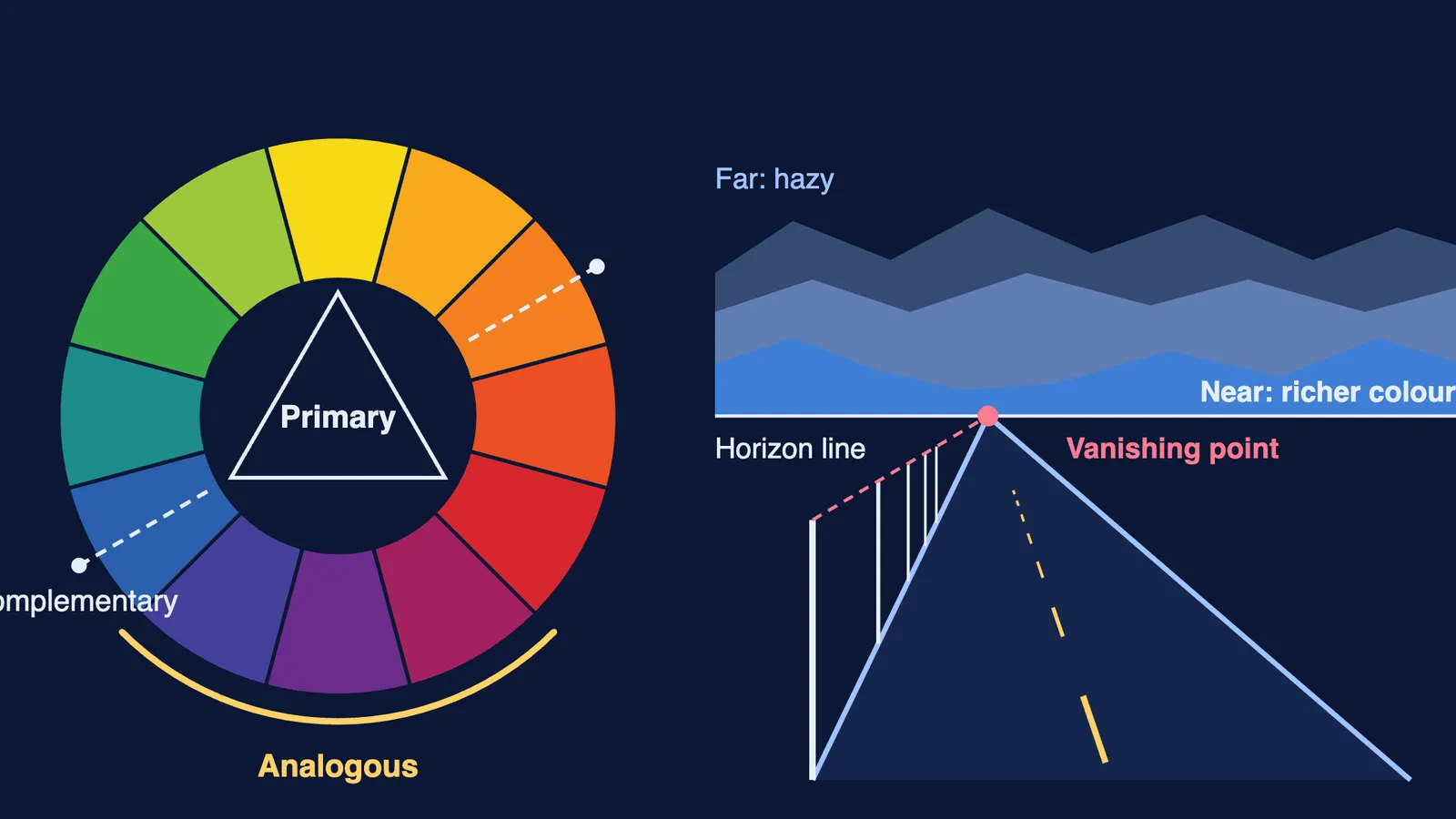
Option B: a thematic painting. Use materials that are cheap, local and sustainable. Work larger than A4 (21 cm × 29.7 cm) and smaller than A2 (42 cm × 59.4 cm). Choose a shape: landscape, portrait, square, circle or oval, or your own. Make three palm-sized layout sketches, get feedback, then draw the chosen one lightly in pencil. Plan colours with the colour wheel, paint the main subject first, and save plain black for the end. Your topic is the subject; your title is the name you give the work.
Option C: a group collage. Work bigger than A2, up to a full chart paper, follow the painting steps, and try torn as well as cut edges.
How is Art Education assessed in Class 9 for 2026-27?
The CBSE 2026-27 Art Education curriculum makes the subject a 100% school-based assessment out of 100: theory 40 marks and practical 60 marks. There is no board exam.
In theory, Visual Arts carries 4 marks, and that covers all four visual arts chapters together, not this one alone. History of Arts carries 20 marks, and an analytical note on an unseen image carries 4.
The Visual Arts practical is out of 60, with 3 hours for your composition. Composition layout carries 10 marks, handling of colour 10, colour value/hatching-cross hatching 5, overall 5 and viva 10. School event participation, project report and formative assessment (average of the two best) add 5, 5 and 10; the final practical score averages all four art sections.
What questions can you practise?
Our own questions; mark values are our suggestion.
Define a compositional layout and name three things it controls. (2 marks)
Describe one realistic and one abstract way to show "monsoon" in a painting. (3 marks)
Sketch two layouts for a poster on saving water and explain which one draws the eye better. (3 marks)
Why should plain black be added last in a painting? (1 mark)
Explain the difference between the topic and the title of an artwork, with your own example. (2 marks)
A classmate says three iterations waste time. Reply in three sentences. (3 marks)
Stuck on what to revise first? Fermi's AI tutor works out what you already know and builds a plan for the session.
Related reading: elements and principles of design in Class 12 Home Science and creativity and problem solving in Class 11 Psychology.