On this page
Thinking is Chapter 7 of the NCERT Class 11 Psychology textbook (Reprint 2026-27). It covers the nature of thinking, problem solving, reasoning, decision-making, creative thinking, and thought and language.
What is thinking in psychology?
NCERT describes thinking as a higher mental process in which we work on and examine information, whether newly taken in or already stored (NCERT Chapter 7). It is mostly organised and goal-directed, and it is internal, so others can only infer it from behaviour.
Thought has two building blocks:
A mental image represents a sensory experience. Picturing the turns to a relative's house uses images.
A concept represents a category of objects, ideas or events that share properties. Calling an unfamiliar breed a dog uses a concept. Concepts save time, like a labelled cupboard.
Box 7.1 adds that culture shapes thinking: analytical thinking focuses on single objects, holistic thinking on relationships and background.
What are the steps of problem solving?
Problem solving is goal-directed thinking that links an initial state (the problem) to an end state (the goal). Table 7.1 of the NCERT chapter lists seven steps:
Identify the problem.
Represent the problem.
Plan the solution by setting sub-goals.
Evaluate all solutions.
Select one solution and execute it.
Evaluate the outcome.
Rethink and redefine problems and solutions.
Two main obstacles block the way. Mental set is reusing steps that worked before: fast on similar problems, rigid on new ones. A related trap, functional fixedness, is seeing only an object's usual use; using a steel tiffin lid as a dustpan beats it. Lack of motivation means giving up after the first failed step.
What is the difference between deductive and inductive reasoning?
Reasoning is gathering and analysing information to reach conclusions, so it is a form of problem solving.
Deductive reasoning goes from general to particular. Its risk is a false starting assumption.
Inductive reasoning goes from particular observations to a general conclusion; most scientific reasoning is inductive. Its risk is concluding before you have all the facts.
Analogy has four parts: pen is to writer as brush is to painter.
Judgment is evaluating events or people from knowledge and evidence; it can be automatic and changes with new information. Decision-making differs from other problem solving because the options are already known: you weigh each one's costs and benefits and choose.
What are convergent and divergent thinking?
Creative thinking produces ideas that are novel, original and appropriate to the context; being merely bizarre is not creativity. NCERT also separates everyday creativity from special-talent creativity.
J.P. Guilford proposed two types of thinking (NCERT Chapter 7):
Convergent thinking solves problems with one correct answer, like the next number in 4, 8, 12.
Divergent thinking is open-ended, like listing uses for an old bicycle tyre. Its abilities are fluency (many ideas), flexibility (varied ideas), originality (rare ideas) and elaboration (working out details).
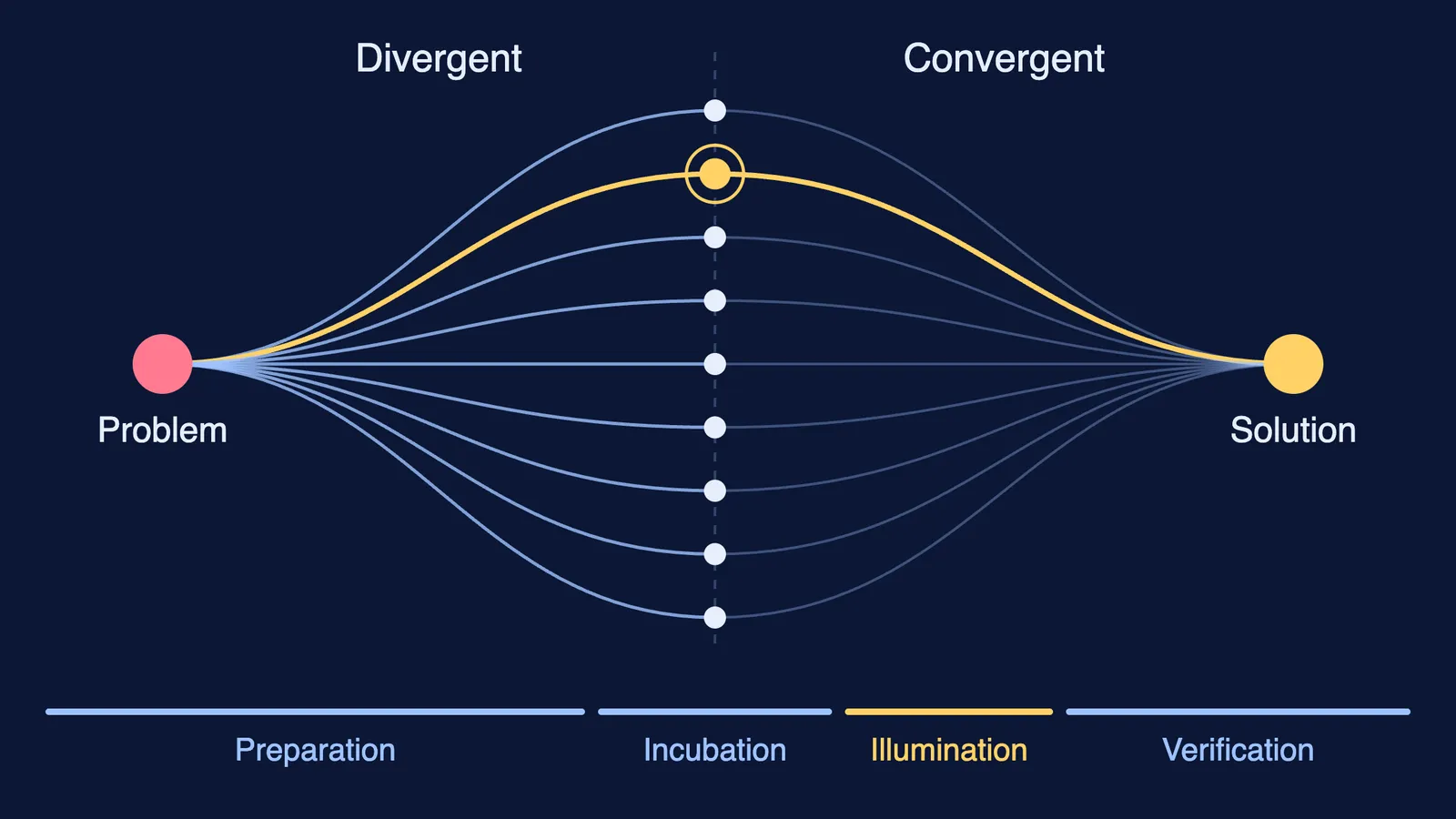
Divergent thinking generates ideas; convergent thinking picks the most useful one. Box 7.2 links divergent thinking to Edward de Bono's lateral thinking and Six Thinking Hats.
The creative process has four stages, shown in the diagram above: preparation (understand the problem, think divergently), incubation (step away when stuck), illumination (the "aha" moment) and verification (test the idea, think convergently). Osborn's brainstorming helps by keeping idea generation separate from judging.
How are thought and language related?
The chapter gives three views:
Language determines thought: Benjamin Lee Whorf's linguistic relativity hypothesis. NCERT contrasts Hindi's many kinship words with the single English word uncle.
Thought determines language: Jean Piaget held that thought precedes language, as when a child imitates an action without words.
Different origins: Lev Vygotsky argued the two develop separately until about two years of age, then merge.
Language has symbols, rules and communication. It develops from crying and cooing to babbling at around six months, one-word holophrases around the first birthday, and two-word telegraphic speech at 18 to 20 months. Skinner explained acquisition through learning; Chomsky proposed an innate universal grammar. Box 7.3 notes that most Indians use more than one language every day.
How much is Thinking worth, and what should you practise?
The CBSE 2026-27 Psychology curriculum gives Unit VII, Thinking, 5 of the 70 theory marks and lists every topic above. Try these questions, written for this guide. CBSE publishes no Class 11 sample paper, so the marks in brackets are our suggestion:
Distinguish a mental image from a concept, with an example of each. (2 marks)
A friend keeps using last year's study method on a new subject and is stuck. Name the obstacle and suggest a way past it. (3 marks)
Explain the four stages of creative thinking, showing where convergent and divergent thinking appear. (4 marks)
Compare Whorf, Piaget and Vygotsky on thought and language. (6 marks)
To revise the chapter before this one, see our guide to human memory in Class 11 psychology. If you are unsure where to start a study session, Fermi's AI tutor works out what you already know and builds a plan for the session. Then move on to motivation and emotion in Class 11 psychology.