On this page
Motivation and Emotion is Chapter 8 of the NCERT Class 11 psychology book, and the 2026-27 reprint runs from the motivational cycle to managing negative emotions and exam anxiety. In the CBSE Psychology syllabus for 2026-27, Unit VIII Motivation and Emotion carries 5 of the 70 theory marks. Still deciding on the subject? Read our guide on whether to take psychology in Class 11.
What is motivation in Class 11 psychology?
The word comes from the Latin 'movere', referring to movement of activity. The NCERT chapter defines motivation as "the process of persistent behaviour directed towards a specific goal, which results from certain driving forces".
In NCERT's words, a need is "lack or deficit of some necessity" and a drive is "a state of tension or arousal produced by a need". Together they form the motivational cycle: need, drive, arousal, goal-directed behaviour, achievement, reduction of arousal.
A worked example:
Need: you skipped lunch before tuition.
Drive: hunger, a state of tension.
Arousal: you cannot focus on the problem.
Goal-directed behaviour: you walk to the canteen.
Achievement: you eat.
Reduction of arousal: you settle back into the problem.
If your trouble is starting to study at all, our piece on why procrastination is about mood, not laziness picks up where this chapter stops.
What are the types of motives?
NCERT sorts motives into two groups, while noting that "no motive is absolutely biological or psychosocial".
Biological motives come from the body: hunger, thirst and sex, regulated by structures such as the hypothalamus.
Psychosocial motives are mostly learned from family, friends and society: the need for affiliation (being close to others), power (influencing others), achievement (n-Ach, meeting standards of excellence), and curiosity and exploration.
For long answers: people high in achievement motivation prefer moderately difficult tasks and want feedback on how they are doing.
How does Maslow's hierarchy of needs work?
Abraham Maslow set out the idea in his 1943 paper A Theory of Human Motivation in Psychological Review. Of the top level he wrote, in the full text: "What a man can be, he must be."
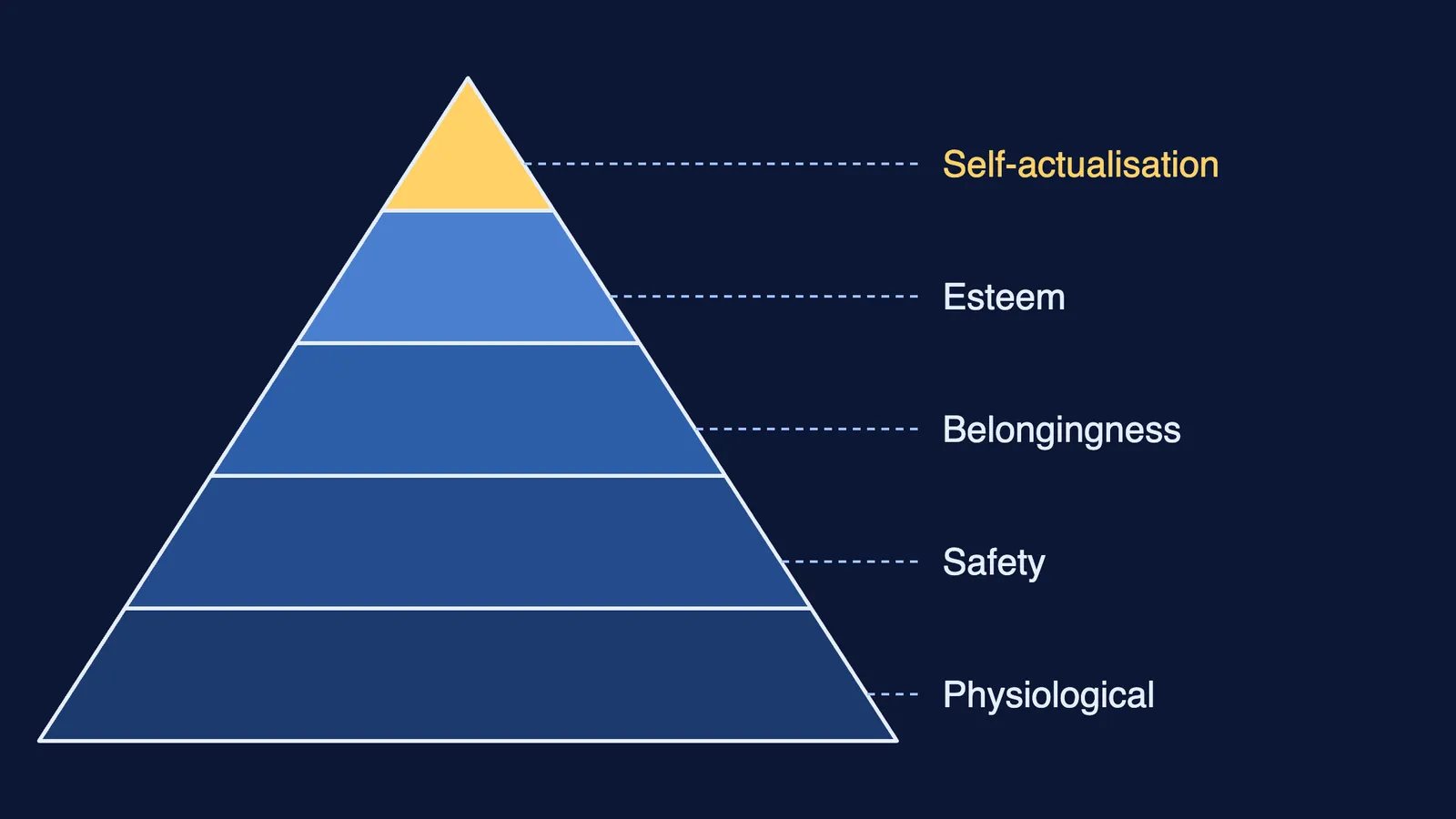
The NCERT pyramid, from the bottom up:
Physiological: hunger, thirst.
Safety: freedom from physical and psychological danger.
Belongingness: to love and be loved.
Esteem: a sense of self-worth.
Self-actualisation: developing your fullest potential.
Lower needs dominate until they are met; then higher needs take over. NCERT notes that very few people reach the top, and its Activity 8.1 asks why soldiers, police officers and fire personnel risk their own safety to protect others.
What does Class 11 say about emotions?
NCERT defines emotions as "a complex pattern of arousal, subjective feeling, and cognitive interpretation". It names six basic emotions experienced and recognised everywhere: anger, disgust, fear, happiness, sadness and surprise. Izard proposed ten, and Plutchik eight in four pairs of opposites: joy-sadness, acceptance-disgust, fear-anger and surprise-anticipation.
The 2026-27 reprint does not include the classic theories of emotion, so ask your teacher whether they are examined. If your school still teaches them, here is the short version:
James-Lange: the bodily change comes first, the feeling follows. William James wrote in What is an Emotion? (1884) that "we feel sorry because we cry, angry because we strike, afraid because we tremble".
Cannon-Bard: Walter Cannon's 1927 critique of the James-Lange theory offered an alternative in which, as this Cannon-Bard theory overview puts it, the bodily changes and the felt emotion are separate and independent, so arousal does not have to come first.
Schachter-Singer two-factor: Stanley Schachter and Jerome Singer's 1962 paper in Psychological Review proposed that an emotion needs physiological arousal plus a cognitive label for it (see this two-factor theory overview).
How does the chapter say to manage exam anxiety?
Box 8.2 of the NCERT chapter splits coping into two strategies:
Monitoring (taking effective action): prepare well and learn the paper pattern, rehearse with a mock test, list your worries and deal with them one by one, and ask friends, parents or teachers for help.
Blunting (stepping back from the stress): relaxation in a quiet place, and a short spell of light exercise.
A script for the night before: "I have done the mock. I know the five levels and the cycle. My stomach is churning, and some anxiety helps me perform." It uses two of the chapter's points: a certain level of anxiety motivates you, and how you appraise an event shapes the emotion. If you watch pep talks instead of revising, try the swap in our piece on motivational videos.
If psychology sits beside biology or physics in your timetable, Fermi's AI tutor can work out what you already know in those subjects and build a plan for the session, so you start with a clear next step.