On this page
Chapter 6 of the NCERT Class 11 Psychology textbook, Human Memory, covers what memory is, its types, why you forget and how to remember better. Here is each part in order, then a revision plan built from the chapter's own ideas.
What is the stage model of memory?
The NCERT chapter defines memory as three stages: encoding (registering information), storage (holding it over time) and retrieval (bringing it back). Memory can fail at any of them.
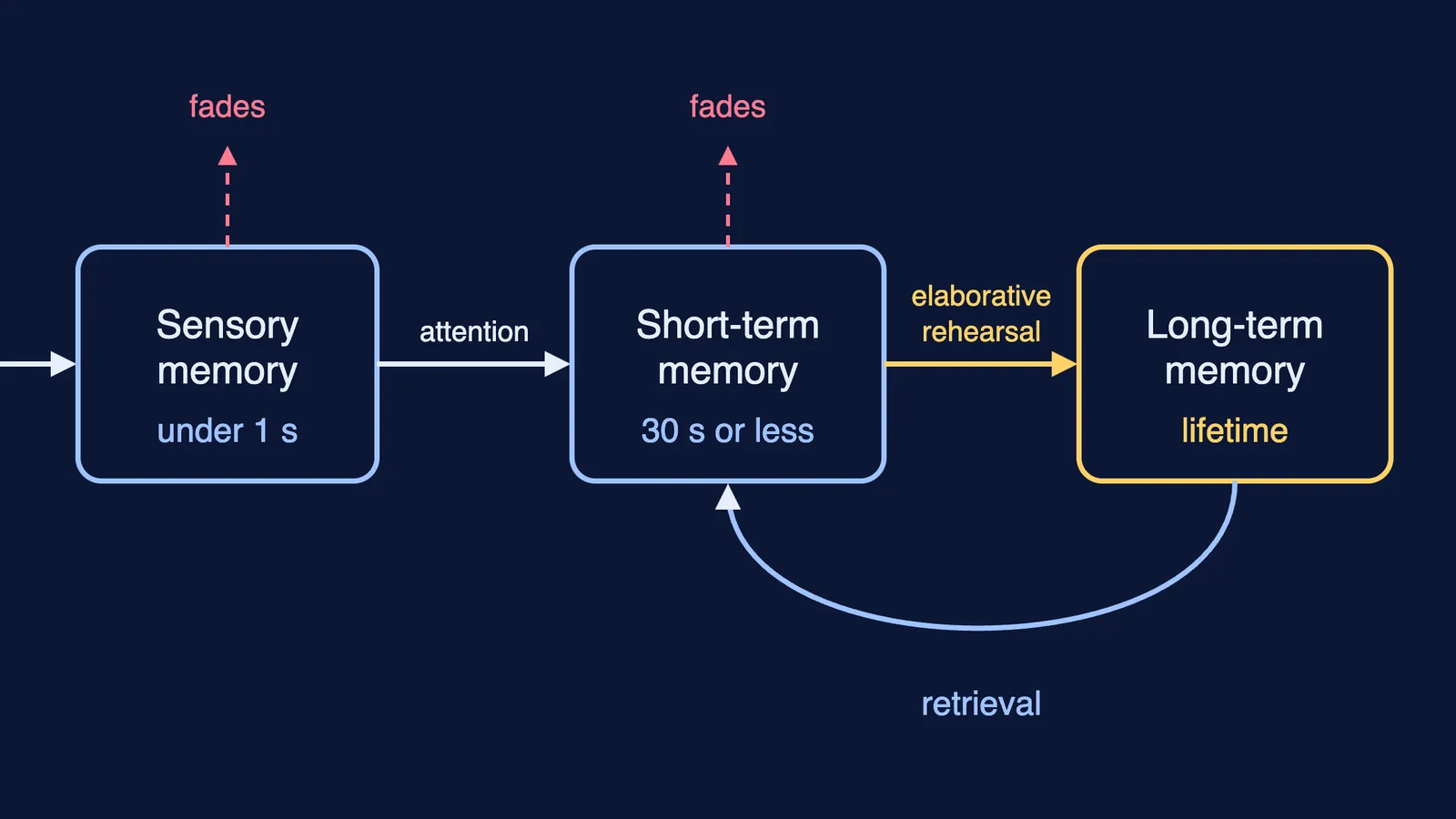
The stage model was proposed by Richard Atkinson and Richard Shiffrin in 1968 (original chapter). It has three stores:
Sensory memory has a large capacity but lasts less than a second, according to NCERT. Iconic memory holds what you see; echoic memory, what you hear.
Short-term memory holds a small amount for 30 seconds or less, encoded mainly by sound.
Long-term memory has a vast capacity, lasts up to a lifetime and is encoded mainly by meaning.
Attention lets information into short-term memory, maintenance rehearsal (repeating) keeps it there, and elaborative rehearsal (linking it to what you already know) moves it into long-term memory. Chunking stretches capacity: the textbook turns 194719492004 into 1947, 1949 and 2004.
NCERT gives short-term capacity as 7 plus or minus 2 items, the figure from George Miller's 1956 paper. A 2001 article by Nelson Cowan argued that when people cannot group items into larger chunks, the limit averages about four chunks. For the exam, write 7 plus or minus 2.
What is working memory in psychology?
Working memory is short-term memory seen as a workbench where information is handled and changed, not a passive store, as Box 6.1 of the NCERT chapter explains. It has three parts:
The phonological loop holds a few sounds, which decay within 2 seconds unless rehearsed.
The visuospatial sketchpad holds visual and spatial information.
The central executive directs attention across both and long-term memory, and plans behaviour.
NCERT credits the idea to Baddeley (1986); it first appeared in Alan Baddeley and Graham Hitch's 1974 chapter Working Memory. In 2000 Baddeley proposed a fourth part, the episodic buffer; NCERT does not list it, so treat it as extra reading.
What are the types of long-term memory?
The textbook's main split is declarative memory (facts you can put into words, such as India's independence on 15 August 1947) versus procedural memory (skills like riding a bicycle, hard to describe). Endel Tulving divided declarative memory again:
Episodic memory holds events from your own life, often emotional: the day your Class 10 results came.
Semantic memory holds general knowledge with no date attached: that a frog is an amphibian.
Why do we forget?
Hermann Ebbinghaus measured his own forgetting in 1885 by learning lists of nonsense syllables and counting how many trials he needed to relearn them. The NCERT chapter summarises his curve: forgetting is fastest in the first nine hours, especially the first hour, then slows. In a 2015 replication, one person spent 70 hours learning and relearning lists at gaps from 20 minutes to 31 days, with results similar to the original.
The textbook gives three explanations:
Trace decay: unused traces fade. It is weak, because people who sleep after learning forget less than those who stay awake. See our post on whether sleep helps you remember what you studied.
Interference: proactive is old learning blocking new; retroactive is new learning blocking old.
Retrieval failure: the memory is stored but the right cue is missing, an idea from Tulving's work.
NCERT also notes that students can blank under exam stress. If that anxiety stays for weeks, talk to a school counsellor or call the free, 24-hour Tele-MANAS helpline, 14416.
How should you revise the memory chapter?
Use the chapter on itself. Box 6.3 of the NCERT text separates recall (producing an answer) from recognition (picking it from options). Written answers need recall, so practise that.
Day 1, encode: draw the stage model from memory and add your own example to every term. That is elaborative rehearsal.
Day 1 evening, retrieve: on a blank page, write the three causes of forgetting with an example each, then check. Our guide to turning notes into active recall cards helps here.
Day 2, separate: write proactive and retroactive interference side by side using the textbook's Learns A, Learns B, Recalls design.
Day 4, re-test: repeat step 2 without notes. Our post on cramming versus spacing explains why the gap helps.
When you blank, name the failure: never understood it (encoding, so explain it aloud first), mixing up two terms (interference, so revise them together), or knew it once you saw the options (retrieval, so practise free recall).
The same loop works in your science subjects. Fermi's AI tutor works out what you already know, builds a plan for the session and checks understanding as it goes, so retrieval is part of the lesson.
Start tonight: one page, the stage model, from memory.