On this page
Chapter 10 of *Madhurima*, NCERT's Class 9 Art Education book (First Edition, April 2026), opens the Dance section. It revisits posture, movement and rhythm, then adds abhinaya. The full chapter is free on the NCERT textbook site.
What does Components of Dance cover in Class 9?
The CBSE Art Education curriculum for 2026-27 gives this chapter 4 hours, or 5 periods, and lists five parts:
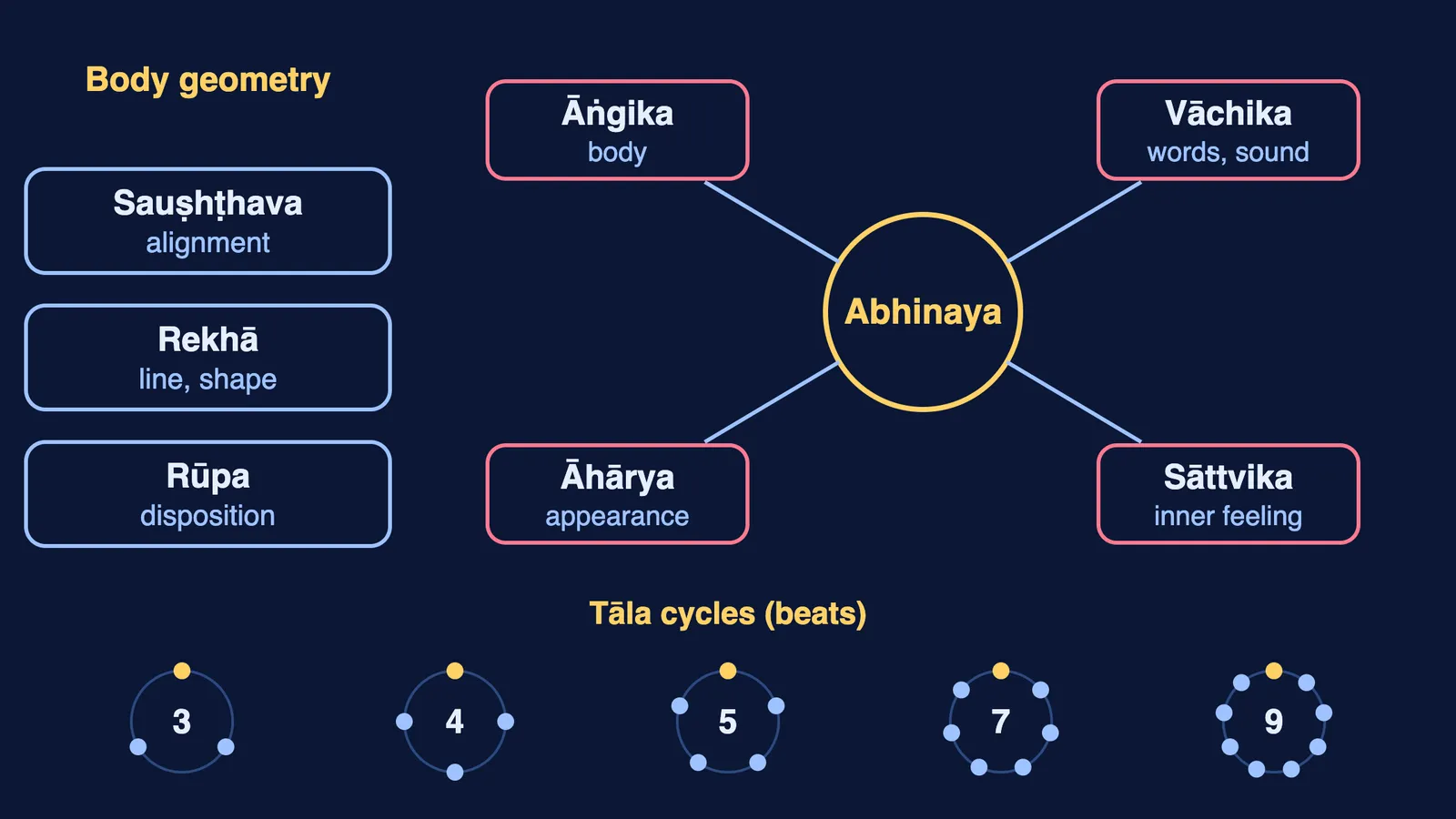
Body geometry: sauṣhṭhava, rekhā and rūpa
Rhythm and tempo, revisited
The four abhinayas
Dance in cinema, with a journal entry on a film sequence
A dance project: watch a performance and write up what you noticed
It also asks you to recall terms from *Bansuri* and *Kriti*, such as sthāna (postures) and bhramarī (spins).
What are sauṣhṭhava, rekhā and rūpa?
Sauṣhṭhava is the poised, aligned stance: feet together, weight shared evenly, torso lifted, and ears, shoulders and waist stacked along an imagined vertical centre line.
Rekhā is the line or shape the body makes: a diagonal with the arms, an arc with the torso, a quadrangle with the legs.
Rūpa is disposition: bright eyes and a pleasant face that show an emotion.
The book links good alignment to stamina and fewer injuries, and treats warming up as safe practice. This is a study summary, not medical advice.
How do tāla and laya build a dance movement?
Tāla is rhythm and laya is tempo. The book compares laya to your heartbeat, which speeds up when you run and slows down while you sleep. It notes that many Indian dance forms build on beat cycles of 3, 4, 5, 7 or 9, or mixes of these, and three basic tempos: slow, medium and fast (chapter PDF).
A dance movement chains shapes with transitions that suit a mood, set to a cycle and tempo.
Nṛitta is pure dance with no story. Nṛitya combines nṛitta with abhinaya, so the dance also carries meaning. In some dances the two fully merge.
What are the four types of abhinaya?
The book introduces Chaturvidha Abhinaya, the four ways a dancer reaches the audience so that they feel rasa:
Āṅgika (the body): stances, movements and hand gestures. The book's example is a Seraikela Chhau dancer from Jharkhand whose stance shows a boatman rowing.
Vāchika (words and sound): song, poetry, music and rhythmic syllables. The Mahārīs of the Shree Jagannatha Temple in Odisha traditionally sang while they danced.
Āhārya (appearance): costume, jewellery, make-up and props. Pulikaḻi, the tiger dance of Kerala, pairs body paint with a tiger mask; Kathakali uses elaborate make-up with different face colours.
Sāttvika (inner feeling): a focused mind draws out genuine emotion that the audience can sense.
For sāttvika abhinaya, the chapter shows exponents from several forms, including Kelucharan Mohapatra (Odissi), Saroja Vaidyanathan (Bharatanatyam) and Jatin Goswami (Sattriya).
The chapter teaches no named hand gestures; it asks you to spot them as part of āṅgika when you watch a dance. Chapter 11 applies three of them in performance.
How is Components of Dance assessed in 2026-27?
Class 9 Art Education is assessed fully in school, out of 100 marks: 40 for theory and 60 for practical, according to the 2026-27 curriculum. In the theory paper, Dance carries 4 marks, shared across all four Dance chapters (10 to 13) rather than given to this chapter alone.
The Dance practical is marked out of 60, and your final practical score is the average of the four art-form sections. The Dance items closest to this chapter are presentation of abhinaya (10 marks), basic dance elements (hand, body and foot movement) based on classical beats (5), performance of different rhythms and tempos (5), and a viva on hand movement, footwork (pad sanchālan) and abhinaya (10). Other items, such as a genre presentation and a project report, make up the rest.
Dancing beyond school? Read about balancing Bharatanatyam classes with studies or BA and BPA degrees in dance.
Practice questions for Components of Dance
Mark values are our suggestion.
A classmate stands with weight on one hip and shoulders tilted forward. Name the principle being broken and give two corrections. (2 marks)
A dancer performs a fast footwork passage, then mimes picking a flower and offering it. Which part is nṛitta and which is nṛitya? Explain. (3 marks)
A dancer paints her face, sings a verse, mimes rowing a boat and lets real sorrow show in her eyes. Name the abhinaya behind each choice. (4 marks)
Using a 7-beat cycle at medium tempo, plan a three-shape phrase for the mood "excitement". Name the shapes, the transitions and the beats each shape gets. (5 marks)
Your group must show a storm on a 5-beat cycle. Plan how tempo would change from start to finish and which rekhā shapes you would use. (5 marks)
Mixing up āhārya and sāttvika? Fermi's AI tutor works out what you already know and builds a plan for the session.