On this page
Chapter 9 of *Madhurima*, the new NCERT Art Education textbook for Class 9 (First Edition, April 2026), is the last of the four Music chapters (NCERT, book prelims). It covers two ideas: genres born from migration, and instrument families found on several continents (NCERT, Chapter 9 PDF).
What is Music Travels Around the World about?
Migration is people moving to settle in a new place. A diaspora is a community with a shared place of origin that has settled in a new country (NCERT, Chapter 9).
Migrants keep their music because it links them to home, bonds them with each other, preserves culture and voices their hardships. Over time it mixes with local sounds into hybrid genres.
The CBSE 2026-27 curriculum gives this unit 5 hours (6 periods). Its topics are music and migration, and the lute and flute instrument families (CBSE Art Education curriculum, Class IX 2026-27).
Which music styles grew out of migration?
The book's examples, all from Chapter 9:
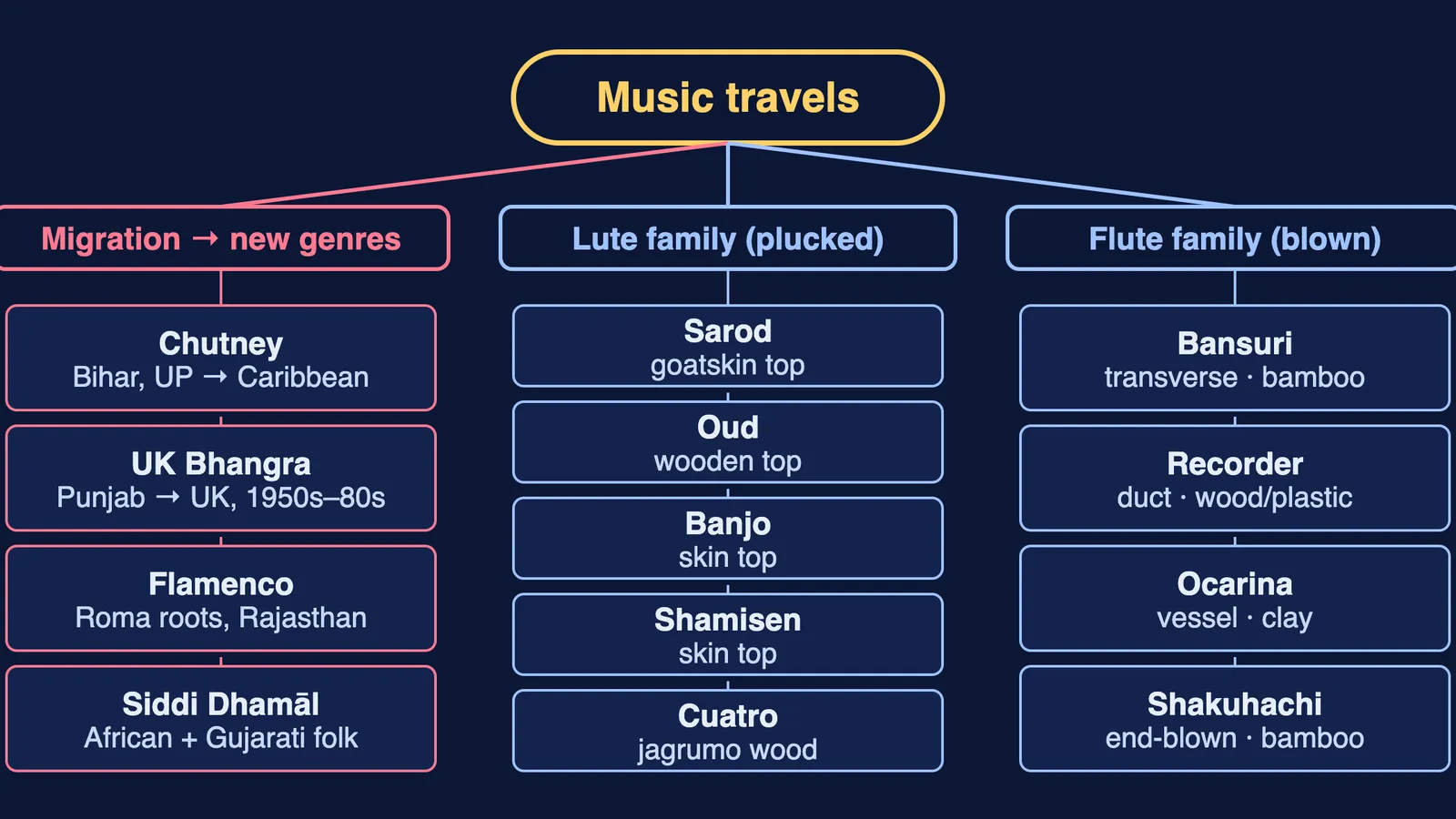
Chutney music: grew in the Caribbean after people from Bihar and Uttar Pradesh migrated there in the 19th and early 20th centuries. Bhojpuri folk songs and bhajans met calypso and soca. Lyrics mix Bhojpuri, Hindi, English and Creole, and the dholak, tassa, dhantal and keyboards set its dance beat.
UK Bhangra: Punjabi families who made the UK their home from the 1950s to the 1980s kept dhol-driven Bhangra as part of their identity. Young musicians later fused it with reggae, hip-hop, pop and electronic music.
Flamenco: the book traces its roots to Roma migration from Rajasthan to Spain between the 9th and 14th centuries, after which it absorbed Jewish and Moorish influences in southern Spain.
Siddi Dhamāl: a flow in the other direction. The Siddi community in India combines African traditions with Gujarati folk in this music and dance form.
How are musical instruments grouped into families?
You have already met the Natyashastra's four classes: tata (string), sushira (wind), avanaddha (percussion) and ghana (solid). Chapter 9 points out that this scheme fits instruments from anywhere in the world. Instruments can also be grouped by genre, by country or region, or by shared features (NCERT, Chapter 9).
Lute family. These are plucked string instruments with a broad resonating body and a slim neck. What changes is the material of the top, or belly: wood on the West Asian oud, skin on the banjo, stretched goatskin on the Indian sarod, traditionally animal skin on the Japanese shamisen, and seasoned jagrumo wood on the Puerto Rican cuatro. Synthetic materials have also come into use.
Flute family. A flute is a hollow tube that sounds when air is blown into it or across a hole. Four examples:
Bansuri (India): transverse flute, bamboo, known for smooth slides called meend.
Recorder (Europe): duct flute, wood or plastic, bright and easy for beginners.
Ocarina (Central America, modern form in Italy): vessel flute, clay or ceramic.
Shakuhachi (Japan): end-blown flute, bamboo, with flexible pitch bending.
The chapter also shows how a veena is made: traditionally from a single block of wood, most often jackwood, with a resonator (kudam), a long hollow neck (dandi) and a carved yazhi at the end. It is central to Carnatic music. For the physics of vibrating strings and air columns, see our Class 9 sound waves guide.
How do you compare two instruments for the activity?
Activity 9.2 asks you to compare stringed instruments. Use this checklist:
How the sound starts: plucked, bowed, blown or struck.
Natyashastra class.
Body shape.
Material of the part that resonates.
Tone, in your own words.
A mood the sound suits.
Worked example using the chapter's facts: the sarod and oud are both plucked, tata, with a wide body and narrow neck. They differ at point 4: goatskin versus wood. Points 5 and 6 come from your own listening.
How many marks does this chapter carry?
Art Education in Class 9 is a fully school-based assessment out of 100: theory 40 marks, practical 60 (CBSE curriculum 2026-27). In the 2-hour theory paper, Music has 4 marks. That figure covers all the Music chapters together and is not split by chapter. The music practical viva (10 marks) can also cover instruments' sound and structure.
Practice questions for Chapter 9
Marks shown are our suggestion, not a CBSE pattern.
Name the type of flute the bansuri is and its material. (1 mark)
Define diaspora and give one musical example from the chapter. (2 marks)
The banjo and the cuatro are both in the lute family. Give one design feature they share and one difference in their materials. (2 marks)
Compare Chutney music and UK Bhangra: origin, what each blended with, and one instrument. (3 marks)
Plan a memory box of four family songs. For each, say what memory it keeps and which Natyashastra class its main instrument belongs to. (4 marks)
Not sure where to start revising four music chapters? Fermi's AI tutor works out what you already know and builds a plan for the session.
Thinking beyond school? Read our guide to a career in music after 12th.