On this page
This guide is for the 2026-27 session. Sound Waves: Characteristics and Applications is Chapter 10 of Exploration, the new NCERT Class 9 science textbook, first published in April 2026. Older notes on sound were written for the previous book, so check them against this chapter.
What does the new Class 9 sound chapter cover?
The Chapter 10 PDF builds one idea at a time:
Production: sound comes from vibrating objects, such as a tuning fork or your vocal cords.
Propagation: sound needs a medium (solid, liquid or gas). In the bell-jar experiment the ringing fades as air is pumped out.
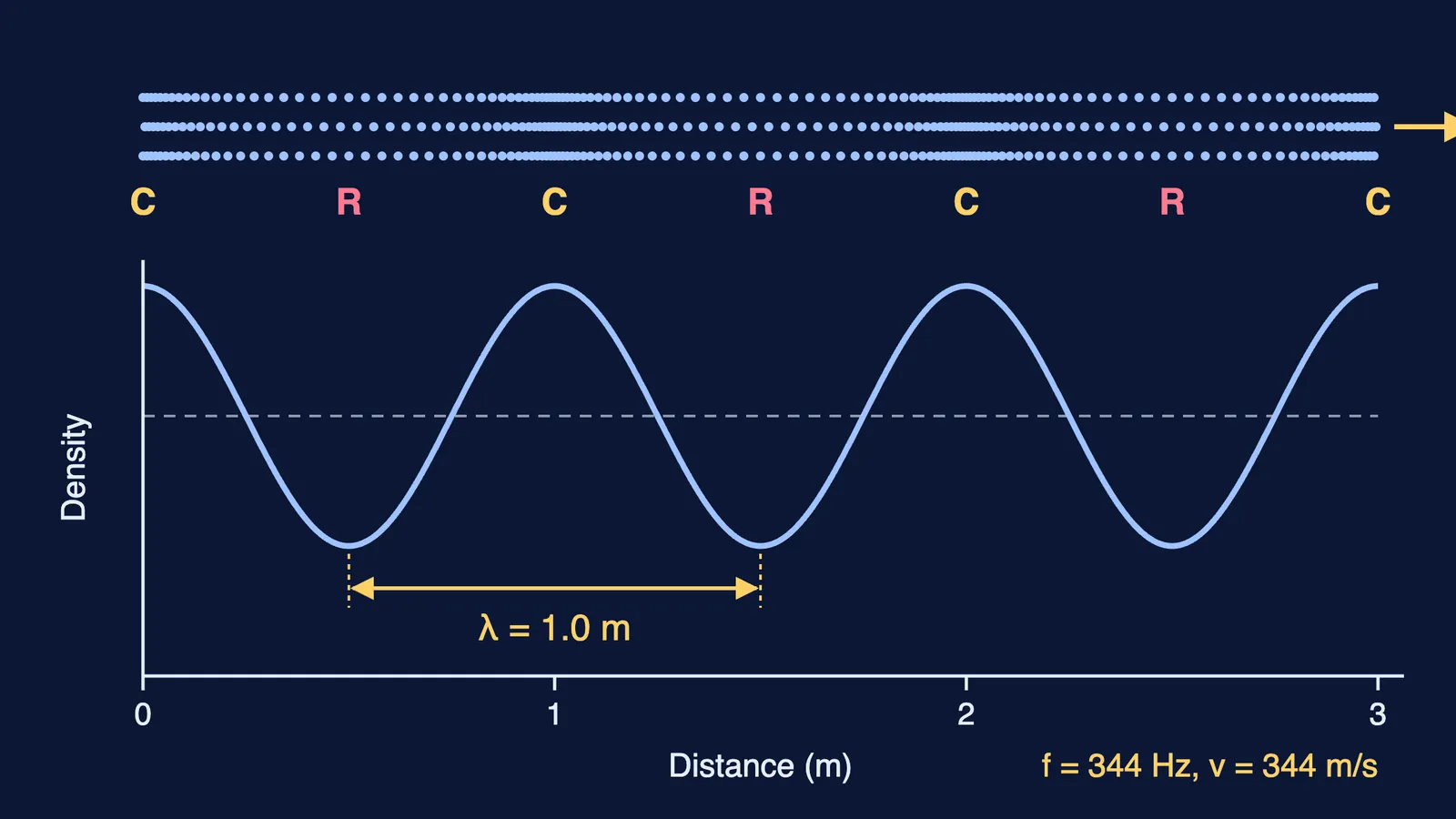
Sound as a wave: a vibrating source makes alternating compressions (denser air) and rarefactions (thinner air). Particles only oscillate about their mean positions; the disturbance and its energy travel. Because particles move parallel to the wave's direction, sound is a longitudinal, mechanical wave.
Graphs: density against distance; crests are compressions, troughs rarefactions.
Characteristics: wavelength, frequency, time period, amplitude, intensity and speed, then pitch and loudness as how we perceive them.
Reflection: echo, reverberation, sonar and echolocation.
What are the key formulas, with worked examples?
The chapter gives two relations: ν = 1/T and v = λν, where ν (nu) is frequency, T is time period, λ is wavelength and v is speed (NCERT Chapter 10). Its examples take sound in air as 340 or 344 m/s and in sea water 1500 to 1530 m/s.
Frequency and period. A tuning fork marked 256 Hz makes 256 oscillations per second. T = 1/256 s = 0.0039 s, or about 3.9 milliseconds.
Wavelength. The same fork in air at 344 m/s: λ = v/ν = 344 ÷ 256 = 1.34 m. The diagram at the top shows a 344 Hz tone at the same speed: λ = 344 ÷ 344 = 1.0 m, so crests sit exactly one metre apart.
Echo distance. You clap facing a school wall and hear the echo 0.3 s later. Sound travels to the wall and back, so distance = (340 m/s × 0.3 s) ÷ 2 = 51 m.
Sonar depth. A ship's pulse returns after 2.4 s in sea water at 1500 m/s. One-way time is 1.2 s, so depth = 1500 × 1.2 = 1800 m.
That 17 m figure is worth understanding rather than memorising; our explainer on why the minimum distance for an echo is about 17 metres walks through it. The chapter also says reflections arriving less than 0.05 s apart blend into reverberation (NCERT Chapter 10).
What numbers should you remember from Chapter 10?
These come straight from the new textbook chapter:
Human hearing spans roughly 20 Hz to 20 kHz, and the range shrinks with age. Below 20 Hz is infrasound; above 20 kHz is ultrasound.
At those limits in air, wavelengths are about 17.2 m (20 Hz) and 1.72 cm (20 kHz).
Sound in dry air travels at about 331 m/s at 0 °C and nearly 344 m/s at 22 °C; warmer or more humid air carries it faster.
Sound is about 4 to 5 times faster in water and typically 15 to 20 times faster in solids than in air.
Ultrasound uses in the chapter include imaging organs and finding flaws in metal. For the medical use, read how an ultrasound scan turns echoes into a picture; for the animal version, see how bats time echoes to find prey.
Which mistakes cost marks in sound numericals?
Forgetting to halve. Echo and sonar times are round trips. Divide by 2 before (or after) multiplying by speed.
Leaving kHz unconverted. 20 kHz is 20,000 Hz. Put that into v = λν, not 20.
Saying particles travel with the wave. They vibrate in place.
Mixing up pitch and loudness. Pitch follows frequency; loudness follows amplitude.
Calling wavelength crest-to-trough. One wavelength is crest to crest (or trough to trough). Crest to trough is half.
If you keep picking the wrong relation for a problem, the Fermi Problem Library has worked problems with a step-by-step solver that explains the reasoning rather than printing an answer.
How is sound tested in CBSE Class 9 for 2026-27?
In the CBSE Class IX Science curriculum for 2026-27, Chapter 10 sits in Unit III, Motion, Force, Work and Sound, with Chapters 4, 6 and 7. That unit carries 23 of the 80 theory marks, and internal assessment adds 20 more. The same document lists question types that include assertion-reasoning, case-based and source-based questions, and Practical 10 asks you to find the speed of a pulse along a stretched string or slinky.
Before a test, redraw the density graph with C, R and λ labelled, then solve five v = λν questions and five echo or sonar questions with your own numbers, circling the halving step each time.
If a definition still feels shaky, the Fermi Concept Library has a lesson for every physics concept and shows where it fits with the ideas around it.