On this page
Chapter 5 of *Madhurima*, the new NCERT Class 9 arts book (chapter PDF, First Edition, April 2026), closes the Theatre unit. It covers what a director plans, how the stage is divided, five styles of direction and the main schools of acting.
What does a director do in Chapter 5?
The book calls the director the captain of the ship. The work runs in five steps.
Script work: read the script many times, note themes, moods, places and changing relationships, and edit where needed.
Visualisation and scene building: sketch each scene, who moves and why, which props matter, and how light or sound carries the emotion.
Blocking: fix positions for actors, sets and props, and plan every entry and exit.
Consolidating departments: align the music, sound, costume and lighting teams with one vision.
Polishing and run-throughs: rehearse the full play with every technical part, for crew as well as cast.
What are the nine stage divisions?
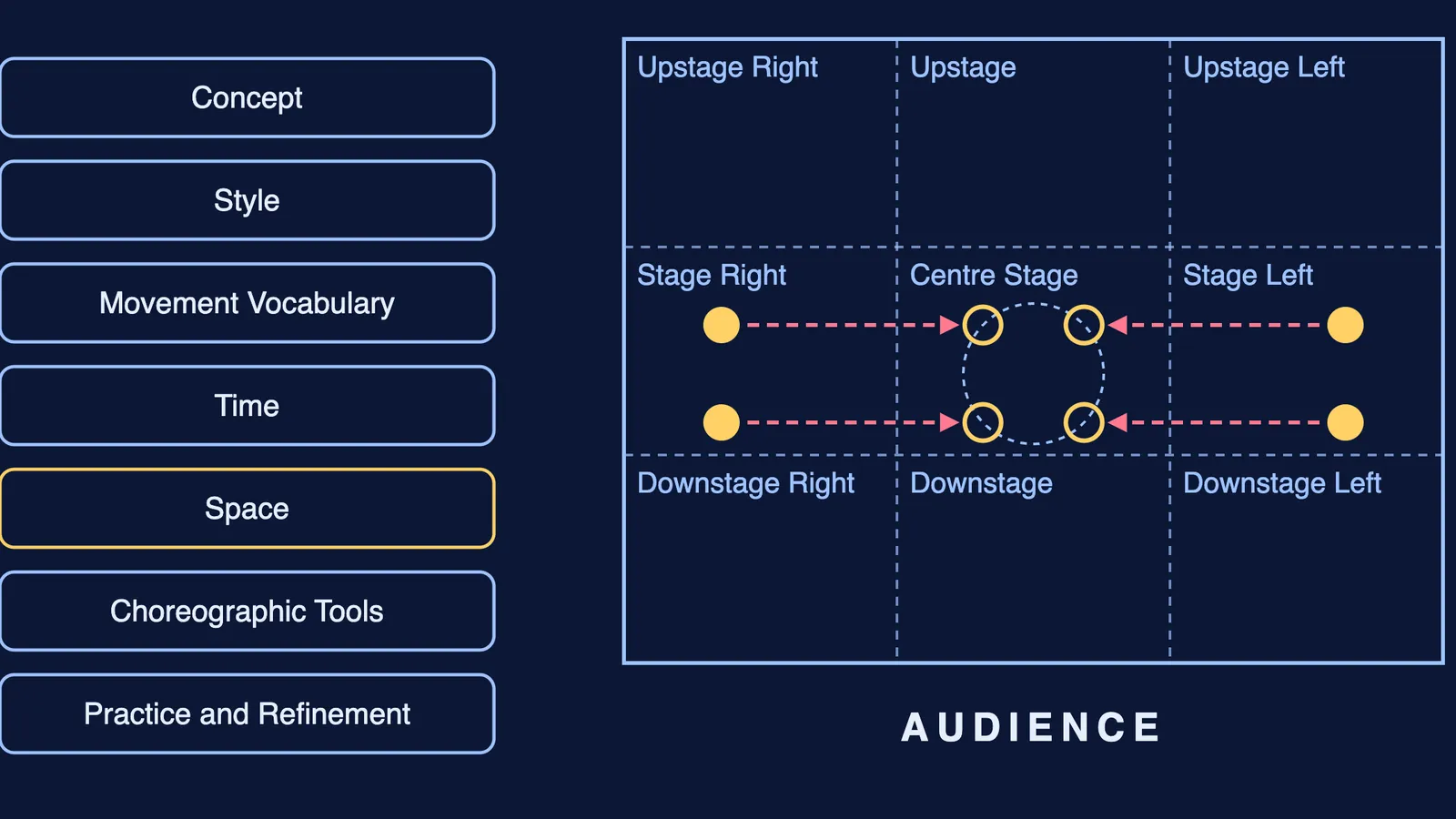
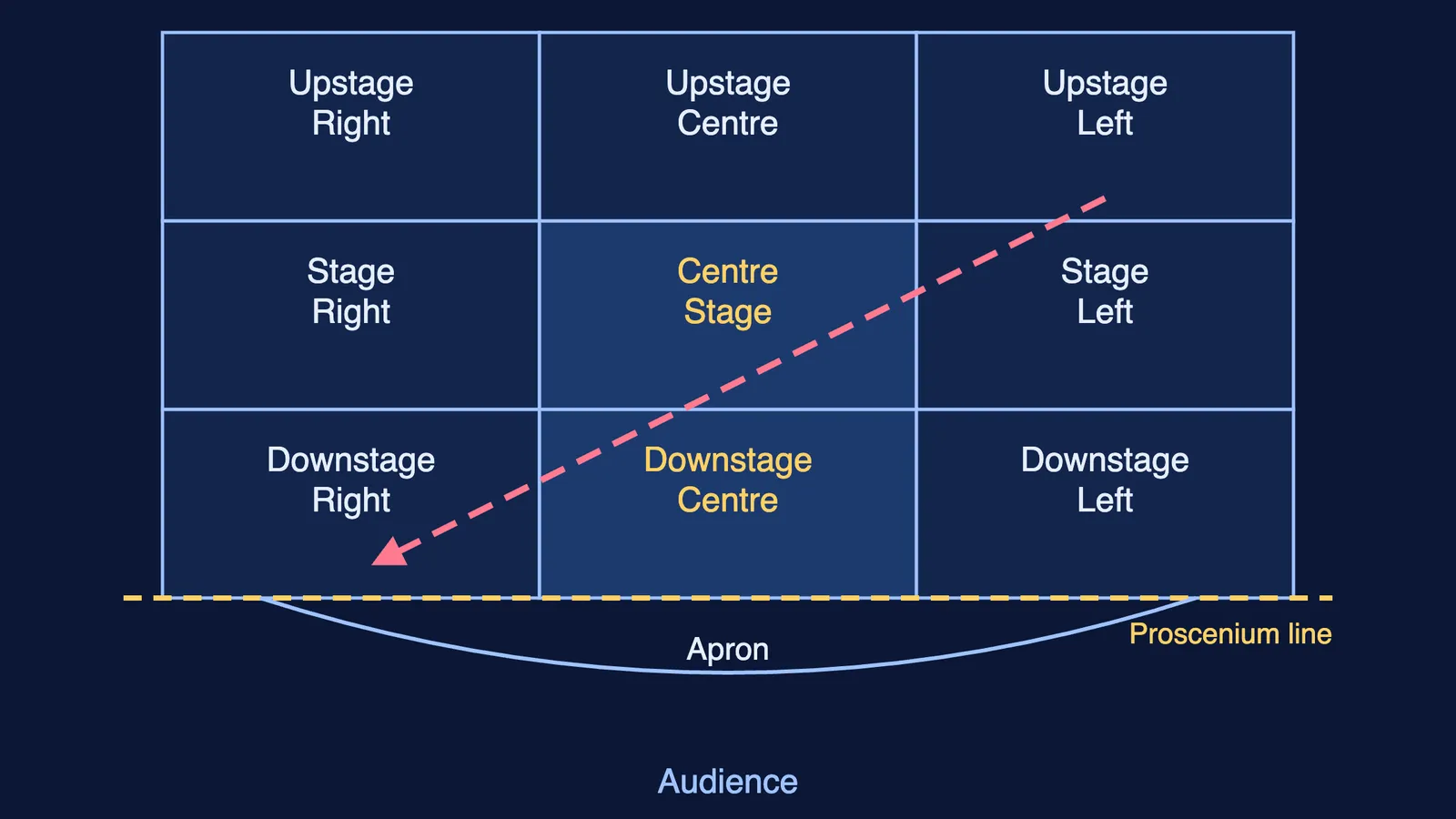
Stage division gives the director, cast and crew one shared name for every spot on stage. It is a 3 by 3 grid. The book's Fig. 5.5 puts the audience at the front, so stage right is on the actor's right as they face the audience:
Back row: upstage right, upstage centre, upstage left
Middle row: stage right, centre stage, stage left
Front row: downstage right, downstage centre, downstage left
In front of the grid is the proscenium line, and beyond it the apron. Four ideas to explain:
Centre stage and downstage centre are the most prominent spots, often used for major speeches or solos.
A move towards the audience is often seen as stronger than a move away.
A diagonal from upstage left to downstage right adds depth.
Move only with a reason, never hide another actor from view (upstaging), and keep every part of the stage alive.
What are the five styles of direction?
Realistic: natural speech and a set that looks like a real place.
Abstract or symbolic: images carry the story; a cloth can stand for a mountain, a coloured light for anger.
Devised: no fixed script; the group builds the play through improvisation, with the director as facilitator.
Script-based: staging starts from a written text and respects the playwright's intention.
Collaborative: two directors, or a director with a choreographer or musician, share one concept.
Which schools of acting does the chapter cover?
Indian. The Nāṭyaśāstra, which the book dates to around the fifth century BCE, describes four kinds of abhinaya: āṅgika (body and gesture), vāchika (voice), āhārya (costume, jewellery and props) and sāttvika (inner experience). The chapter also introduces four regional traditions, per the NCERT chapter:
Gaura-līlā and Gūsta-līlā (Manipur), where the audience joins in through chants
Bhūta-kola (Karnataka), with ritual dance and Chende drums
Rammāṇ (Uttarakhand), on UNESCO's list of Intangible Cultural Heritage
Teyyam (Kerala), with more than 400 variants
Global (twentieth century).
Stanislavsky's System and Lee Strasberg's Method: emotional truth, the magic "if", an inner monologue, and staying in character off stage.
Bertolt Brecht's epic theatre: the actor keeps a distance from the role so the audience thinks instead of being swept away.
Jerzy Grotowski's poor theatre: no elaborate sets or costumes; the actor's body carries the show. (The book prints the name as "Grotowsky".)
Stella Adler's technique: build the character from imagination rather than personal memory.
The chapter ends with solo acting (monologues and soliloquies held by one performer) and group acting (an ensemble that listens and reacts).
How is Chapter 5 assessed in 2026-27?
Class 9 Art Education is assessed entirely by the school, out of 100: theory 40 and practical 60, per the CBSE 2026-27 Art Education curriculum. In the theory paper, Theatre has 4 marks for the whole Theatre unit (Chapters 2 to 5), not this chapter alone. Direction and acting get 6 hours (7 periods). In the Theatre practical, out of 60, "Application of concept learnt from the book" is worth 10 marks, and your final practical score is the average of the four art sections.
Practice questions (marks are our suggestion)
Give two reasons directors use stage divisions. (2 marks)
Where would you place a lonely character so he seems distant, and why? (2 marks)
Compare devised theatre with script-based direction. (3 marks)
How would a Brecht-style actor and a Method actor play the same angry scene differently? (3 marks)
Name the four kinds of abhinaya, with one example of each from a school play. (4 marks)
Not sure what to revise first? Fermi's AI tutor works out what you already know and builds a plan for the session.
Beyond the classroom, read should you join a theatre or drama club, or for a performing arts path, BA or BPA in dance after Class 12.