On this page
Exploring the Fundamentals of Visual Arts is Chapter 14 of NCERT's Madhurima, the Class 9 arts textbook (First Edition, April 2026). It opens the Visual Arts section: set up a journal, practise the elements of art, spot design principles in print, and sketch from life.
Is Chapter 14 compulsory, and how many marks does it carry?
The book's preface makes Chapter 1 and the first chapter of each art-form section compulsory for students at Learning Standards 1 and 2. Chapter 14 is the first Visual Arts chapter.
In the CBSE Art Education curriculum for 2026-27, it matches the block called Visual Arts Fundamentals, given 4 hours (5 periods). Its topics: an introductory discussion, the visual journal, elements of visual arts, principles of visual design and sketching basics.
Art Education is assessed entirely in school, out of 100: 40 theory and 60 practical. In theory, Visual Arts carries 4 marks for the whole section; CBSE gives no per-chapter figure. The Visual Arts practical includes a 3-hour composition, a viva and a project report.
What goes in a visual journal?
Madhurima calls the journal the most important item in your art bag. It needs 50 or more blank pages, on plain, lined, graph or recycled paper. Add a pencil, a sharpener and glue. (The book prints "sharperner"; we use the standard spelling.)
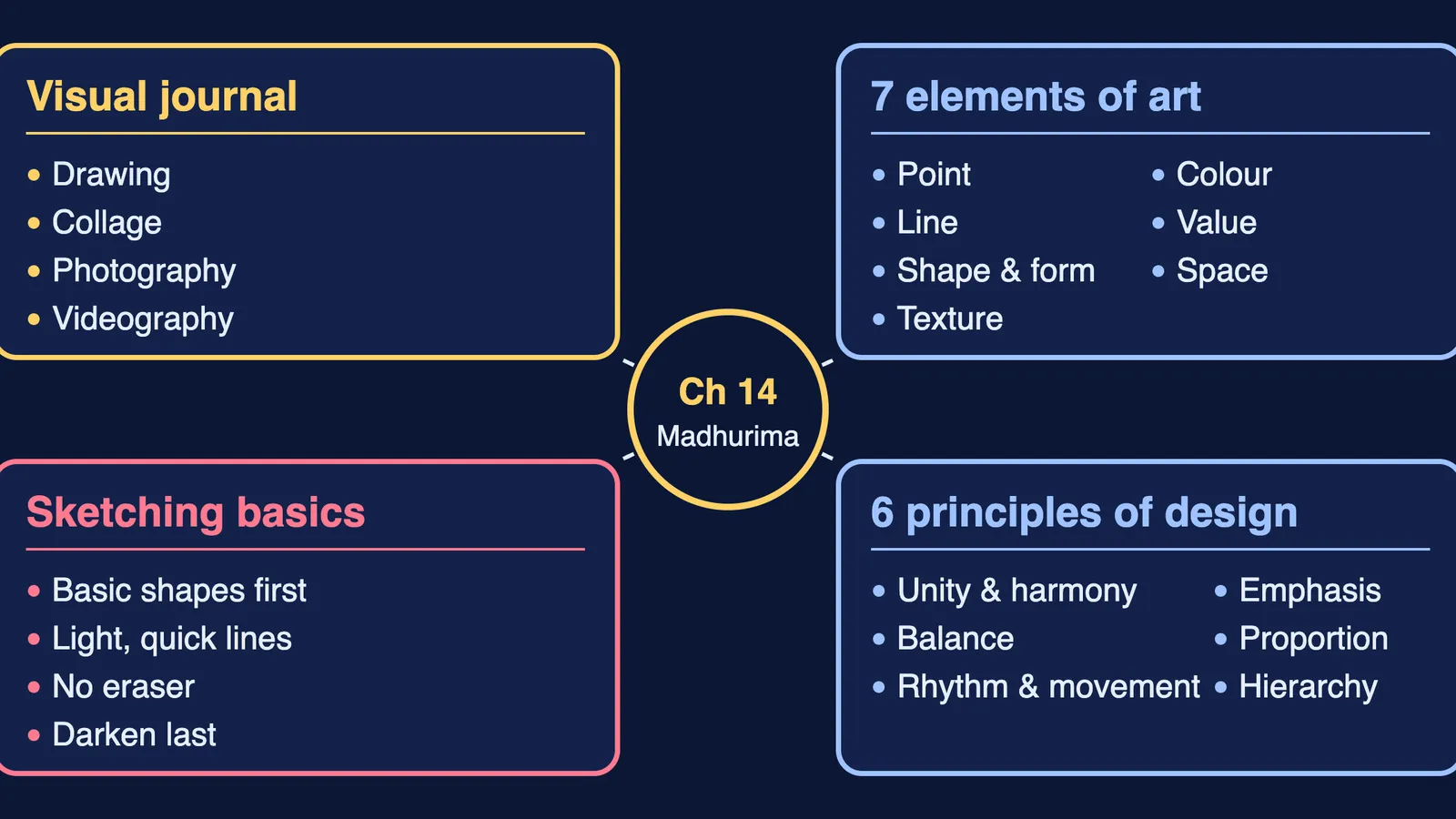
The chapter names four ways to journal:
Drawing or sketching, to visualise ideas and make small studies
Collage, pasting printed pictures, fabric scraps or fibres
Photography, often on a phone, around a theme
Videography, clips of a few seconds to a minute
Every entry carries the date, time and place. A heading in the book's format: 18/11/2026, 7:40 a.m., waiting at the bus stop with my cousin. Note what caught your eye, set weekly goals, and spend 10 minutes each weekend checking your pages. At term end, everything becomes your Visual Art portfolio.
What are the 7 elements of art and 6 design principles?
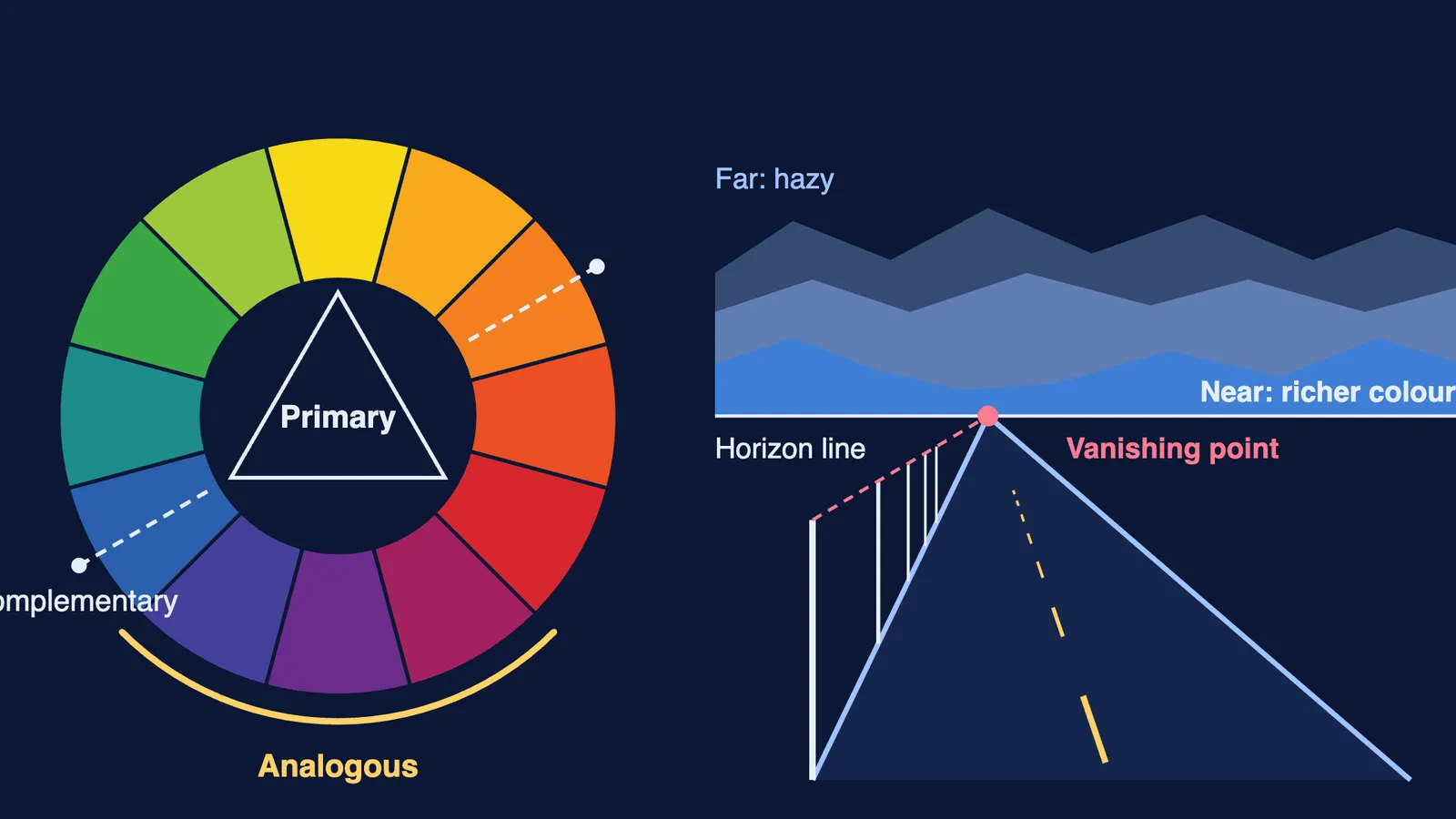
Elements are the building blocks; principles decide how you arrange them. Activity 14.2 gives one journal page to each element:
Point: dots of many sizes
Line: wavy, zigzag, dashed, thick and thin
Shape and form: shading turns a flat shape into a 3D form
Texture: collage and frottage (rubbings of textured surfaces)
Colour: blotches in crayon, watercolour or poster colour
Value: tints, tones and shades
Space: positive and negative space
Activity 14.4 adds six principles: emphasis, balance, proportion, rhythm and movement, unity and harmony, and hierarchy (order of importance).
Worked example (ours). An annual-day invitation card from your school:
Emphasis: the event name in the largest, brightest letters
Hierarchy: event name, then date, then venue, RSVP line smallest
Balance: a large lamp motif on the left against three short text lines on the right
Rhythm: small flowers repeated along the border lead your eye round
Unity: one typeface and two colours throughout
How should you practise sketching?
The book compares sketching to an athlete's warm-up: quick drawing from observation, not copied from other pictures. See basic shapes first, keep early lines light and quick, skip the eraser so corrections stay visible, and darken lines only once the structure is right.
Activity 14.3 sets themes with minimum times. Its counts add up to 8 sketches, needing at least 75 minutes (2 × 5 + 2 × 10 + 1 × 10 + 2 × 10 + 1 × 15). The book heads that column "Sketches per day" but calls the total a "Weekly target"; we read it as weekly, so check with your teacher. One way to spread them:
Monday: two objects at home, 5 minutes each
Tuesday: two plants or a landscape, 10 minutes each
Wednesday: one bird, animal or insect, 10 minutes
Thursday: two people in action, 10 minutes each
Friday: one building detail, such as a window grille, 15 minutes
Sunday: a 10-minute journal review
That is 75 minutes of sketching plus 10 of review: 85 a week. The book and curriculum also suggest 10 to 15 minutes of observational drawing every day, so add short sketches on the other days.
Practice questions for Chapter 14
Marks are our suggestion.
(1 mark) Which set lists only design principles? (a) point, line, balance (b) emphasis, proportion, hierarchy (c) texture, rhythm, value (d) colour, unity, space. *(b)*
(1 mark) What is frottage? *Making rubbings of textured surfaces.*
(2 marks) Write a journal heading for a sketch of a vegetable seller made after school. *Date as DD/MM/YYYY, time and place.*
(2 marks) Why sketch without an eraser? *Mistakes, corrections and progress stay visible.*
(3 marks) Look at a bus or railway timetable board. Name one element and two principles it uses, with evidence for each.
The same ideas return in design for fabric and apparel in Class 12 Home Science. If art may become your career, see how BFA admission and portfolios work.
Planning revision across subjects? Fermi's AI tutor works out what you already know and builds a plan for the session.