On this page
Creativity in Light and Sound is Chapter 4 of *Madhurima*, NCERT's Class 9 Art Education book (First Edition, April 2026, per the book's prelims). In the Theatre section (chapter PDF, pages 62 to 71), it shows how light and sound shape an audience's feelings.
Why does a play need designed light?
We see an object only if it emits light or reflects light into our eyes (Madhurima, Chapter 4). So most theatres begin as a "black box": a dark hall with few stray reflections, where light goes only where the designer puts it. The book likens lighting design to painting with light.
Stage lighting has six jobs:
visibility
information (day or night, indoors or outdoors)
mood
composition and stage balance
drawing attention to an actor, object or area
symbolism and special effects
After sunlight, fire, candles and lamps, tungsten bulbs led from the mid-1900s; LEDs now give finer control.
What lights and positions does Chapter 4 cover?
Fixtures range from the simple floodlight to the profile, which gives most control (NCERT Chapter 4):
Floodlight: source plus reflector; the tungsten type has no lens, little beam control and runs hot (LED floods don't).
PAR (PARcan): Parabolic Aluminised Reflector. Lens, reflector and source in one unit, with a bright, slightly oval beam of fixed size, for even general cover; it can pan and tilt.
Fresnel and PC: the Fresnel (said "fray-nel") has a ringed lens; the PC (plano-convex lens) has a more defined edge than a PAR, which barndoors can shape.
Profile (spotlight): the most control, with hard or soft edges, shutters, and a gobo to project patterns like window bars.
Moving lights: a moving spot acts like a profile, a moving wash like a PAR.
Light console: selects lights, sets intensity and colour, and stores the plan.
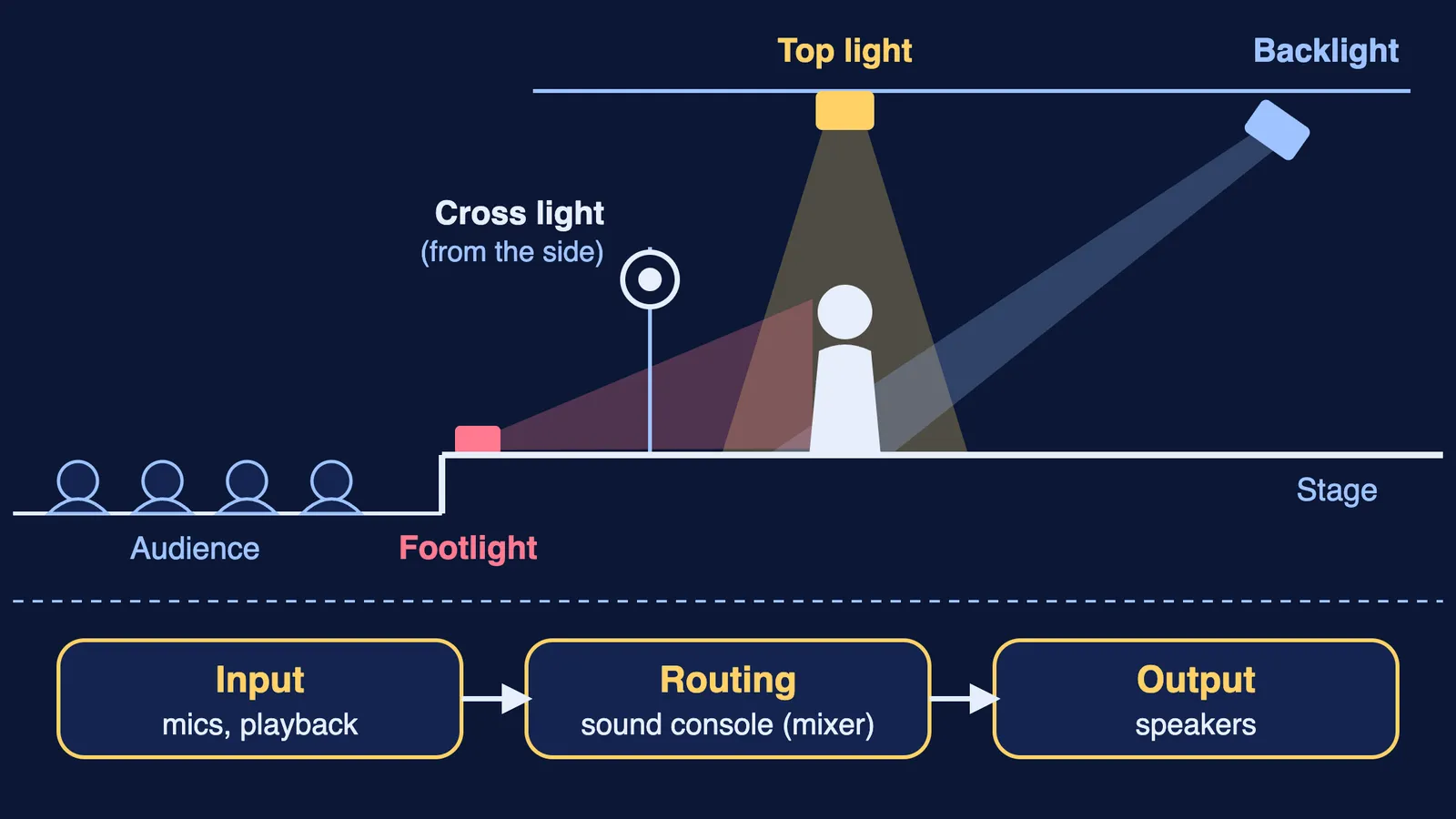
Position matters too: cross lights model actors from either side, backlights give depth and outline, top lights feel natural, and footlights light actors from below for special effects. Colours must suit costumes and sets, or actors look washed out.
How does sound design work on stage?
Sound design builds a show's audio from music, effects and dialogue without burying the actors' lines. A hall with excellent acoustics needs no microphones, but most venues do. The book splits a sound system into three stages:
Input: mics and playback devices. Dynamic mics cut outside noise (good for open-air stages), lapel mics are cordless, hanging mics cover the stage from above, and foot mics sit near the front edge.
Routing and processing: the sound console (mixer) sets volumes and blends inputs. Each channel is a strip of knobs and faders: 4 on a simple mixer, 12 to 20 mid-range, over 96 on professional desks.
Output: speakers turn the amplified signal back into sound, as mono, stereo or Left Centre Right (LCR).
The chapter ends with AI lighting and sound tools, framed as aids to human designers.
For the physics, see our Class 9 sound waves guide; gobos rely on the shadows in these light and shadow experiments.
Worked example: a cue sheet for a one-minute scene
Our scene: at night, a girl waits on a platform for her grandfather's train.
Cue 1, waiting: dim, cool top light on the bench (night, outdoors). Sound: low crickets. Jobs: information, mood.
Cue 2, the train: strong backlight from upstage makes her a silhouette. Sound: a rumble that swells, then fades. Jobs: special effect, attention.
Cue 3, the meeting: a PC with barndoors frames the pair in warmer light; crickets drop under the dialogue. Jobs: attention, mood, clear speech.
Checks: if his shawl is pale blue, keep the cool wash faint. One hanging mic covers the bench.
The colours are our choice; Activity 4.2 asks you to justify yours.
How is Chapter 4 assessed in Class 9?
Art Education is fully school-assessed out of 100: theory 40, practical 60 (CBSE Art Education curriculum 2026-27). In the 2-hour theory paper, Theatre carries 4 marks, shared across all Theatre chapters. The Theatre practical (out of 60) gives 10 marks for applying a concept from the book, and your practical score averages all four art-form sections. The curriculum numbers it Theatre topic 2 and allots it "3.20 hours/ 4 periods".
The prelims make Chapter 1 and each section's first chapter compulsory for Learning Standards 1 and 2; Chapter 4 isn't one, so check your school's list.
Practice questions on Creativity in Light and Sound
Original questions; mark labels are our suggestion.
(1 mark) Which fixture gives the most beam control? Answer: the profile (spotlight).
(1 mark) Expand PAR. Answer: Parabolic Aluminised Reflector.
(2 marks) An open-air show has traffic noise and an actor who runs around. Pick a mic for each problem, with reasons.
(2 marks) Why do most theatres start from a dark space?
(Practical prompt) With a torch and paper gobo, light a forest at dawn; explain colour and direction.
Mixing up fixtures? Fermi's AI tutor works out what you already know and builds a plan for the session.
Tonight, sketch a stick figure and label the four light positions from memory.