On this page
Chapter 8 of NCERT Madhurima, the new Class 9 arts textbook (First Edition, April 2026), covers two pillars of Indian classical music. A rāga organises notes into a melody; a tāla organises beats into a cycle that keeps coming back.
What is a rāga, and how are rāgas classified?
S, R, G, M, P, D and N are the 7 svaras. S and P never change (achala or prakṛiti svaras). R, G, M, D and N each have a lower and a higher form (chala or vikṛiti svaras), which gives 2 + (5 × 2) = 12 note positions, the same in Hindustani and Carnatic music (Madhurima, Ch. 8).
A rāga is a melodic framework built from these notes; the chapter sorts rāgas two ways.
1. By how many notes they use (rāga-jāti). Count the notes in the ārohaṇa (going up) and avarohaṇa (coming down):
7 notes: saṁpūrṇa, for example Yaman or Śhaṅkarābharaṇam
6 notes: ṣhāḍava, for example Gurjarī Todī or Śhrīrañjanī
5 notes: auḍava, for example Bhūpālī or Haṁsadhvani
Up and down can differ: ṣhāḍava–saṁpūrṇa is 6 up, 7 down.
2. By note positions. Carnatic music has 72 meḻakartā (parent) scales, each using all seven svaras going up and down, derived in Venkatamakhi's Chaturdaṇḍī-Prakāśhikā. Janya rāgas come from a parent by dropping or reordering notes: drop M and D from Śhaṅkarābharaṇam and you get the five-note Haṁsadhvani. Hindustani music groups every rāga into one of 10 thāṭs, a system the book attributes to Pandit Vishnu Narayan Bhatkhande; Yaman and Śhuddha Kalyāṇ both sit in Kalyāṇ thāṭ.
Which rāgas and compositions does Chapter 8 use?
Carnatic: Śhaṅkarābharaṇam (meḻakartā 29, saṁpūrṇa, likened to the Western major scale), with a jatisvaram in Kaṇṇaḍā (svaras and optional rhythm syllables, usually no lyrics) and a svarajati in Haṁsadhvani (which adds simple lyrics). Hindustani: Alhaiyā Bilāval, a saṁpūrṇa rāga of Bilāval thāṭ, D as vādī and G as saṁvādī, with a bandiśh and a lakṣhaṇa-gīta in Teen tāla.
What is a tāla, and how do you count mātrās?
A tāla is a repeating cycle of beats. Key terms (Madhurima, Ch. 8):
Mātrā: one beat
Vibhāg: a group of beats
Tālī: a stressed beat, shown with a clap
Khālī: an unstressed beat, shown with a wave
Sam: beat 1, the most important beat of the cycle
Ṭhekā: the basic tabla pattern that defines a Hindustani tāla
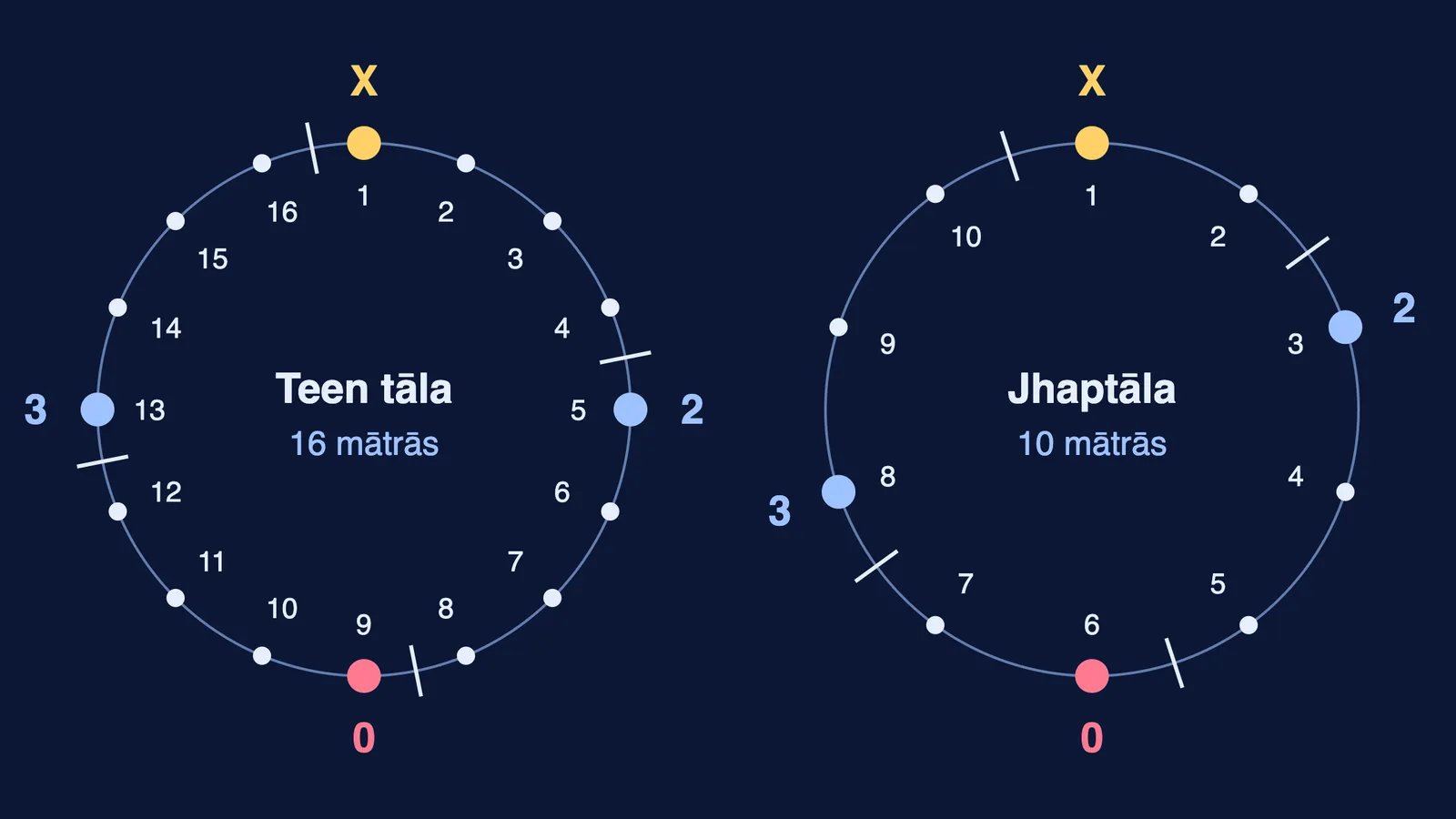
The diagram above shows both Hindustani tālas. Teen tāla has 16 mātrās in 4 vibhāgs of 4, with tālī on 1, 5 and 13 and khālī on 9. Jhaptāla has 10 mātrās in 4 uneven vibhāgs (2, 3, 2, 3), with tālī on 1, 3 and 8 and khālī on 6. Carnatic Ādi tāla has 8 beats and Rūpaka 6, counted with beats, finger counts and hand turns.
A worked example: when do two tālas meet again?
The music practical asks you to link beats and mātrās to calculation (CBSE curriculum 2026-27).
One friend keeps Teen tāla (16 mātrās), another Rūpaka (6 beats), starting together at one beat per second. When do both cycles end together?
Write the multiples of 16: 16, 32, 48.
Write the multiples of 6: 6, 12, 18, 24, 30, 36, 42, 48.
The first shared number is 48, the lowest common multiple.
Both cycles end together after 48 beats (3 Teen tāla cycles, 8 Rūpaka cycles); beat 49 is a shared beat 1.
Jhaptāla (10) and Rūpaka (6) give LCM 30: 3 Jhaptāla cycles, 5 Rūpaka cycles. For the arithmetic, see Euclid's gcd method, step by step; for the physics, our Class 9 guide to sound waves.
How is this chapter assessed in 2026-27?
Art Education in Class 9 is a 100% school-based internal assessment: 40 theory marks and 60 practical marks (CBSE curriculum 2026-27). Music as a whole carries 4 theory marks, with no separate figure for this chapter. The music practical section is out of 60 (final practical score: average of all four art sections) and includes 10 marks for a rāga of your choice, 5 for the tāla demonstration and 10 for a viva. The book's preface says Chapter 1 and the first chapter of each art section are compulsory for Learning Standards 1 and 2 (Madhurima prelims); Chapter 8 is the third music chapter, so ask your teacher what your school covers.
Answers: saṁpūrṇa–auḍava; auḍava–saṁpūrṇa (5 up, 7 down); 16 beats (one Teen tāla cycle, two Ādi cycles).
Not sure where to start revising? Fermi's AI tutor works out what you already know and builds a plan for the session.