On this page
Chapter 11 of Ganita Manjari Grade 9 Part II, the new NCERT maths book for the 2026-27 session (first edition, August 2026), is called "The World of Algorithms". It starts with ordinary column addition and ends with Euclid's method for the greatest common divisor (gcd, the same thing as HCF).
What is an algorithm in Class 9 maths?
The chapter defines an algorithm as a step-by-step procedure that reaches an answer. It also says you must justify why an algorithm is correct, and you can count how many steps it takes as numbers grow. The word itself, the chapter notes, comes from the name of Al-Khwarizmi, who wrote about Indian arithmetic.
Take 586 + 749 by the column method:
Units: 6 + 9 = 15. Write 5, carry 1.
Tens: 8 + 4 + 1 = 13. Write 3, carry 1.
Hundreds: 5 + 7 + 1 = 13. Write 3, carry 1.
No columns left, but the carry is 1, so write 1 on the left. Answer: 1335.
Counting 1335 dots would take ages; columns need three additions. One more digit means one more column, not ten times the work, and that contrast runs through the whole chapter.
How does Euclid's algorithm find the gcd?
The book first lists all divisors of both numbers and takes the largest common one. For 36 and 60 the common divisors are 1, 2, 3, 4, 6 and 12, so gcd(36, 60) = 12. But the checking grows with the numbers.
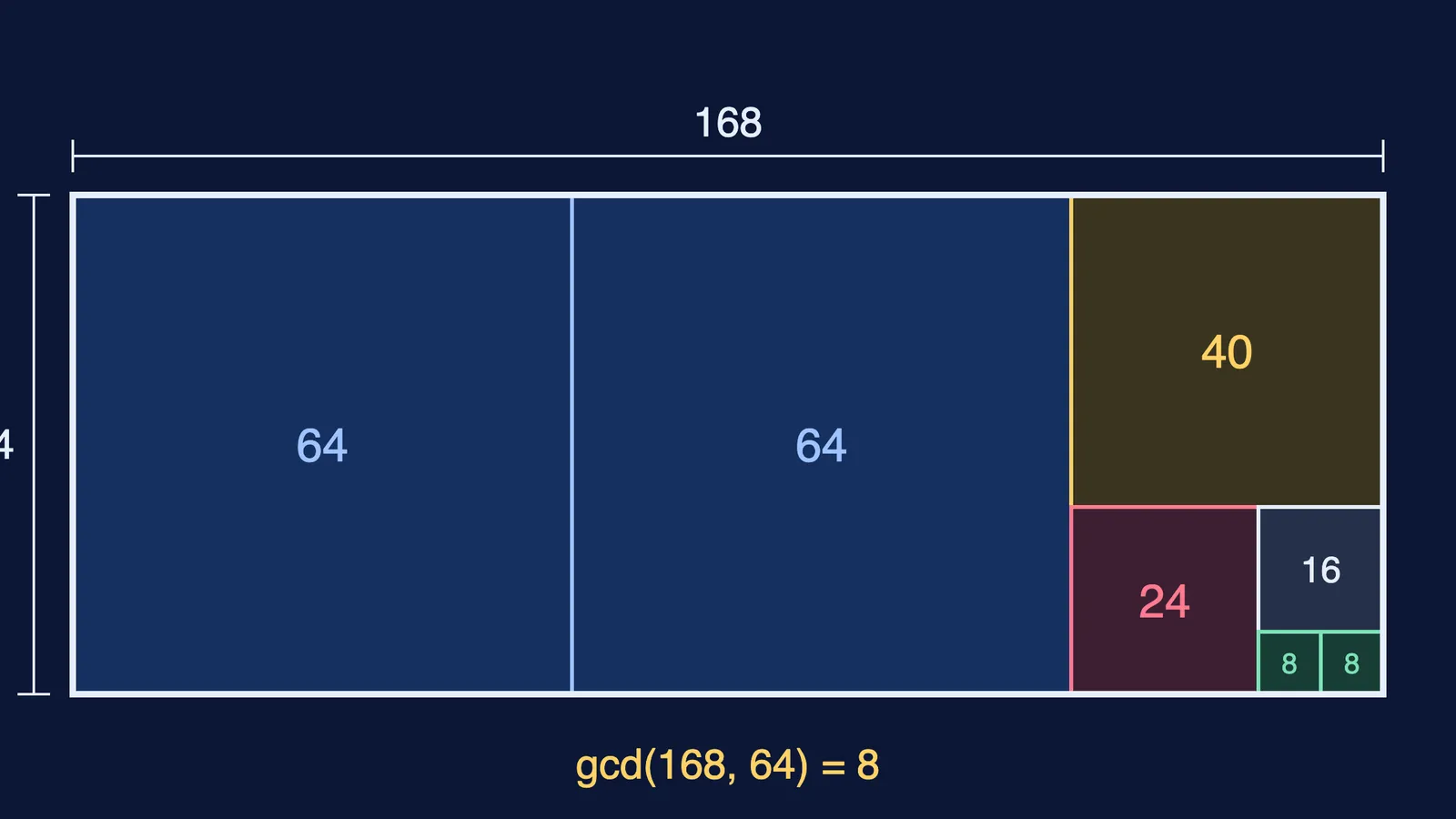
Euclid's idea: for m ≥ n, gcd(m, n) = gcd(n, m − n), because any number dividing m and n also divides their difference, and the other way round. Repeat until the second number is 0; the first is then the gcd. Here is gcd(168, 64) by subtraction:
168 − 64 = 104, so find gcd(64, 104), which is gcd(104, 64) after swapping.
104 − 64 = 40 gives gcd(64, 40).
64 − 40 = 24 gives gcd(40, 24).
40 − 24 = 16 gives gcd(24, 16).
24 − 16 = 8 gives gcd(16, 8).
16 − 8 = 8 gives gcd(8, 8).
8 − 8 = 0 gives gcd(8, 0), so the answer is 8.
The picture at the top shows this as squares: cut the biggest squares you can from a 168 by 64 rectangle, then from what is left, until 8 by 8 squares fit exactly.
Why is the division method faster than subtraction?
Subtracting 64 twice from 168 just leaves the remainder of 168 ÷ 64, which is 40. The chapter points to Aryabhata's Aryabhatiya (499 CE) as an Indian text where this long-division method for the gcd appears. The rule becomes gcd(m, n) = gcd(n, m mod n), where m mod n is the remainder. For 168 and 64:
168 = 2 × 64 + 40
64 = 1 × 40 + 24
40 = 1 × 24 + 16
24 = 1 × 16 + 8
16 = 2 × 8 + 0, so gcd(168, 64) = 8.
That is 5 divisions instead of 7 subtractions. The gap gets huge for pairs like gcd(41, 2): subtraction needs 22 reductions, division needs 2 (41 = 20 × 2 + 1, then 2 = 2 × 1 + 0). If you learnt continued division in earlier classes, our Class 6 guide to HCF by long division shows the same layout.
What mistakes do students make in this chapter?
Reporting the last remainder (0) instead of the last divisor. Stop when the remainder is 0; the gcd is the divisor in that line.
Not swapping when the first number is smaller: gcd(64, 168) becomes gcd(168, 64).
Carrying only when a column is "more than 10". A column total of exactly 10 also carries 1.
If you keep losing track mid-way, the Fermi Problem Library has worked problems with a step-by-step solver that explains the reasoning rather than printing an answer.
How is this chapter assessed in CBSE 2026-27?
The CBSE Class IX Mathematics curriculum for 2026-27 sets an 80-mark theory paper plus 20 marks of internal assessment. The 80 marks are split across six units, and none of the chapters listed under them is "The World of Algorithms", so it has no unit or marks of its own. The document does set computational thinking (goal CG-9: breaking a problem into sub-problems and designing step-by-step procedures) as a goal across units. Ask your teacher how your school will test this chapter.
Practice questions with answers
Find gcd(1071, 462) by division. Answer: 1071 = 2 × 462 + 147; 462 = 3 × 147 + 21; 147 = 7 × 21 + 0, so the gcd is 21.
How many subtractions would Euclid's original method need for gcd(1071, 462)? Answer: 12, because each division step hides as many subtractions as its quotient, and 2 + 3 + 7 = 12.
Next, see how the division steps give Bézout's identity, gcd as ax + by, or try predicting spirograph patterns with LCM and HCF.