On this page
You pick a ring and a wheel, push the pen through a hole and go round and round until the line meets its starting point. The toy most people know was developed by British engineer Denys Fisher and first sold in 1965. Its patterns look random, but they are not. Before you draw a single line, you can predict how many points the pattern will have and how many laps it will take. All you need is LCM and HCF.
How many points will a spirograph pattern have?
In a 2024 article in Chalkdust magazine, Ashleigh Ratcliffe and Jenny Power give the number of spokes as LCM(n, N) ÷ n, where n is the number of teeth on the cog and N is the number on the ring. For two numbers, LCM × HCF equals their product (here is why that only works for two), so the same rule can be written in a form that is quicker to work out:
Points = ring teeth ÷ HCF(ring, wheel)
Laps = wheel teeth ÷ HCF(ring, wheel)
Here is why. The wheel's teeth mesh with the ring one at a time. The pen comes back to an outer tip every time the wheel has rolled through all its own teeth, which is once every r teeth along the ring (r is the wheel's tooth count). The pen is back where it started only when the number of teeth rolled is a multiple of both r and the ring's count R. The first number that is a multiple of both is LCM(R, r). Divide that by r and you get the number of tips. Divide it by R and you get the number of laps.
The same Chalkdust article makes one more point: the pen position has no effect on the number of spokes. An inner hole gives rounder loops and an outer hole gives sharper ones, but the count stays the same.
Worked example: one 96-tooth ring, six wheels
Chalkdust mentions the 144/96 ring found in a standard kit, so take its 96-tooth inside edge. If your wheels are different, use your own tooth counts. Find the HCF first, then divide:
24-tooth wheel: HCF 24, so 96 ÷ 24 = 4 points in 1 lap
36-tooth wheel: HCF 12, so 8 points in 3 laps
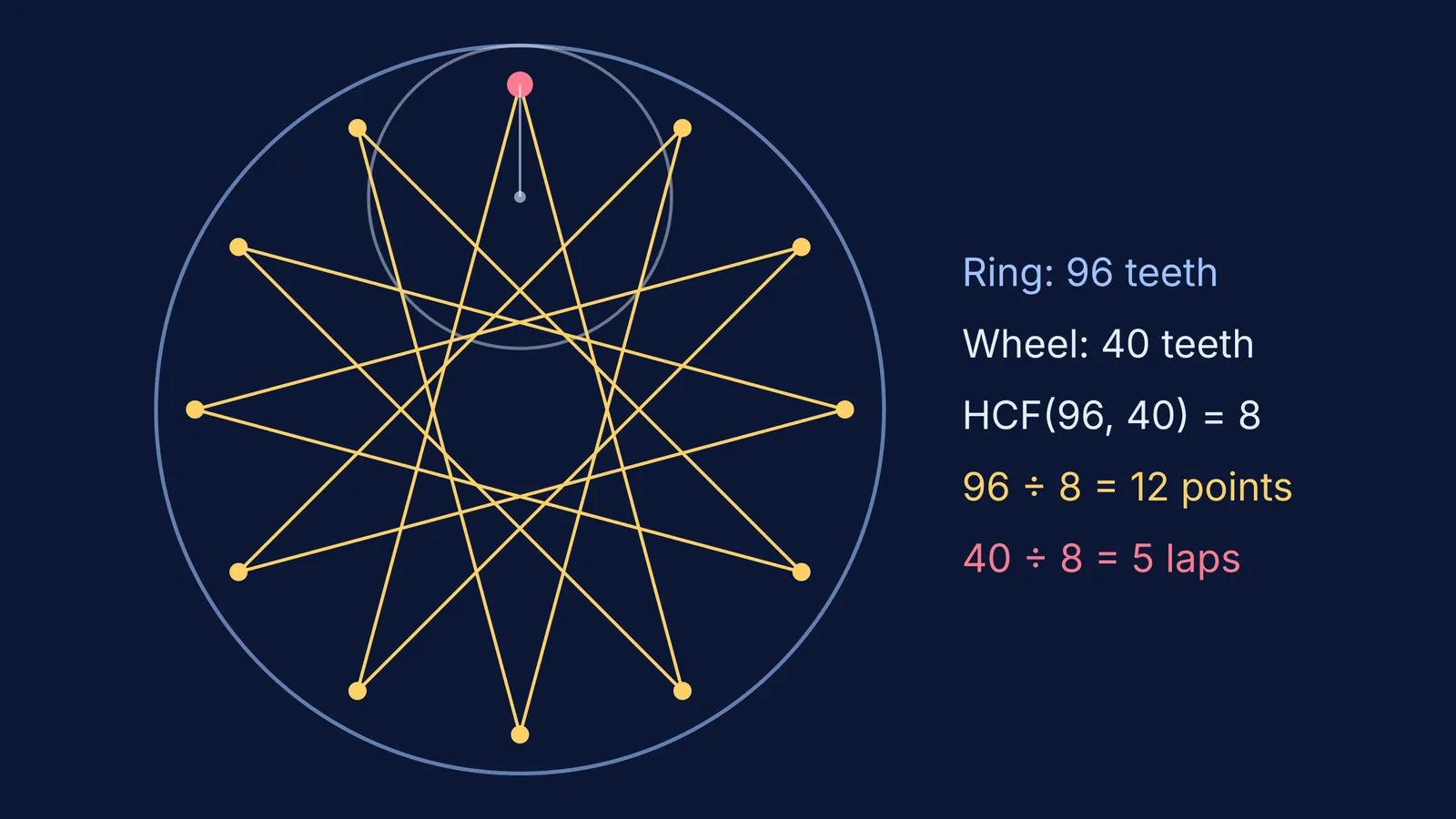
40-tooth wheel: HCF 8, so 12 points in 5 laps
42-tooth wheel: HCF 6, so 16 points in 7 laps
52-tooth wheel: HCF 4, so 24 points in 13 laps
35-tooth wheel: HCF 1, so 96 points in 35 laps
Check one with the LCM form: LCM(96, 40) = 480, and 480 ÷ 40 = 12 points while 480 ÷ 96 = 5 laps. The answers match.
Why predict before you draw?
Predicting first is not just a fun extra. In a study in the American Journal of Physics, Catherine Crouch, Eric Mazur and colleagues found that students who predicted the outcome of a demonstration before seeing it showed significantly greater understanding. Students who only watched understood the ideas no better than students who did not see the demonstration at all.
Here is a short predict-then-test plan for one sitting at a desk:
Write down the ring and wheel tooth counts. If they are not printed on the pieces, count them.
Guess the number of points by eye, and write it down.
Now work it out: HCF, then points and laps. Write that down too.
Put a small pencil mark at the starting tooth. Draw slowly, and tally each time the wheel passes the mark.
Count the tips. If your count does not match, check whether a tooth slipped. One skipped tooth changes where the pattern closes.
Change only the pen hole and draw again. Did the count stay the same?
The same habit works beyond spirographs. The Fermi Simulation Lab has interactive simulations for the ideas that are easier to see than to read, so you can predict, run and compare there too.
Where else does this LCM idea come up?
Any time two cycles of different lengths have to line up again, you are working out an LCM. Bells that ring at different intervals, traffic lights and gears all work this way, and so does the remainder trick in finding the smallest number that leaves the same remainder. The spirograph just lets you see the answer drawn on paper.
One warning: a rule that works for the first few cases is not proved yet. Points on a circle: why 1, 2, 4, 8, 16 is followed by 31 shows a pattern that breaks. This is why step 3 above uses the reason, not just the pattern. If the link between LCM, HCF and prime factors still feels shaky, the Fermi Concept Library has a lesson for every concept in mathematics.
Pick two tooth counts tonight, write your prediction in the margin, and let the pen tell you if you were right.