On this page
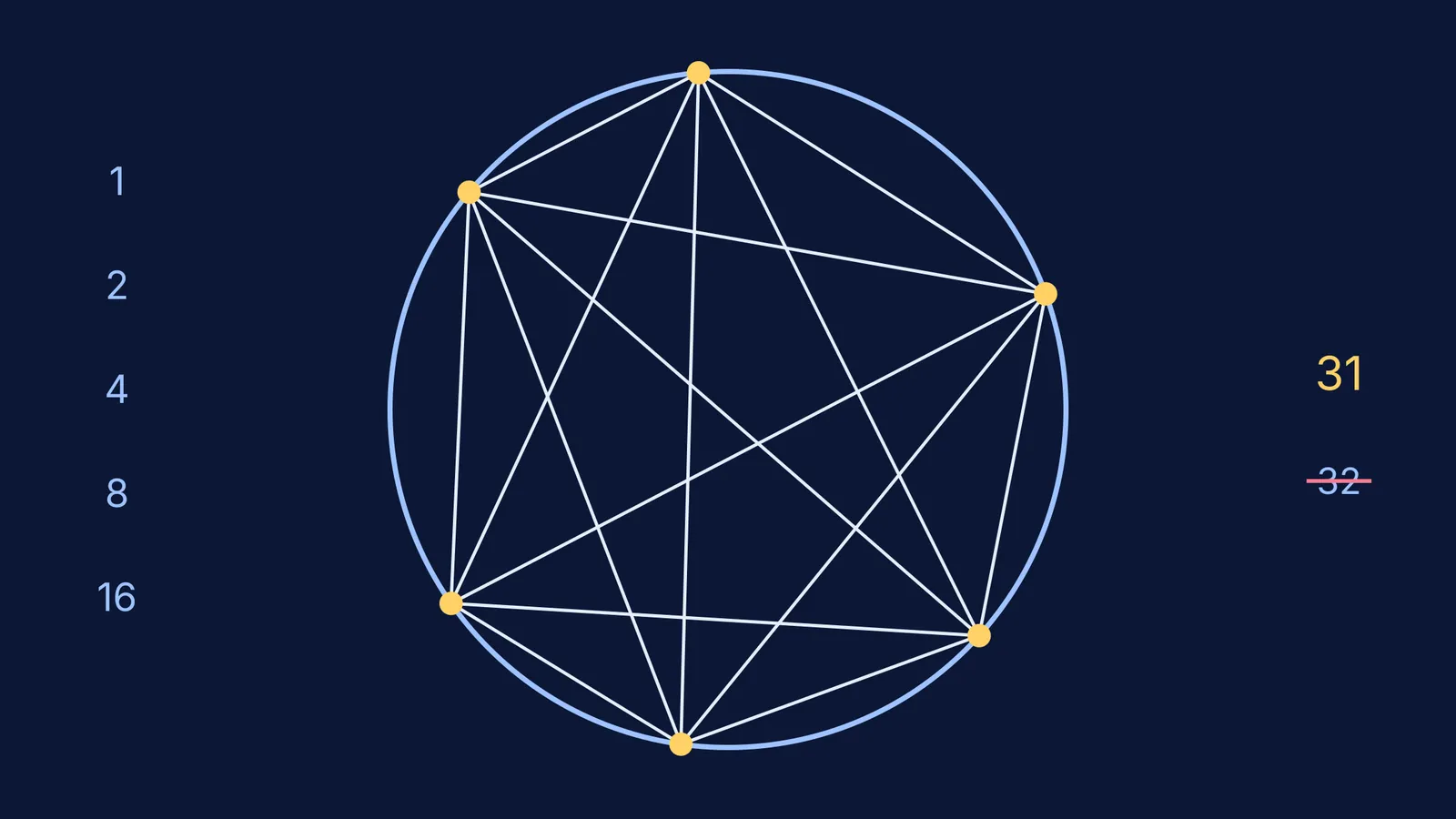
Put points on a circle, join every pair with a straight line, and count the pieces. One to five points give 1, 2, 4, 8 and 16 regions. Doubling says 32 for six. Make your prediction, then count.
How many regions do points on a circle make?
This is Moser's circle problem: choose n points on a circle, join each pair with a chord, and count the regions, as the Wikipedia article on Moser's circle problem describes it. The maximum counts, listed in OEIS sequence A000127, run 1, 2, 4, 8, 16, 31, 57, 99, 163, 256.
You get the maximum only when no three chords pass through the same point, according to the same Wikipedia article.
Try it before reading on:
Draw a large circle and mark 6 points at uneven spacing.
Write your prediction in the margin.
Join every pair. You should have 15 lines.
Count the regions, ticking each one with a pencil so you count none twice.
If your points are evenly spaced, like the corners of a regular hexagon, you get 30 regions instead (Wikipedia). The three longest diagonals all meet at the centre, so one region is lost. Nudge one point and the centre opens into a small triangle, giving 31.
Why is the answer 31 and not 32?
Because doubling was never the rule.
Start with an empty circle: 1 region. Draw chords one at a time. A new chord that crosses k chords already drawn passes through k + 1 regions and splits each into two, so it adds k + 1 regions. Add this up over every chord:
Each chord adds 1 for itself, and there are C(n,2) chords, one for every pair of points.
Each crossing adds 1. Two chords cross inside the circle exactly when their four endpoints alternate around it, and every group of 4 points gives exactly one such crossing, so there are C(n,4) crossings.
So the number of regions is 1 + C(n,2) + C(n,4), the formula given in the Wikipedia article. If counting pairs with C(n,2) is new, see the same idea in why the number of diagonals in a polygon is nC2 minus n.
Worked example for six points: C(6,2) = 15 chords and C(6,4) = 15 crossings, so 1 + 15 + 15 = 31. For five points: 1 + 10 + 5 = 16, which is why the pattern looked perfect.
Why did it look like doubling? OEIS A000127 also writes the count as C(n-1,0) + C(n-1,1) + ... + C(n-1,4): the first five numbers in row n-1 of Pascal's triangle. Up to five points that is the whole row, and a whole row adds up to a power of 2. At six points, row 5 is 1, 5, 10, 10, 5, 1, and the formula stops before the last 1. For more on these row properties, read nCr identities and Pascal's rule.
Is spotting a pattern the same as proof?
No. A pattern is a guess about what comes next; a proof is a reason it must. OEIS A000127 cites a 1949 Mathematics Magazine piece by Leo Moser and W. Bruce Ross, listed as "Mathematical Miscellany, On the Danger of Induction", and the Wikipedia article notes that Moser pointed out in 1949 that this sequence shows the risk of generalising from only a few observations.
Five matching terms felt like strong evidence. But a short list of numbers can be continued in many ways, so the list alone cannot decide. A reason can. Why would one more point double the regions? Nothing in the picture forces that.
Parents can try this at the dinner table: ask for a written prediction for six points, then let your child count rather than giving the answer. The surprise is the lesson.
How do you check a pattern before you trust it?
Use this five-step check on any "find the next term" question:
Predict in writing, so you cannot quietly change your guess later.
Say the reason aloud: "It doubles because..." If you cannot finish the sentence, you have a guess, not a rule.
Test one more case you did not use. Here that is six points, and it breaks the guess.
Look for hidden conditions. The 31 needs no three chords through one point; evenly spaced points give 30.
Prove it, by counting as above or by induction, before you rely on it.
The same check works with AI. A tool shown only 1, 2, 4, 8, 16 cannot know you mean circle regions, so give it the full problem, ask for the reason, and test its answer on one case you count yourself. Our guide on how to check an AI's proof of a trigonometric identity applies the same test to proofs.
Fermi's AI tutor teaches rather than just answering: it decides whether to explain, ask or show, and checks understanding as it goes. For ideas that are easier to see than to read, the Fermi Simulation Lab has interactive simulations.
Next time five terms line up, count the sixth before you believe them.