

On this page
Three species, one central atom, three different angles. This trio tests one idea cleanly: what a non-bonding electron on the central atom does to the bonds around it. Here is the trend, where the numbers come from, and a method for any "arrange in order of bond angle" question.
What are the bond angles of NO2+, NO2 and NO2-?
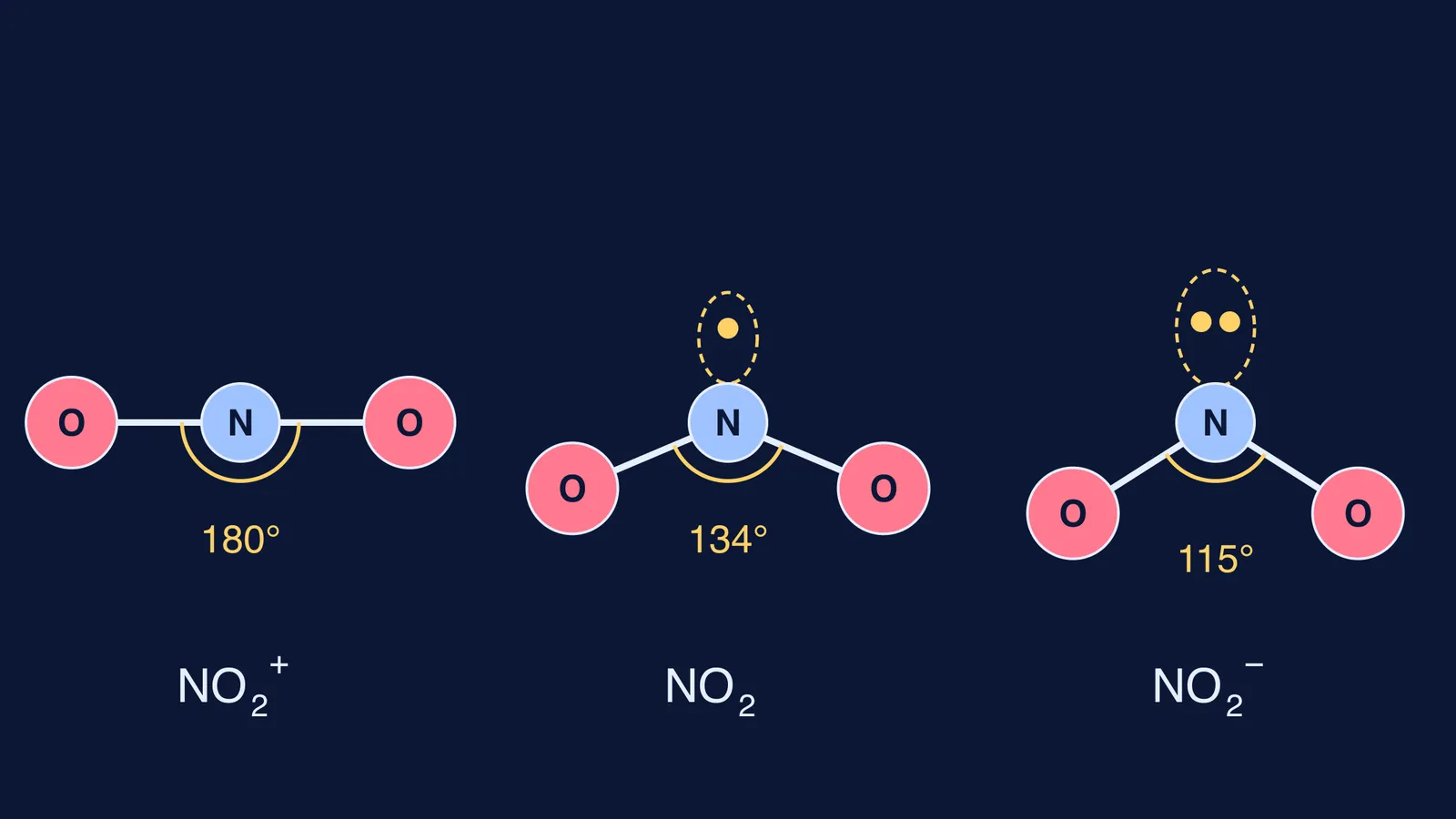
NO2+ (nitronium ion): 180°. It is linear and isoelectronic with CO2, as the LibreTexts inorganic chemistry chapter on nitric acid and its derivatives/15%3A_The_Group_15_Elements/15.09%3A_Oxoacids_of_Nitrogen/15.9C%3A_Nitric_Acid_(HNO_3)_and_its_Derivatives) states.
NO2 (nitrogen dioxide): 134.1°. This is the experimental O–N–O angle listed by the NIST Computational Chemistry Comparison and Benchmark Database, with an uncertainty of 2° and an N–O bond length of 1.193 Å.
NO2- (nitrite ion): about 115°. The ion is symmetrical, with two equal N–O bonds, as described in the Wikipedia entry on nitrite, which cites a 1983 Physical Review A paper on the structure of the nitrite ion.
So the order is NO2- < NO2 < NO2+. The angle shrinks as you add electrons.
Why does adding one electron change the angle?
Start by counting valence electrons. Nitrogen brings 5 and each oxygen brings 6, so neutral NO2 has 17. Remove one for the cation and add one for the anion:
NO2+ has 16 electrons, the same count as CO2. All 16 are used in the two N=O bonds and the lone pairs on oxygen. Nitrogen has nothing left over, so the two bonds point in opposite directions: 180°.
NO2 has 17. The 17th electron sits alone in a non-bonding orbital on nitrogen. Now there are three regions around nitrogen (two bonds and one lone electron), so the shape is bent, roughly trigonal.
NO2- has 18. The 18th electron pairs with the 17th, and nitrogen now carries a full lone pair.
The key point is how strongly that non-bonding region pushes. A University of Sheffield VSEPR page on radicals describes NO2 as having two and a half electron pairs, and explains that the O–N–O angle "opens out a little (to 134.1°) from the ideal trigonal angle of 120°". A single electron repels the bonds less than a bonding pair does, so the two N–O bonds spread past 120°.
The same page says that adding one electron to NO2 "completes the half-occupied lone-pair orbital", which makes it fill out and close the angle to 115°. A full lone pair repels more than a bonding pair, so the bonds are squeezed below 120°.
If the general rule (lone pair beats bond pair beats single electron) feels shaky, our post on how lone-pair repulsion sets the order of bond angles works through it with more examples, and the guide to VSEPR molecular shapes covers the full set of shapes.
How do you solve a bond-angle ordering question in 30 seconds?
Use this check on species with the same central and outer atoms:
Count valence electrons for each species, adjusting for charge (+1 removes one, -1 adds one).
Find what is left on the central atom after the bonds and the outer atoms' lone pairs are filled. For NO2+, NO2 and NO2-, that is 0, 1 and 2 electrons.
Name the shape. Nothing left over with two bonds gives linear. Anything left over gives bent.
Rank by repulsion. More non-bonding electron density on the central atom gives a smaller angle.
Worked example: arrange NO2-, NO2+ and NO2 in increasing order of O–N–O angle. Counts are 18, 16 and 17. Leftover electrons on nitrogen are 2, 0 and 1. So NO2- (115°) < NO2 (134°) < NO2+ (180°), the same angles the Sheffield VSEPR page on radicals gives for the two bent species.
Why does NO2 behave so differently from its ions?
That lone 17th electron also makes NO2 a radical, and two NO2 molecules can pair their odd electrons to form N2O4. Our explainer on why NO2 dimerises to N2O4 picks up that thread.
If counting non-bonding electrons is where you lose marks, the Fermi Concept Library has a lesson for each idea in chemical bonding, with its place in the map, so you can see what VSEPR builds on. For practice, the Fermi Problem Library has worked problems with a step-by-step solver that explains the reasoning rather than printing an answer.
Next time you meet an ordering question, write the three electron counts in the margin first. The angles follow from there.


