

On this page
Nitrogen dioxide (NO2) is one of the few stable odd-electron molecules encountered in school chemistry. Unlike compounds where every valence electron finds a spin-paired partner, monomeric nitrogen dioxide possesses an unpaired radical electron. This single electron dictates its chemical reactivity, paramagnetism, and intense reddish-brown colour. When cooled or compressed, NO2 molecules pair up into dinitrogen tetroxide (N2O4), an entirely colourless and diamagnetic dimer. Understanding why this dimerisation occurs connects electron configurations to dynamic equilibrium and Le Chatelier's principle.
Why does NO2 have an unpaired odd electron?
Counting valence electrons explains why the monomer cannot satisfy the classical octet rule for every atom. A nitrogen atom contributes 5 valence electrons, while each oxygen atom provides 6, giving 17 valence electrons in total as detailed in the OpenStax Chemistry 2e guide to Lewis symbols and structures. Because 17 is an odd number, at least one electron must remain unpaired regardless of how bonds and lone pairs are arranged.
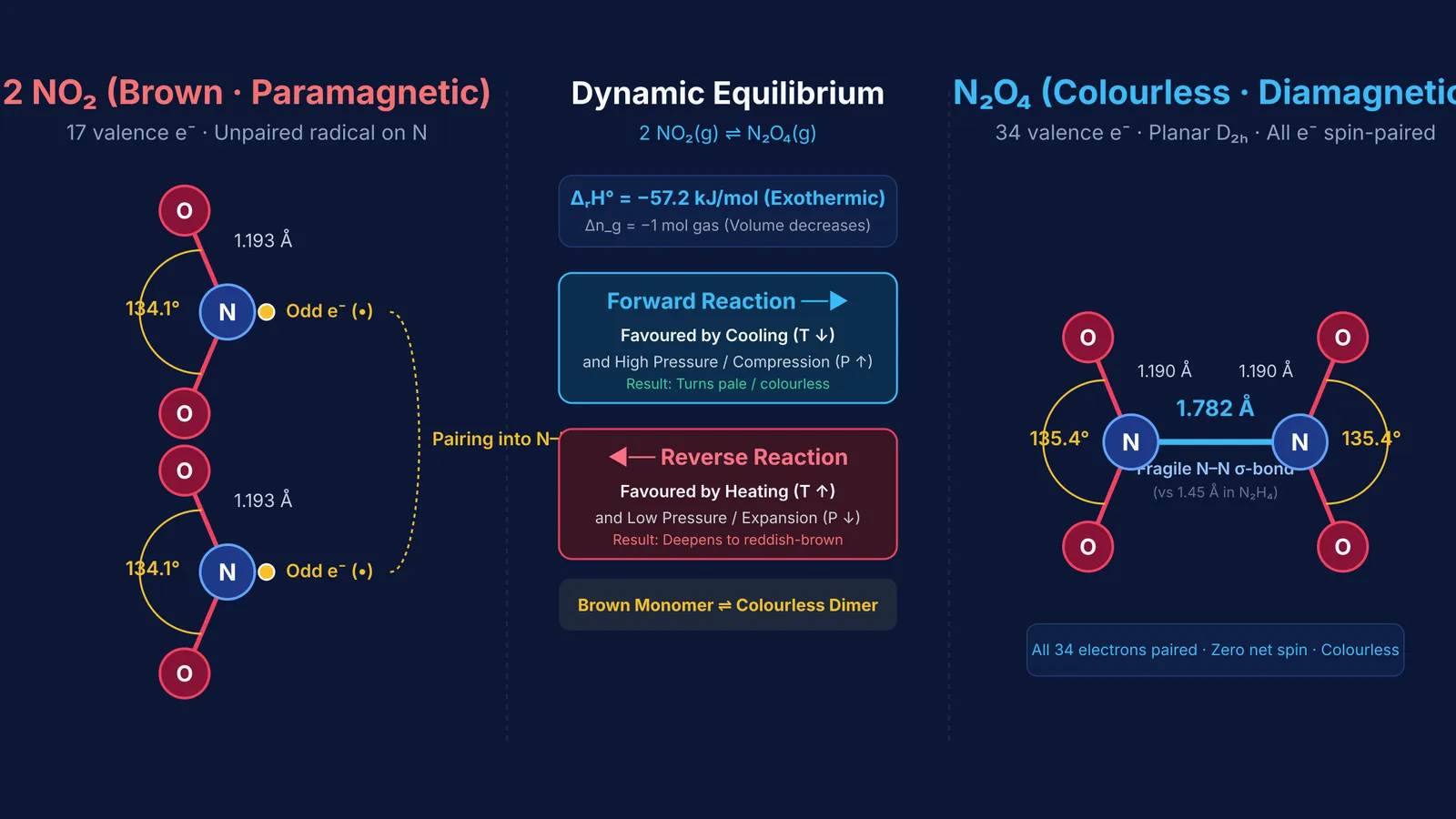
Measurements in the NIST Computational Chemistry Comparison and Benchmark Database show gaseous NO2 has a bent geometry with an N–O bond length of 1.193 Å and an O–N–O angle of 134.1°. Nitrogen is sp² hybridised: two hybrid orbitals form sigma bonds with oxygen, while the third holds the odd electron. Because a single electron exerts less repulsion than a full lone pair, the bond angle opens to 134.1°, wider than the 115.4° in the nitrite ion (NO2⁻). To compare other oxides, review our guide to oxides of nitrogen structures and oxidation states.
Why does NO2 dimerise to N2O4?
Molecules with unpaired electrons behave as free radicals: they readily undergo pairing reactions that eliminate open shells. When two NO2 molecules collide with proper orientation, their singly occupied sp² orbitals overlap head-on to form a covalent N–N sigma bond:
2 NO2(g) ⇌ N2O4(g)
In dinitrogen tetroxide, all 34 valence electrons are paired, making N2O4 diamagnetic and colourless.
However, the central N–N bond is fragile. In The Journal of Chemical Physics, McClelland, Gundersen, and Hedberg showed planar N2O4 has an N–N bond length of 1.782 Å, compared to 1.45 Å in hydrazine (N2H4). Repulsion between the four oxygen lone pairs weakens this bond. According to the NIST Chemistry WebBook, standard enthalpy of formation is 33.1 kJ/mol for gaseous NO2 and 9.08 kJ/mol for dinitrogen tetroxide. Dimerisation releases standard enthalpy ΔrH° of −57.1 kJ/mol (conventionally tabulated as −57.2 kJ/mol), making the reaction exothermic.
How does temperature and pressure shift the equilibrium?
Because the N–N bond is weak, forward dimerisation and reverse dissociation occur rapidly at room temperature, establishing a dynamic equilibrium described in OpenStax Chemistry 2e Section 13.3:
Temperature: Lowering temperature favours the exothermic forward reaction (releasing 57.2 kJ/mol), converting brown NO2 into colourless N2O4. In a sealed tube at 273 K, the mixture turns pale. Boiling water drives endothermic dissociation back to brown NO2.
Pressure: The reaction converts two moles of gas into one mole of gas (Δng = −1). Compressing the container increases total pressure, shifting the equilibrium toward the right where fewer gas moles exist.
To evaluate whether a disturbed system will move forward or backward, see our explanation of reaction quotient Q versus K.
Worked example: calculating degree of dissociation
Consider pure N2O4 gas admitted into an evacuated vessel at 298 K and allowed to reach equilibrium at a total pressure of 1.0 bar. If the dissociation equilibrium constant Kp for N2O4(g) ⇌ 2 NO2(g) is 0.14 bar at 298 K (derived from standard free energies in OpenStax Chemistry 2e Section 13.2), determine the degree of dissociation α and partial pressures:
Tabulate equilibrium moles: Starting with 1.0 mole of N2O4, dissociation of α moles leaves (1 − α) moles of N2O4 and yields 2α moles of NO2, totaling 1 + α moles.
Formulate partial pressures: p(N2O4) = [(1 − α)/(1 + α)] × P, and p(NO2) = [2α/(1 + α)] × P.
Express Kp: Kp = [p(NO2)]² / p(N2O4) = [4α² / (1 − α²)] × P.
Solve for α: With P = 1.0 bar, 4α² = 0.14(1 − α²), giving 4.14α² = 0.14 and α = √(0.14 / 4.14) ≈ 0.184.
At 298 K and 1.0 bar, N2O4 is 18.4% dissociated, yielding p(NO2) = 0.31 bar and p(N2O4) = 0.69 bar. The Fermi Problem Library provides worked problems with a step-by-step solver that explains the reasoning rather than printing an answer, helping students avoid algebraic slips. For more practice, consult our tutorial on chemical equilibrium problems and Le Chatelier errors.
A four-step framework for Le Chatelier exam questions
Use this sequence to answer structured exam questions systematically:
Identify the thermochemical sign: State whether the forward step is exothermic (ΔH < 0) or endothermic (ΔH > 0). Dimerisation releases heat (ΔH = −57.2 kJ/mol).
Calculate the change in gas moles: Compute Δng = ng(products) − ng(reactants). Here, Δng = 1 − 2 = −1.
Deduce the directional shift: Apply Le Chatelier's principle. Cooling removes heat, driving the reaction forward. Increasing pressure favours fewer gas moles, also driving the reaction forward.
Link the shift to observables: Connect concentrations to visual outcomes. More NO2 deepens the reddish-brown colour, while more N2O4 lightens the mixture.
For learners building intuition across reaction thermodynamics, the Fermi Concept Library covers every concept in physics, chemistry, biology, mathematics and computing, each with its own lesson and its place in the map.


