

On this page
You have probably used the shortcut LCM = (a × b) ÷ HCF in Class 10. The NCERT Class 10 Real Numbers chapter states it for "any two positive integers a and b". The trouble starts when a question gives three numbers and you reach for the same rule.
Does HCF × LCM equal the product for three numbers?
No, not in general. In Example 4 of the NCERT Real Numbers chapter, HCF(6, 72, 120) = 6 and LCM(6, 72, 120) = 360. The book then adds a remark: the product of three numbers is not equal to the product of their HCF and LCM.
Do the arithmetic yourself:
6 × 72 × 120 = 51,840
HCF × LCM = 6 × 360 = 2,160
51,840 ÷ 2,160 = 24
The product is 24 times bigger, and that 24 is not random. Once you see where it comes from, you will see why the rule stops at two numbers.
Why does HCF × LCM = a × b work for two numbers?
Write both numbers as products of prime powers, as the Fundamental Theorem of Arithmetic lets you do. NCERT gives the rule: the HCF is the product of the smallest power of each common prime factor, and the LCM is the product of the greatest power of each prime factor.
Pick one prime, p, with power x in a and power y in b. The HCF takes the smaller power and the LCM takes the larger. With only two powers, smaller + larger = x + y, so every power of p lands in the HCF or the LCM exactly once. This is the identity gcd(a, b) × lcm(a, b) = ab, which Wikipedia's least common multiple article derives from min(x, y) + max(x, y) = x + y.
Check it with NCERT's Example 2: 6 = 2 × 3 and 20 = 2² × 5. The HCF is 2, the LCM is 60, and 2 × 60 = 120 = 6 × 20.
Why does it fail for three numbers?
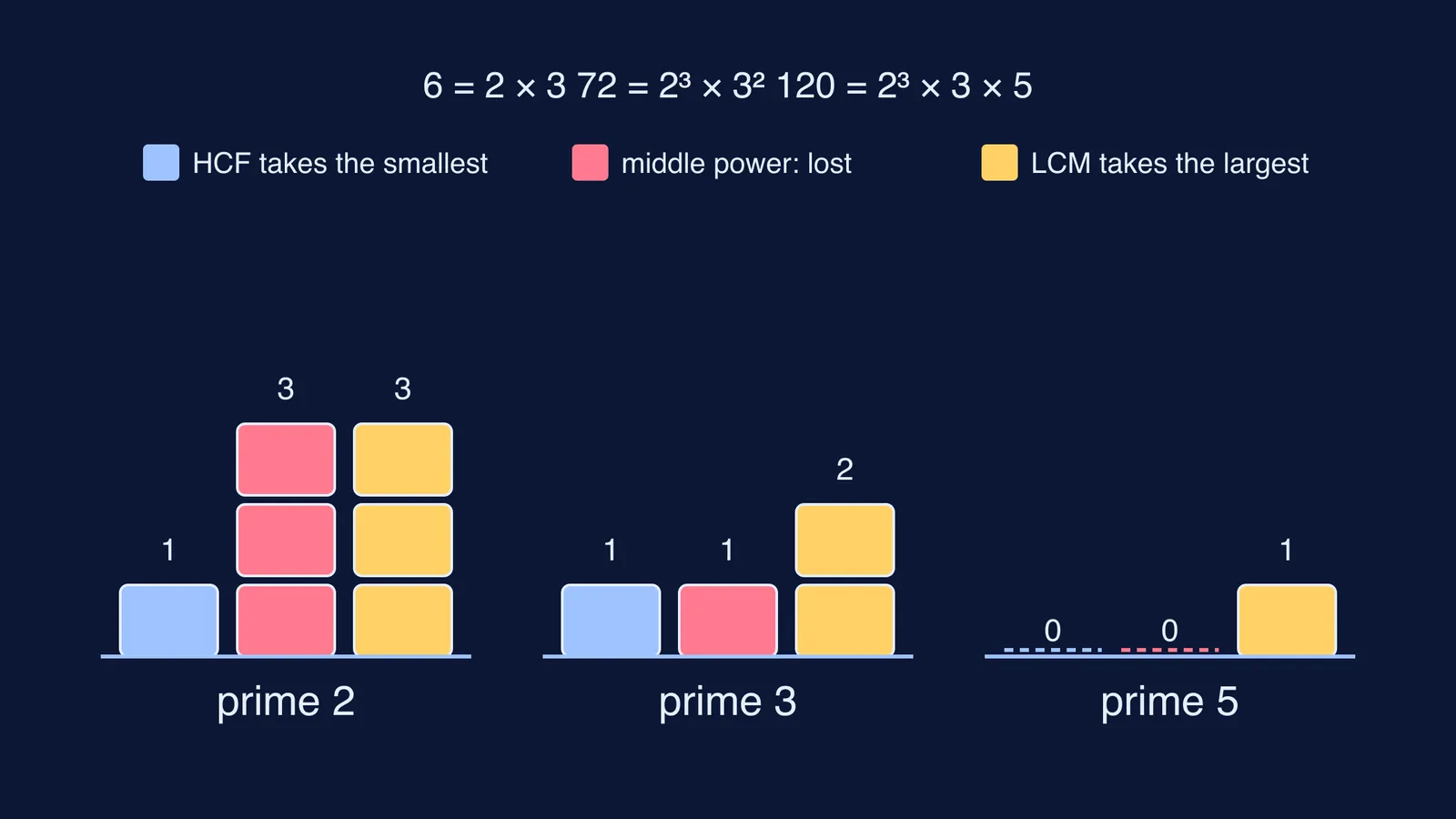
With three numbers, each prime has three powers: a smallest, a middle and a largest. The HCF takes the smallest. The LCM takes the largest. The middle power goes into neither.
Use NCERT's factorisations from Example 4: 6 = 2 × 3, 72 = 2³ × 3², 120 = 2³ × 3 × 5.
Prime 2: powers 1, 3, 3. The HCF takes 1, the LCM takes 3, and the middle 3 is lost, which is 2³ = 8.
Prime 3: powers 1, 2, 1, sorted 1, 1, 2. The middle 1 is lost, which is 3.
Prime 5: powers 0, 0, 1. The middle power is 0, so nothing is lost.
The lost part is 8 × 3 = 24, exactly the gap you found. So the full relation for three numbers is: a × b × c = HCF × LCM × (each prime raised to its middle power). To get the factorisations quickly, compare the factor tree and division methods.
When does HCF × LCM equal the product for three numbers?
It works only when every middle power is 0. That means each prime divides at most one of the three numbers, so the numbers are pairwise coprime. Then the HCF is 1 and the LCM is the full product. The NCERT exercise includes 8, 9 and 25 (2³, 3² and 5²): the HCF is 1 and the LCM is 1,800, which is also 8 × 9 × 25.
An HCF of 1 is not enough on its own. Take 2, 3 and 4: the HCF is 1, but the LCM is 12 and the product is 24. Prime 2 has powers 1, 0, 2, and the middle 1 is lost.
What should you do with three numbers instead?
Count the numbers. With two, LCM = (a × b) ÷ HCF is safe.
With three or more, do not divide. Factorise each number and take the smallest and largest power of each prime, as NCERT does in Example 4.
If a question claims the product equals HCF × LCM for three numbers, test it: if any prime divides two of the numbers, the claim is false.
Sanity-check your answer: the LCM must be a multiple of every number, and every number must be a multiple of the HCF.
If word problems are the real problem, here is how to tell whether a question needs the HCF or the LCM.
If you keep reaching for the two-number shortcut, the Fermi Problem Library has worked problems with a step-by-step solver that explains the reasoning rather than printing an answer. To go back over prime factorisation itself, the Fermi Concept Library gives every mathematics concept its own lesson and its place in the map.


