

On this page
Every year, students learn the ladder method or prime factorisation to calculate the Highest Common Factor (HCF) and Lowest Common Multiple (LCM). They master the mechanics of pulling numbers apart, but when they turn the page to word problems, they stall.
When a student reads about bells tolling, traffic lights changing, or ribbons being cut, the challenge is no longer arithmetic; it is translation. A 2016 study of primary students by Mohyuddin and Khalil discovered that nearly one-third of students selected the HCF method when a problem actually required the LCM, revealing a fundamental mix-up in their conceptual understanding.
The root of this confusion often lies not in the math itself, but in how we teach them to read the question.
Why is keyword hunting a problem?
To make word problems easier, many students are taught to scan for trigger words. They are told that "greatest", "maximum" or "largest" automatically means HCF, while "least", "minimum" or "smallest" means LCM.
This shortcut works for basic questions, but it falls apart quickly in exams. Consider this problem: *What is the greatest number of days that must pass before both buses leave the depot at the exact same time?*
A student relying solely on keywords sees "greatest" and immediately calculates the HCF. However, because this problem is about two separate schedules moving forward until they coincide, it is an LCM problem. The keyword contradicts the underlying mathematics.
If your child struggles to see the geometry behind these rules, the Fermi Concept Library holds every concept in physics, chemistry, biology, mathematics and computing, each with its own lesson and its place in the map. This helps students visualise what factors and multiples actually look like, rather than memorising tricks.
How to spot an HCF problem?
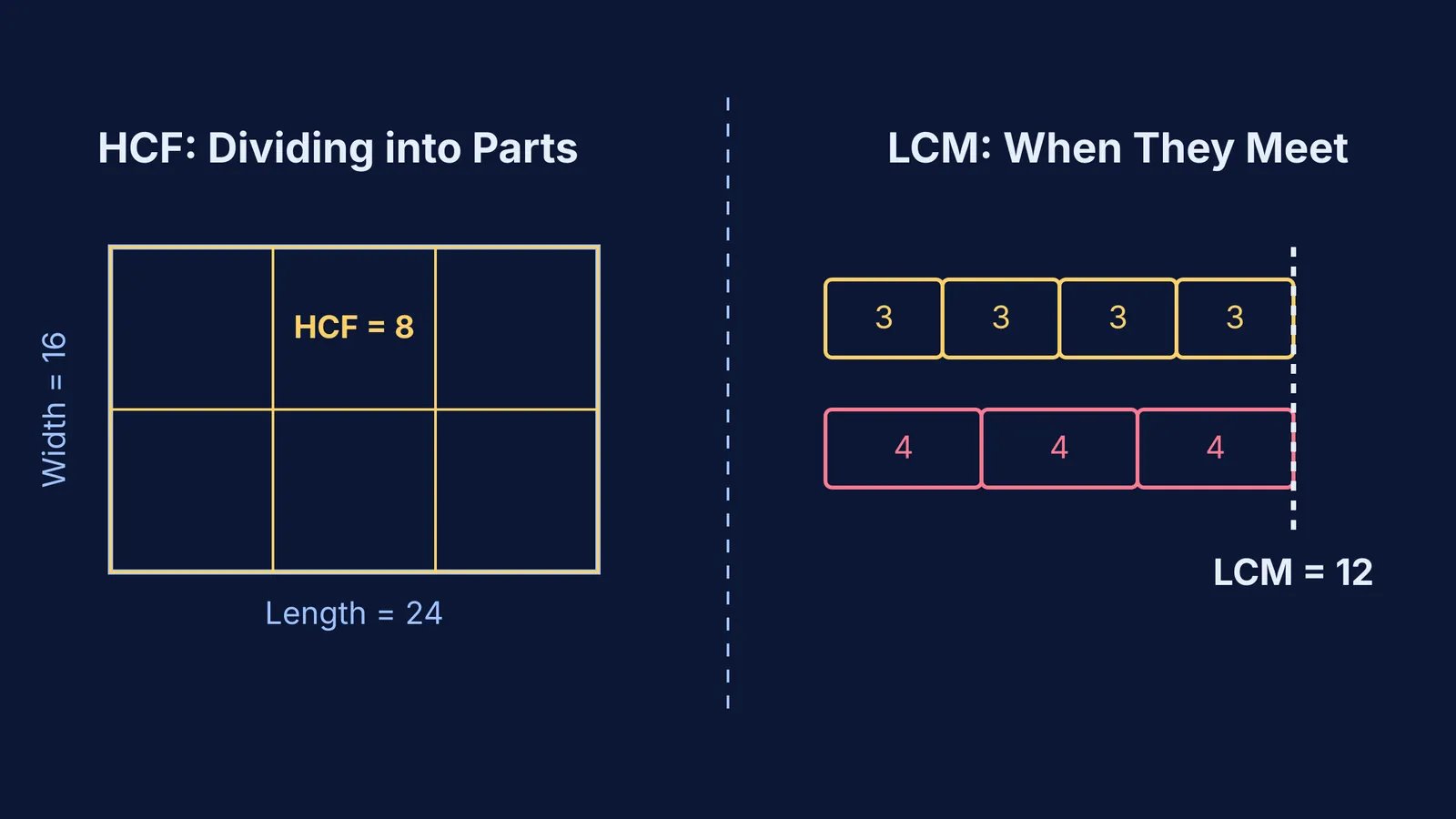
The HCF is the largest number that divides exactly into two or more numbers. In the real world, you use it when you have a set total of something and you need to break it down.
You are dealing with an HCF problem if the story involves:
Splitting or cutting: You have large pieces of timber, ribbon or cloth of different lengths, and you need to cut them into smaller, equal pieces without any waste.
Grouping or distributing: You are packing equal numbers of pencils and erasers into identical gift bags, or arranging different classes of students into equal rows in an assembly.
The answer is smaller: The result you are looking for will be smaller than or equal to the smallest number given in the problem.
How to spot an LCM problem?
The LCM is the smallest number that is a multiple of two or more numbers. You use it when you are looking forward in time or building things up until they match.
You are dealing with an LCM problem if the story involves:
Repeating events: Traffic lights changing, bells ringing, or planets orbiting at different, regular intervals.
Meeting points: Two people running around a track at different speeds, and you need to know when they will cross paths again at the starting line.
The answer is larger: The result you are looking for will be larger than or equal to the largest number given in the problem.
If you need a step-by-step breakdown of how these calculations work when the numbers get tricky, the Fermi Problem Library has worked problems with a step-by-step solver that explains the reasoning rather than printing an answer.
How can you decode exam questions?
When you sit down with your teenager to review their homework, encourage them to stop looking for "greatest" or "least". Instead, you can help them navigate the text by asking three diagnostic questions:
Are we breaking things down or building things up? If the problem involves cutting or dividing, it is an HCF problem. If it involves repeating cycles, it is an LCM problem.
Will our answer be smaller than our starting numbers, or larger? If you cannot have an answer larger than what you started with (like the length of a single tile fitting into a room), you need the HCF. If the answer must be larger (like the time until two buses meet), you need the LCM.
Are we looking for a common size, or a common time in the future? Finding a uniform size or grouping requires the HCF. Finding a future meeting point or distance requires the LCM.
By shifting the focus from individual words to the action happening in the story, you give them a reliable tool to decode any problem, no matter how the examiner phrases it. If you want more strategies on helping them talk through their reasoning, read our guide on helping your child with maths word problems. For students preparing for board exams, you can also review how these topics tie into Class 10 real numbers.


