

On this page
Prime factorisation is the process of breaking down a composite number into the prime numbers that multiply together to make it. Think of primes as the indivisible building blocks of mathematics.
What is prime factorisation?
The official rule behind this process is called the Fundamental Theorem of Arithmetic. The NCERT Class 10 Maths textbook defines it clearly: every composite number can be expressed as a product of primes, and this factorisation is unique, apart from the order in which the prime factors occur [[1]](https://schools.aglasem.com/ncert-books-class-10-maths-chapter-1/). This means that no matter what method you use to break down a number like 60, you will always end up with the exact same set of prime factors.
How do you use a factor tree?
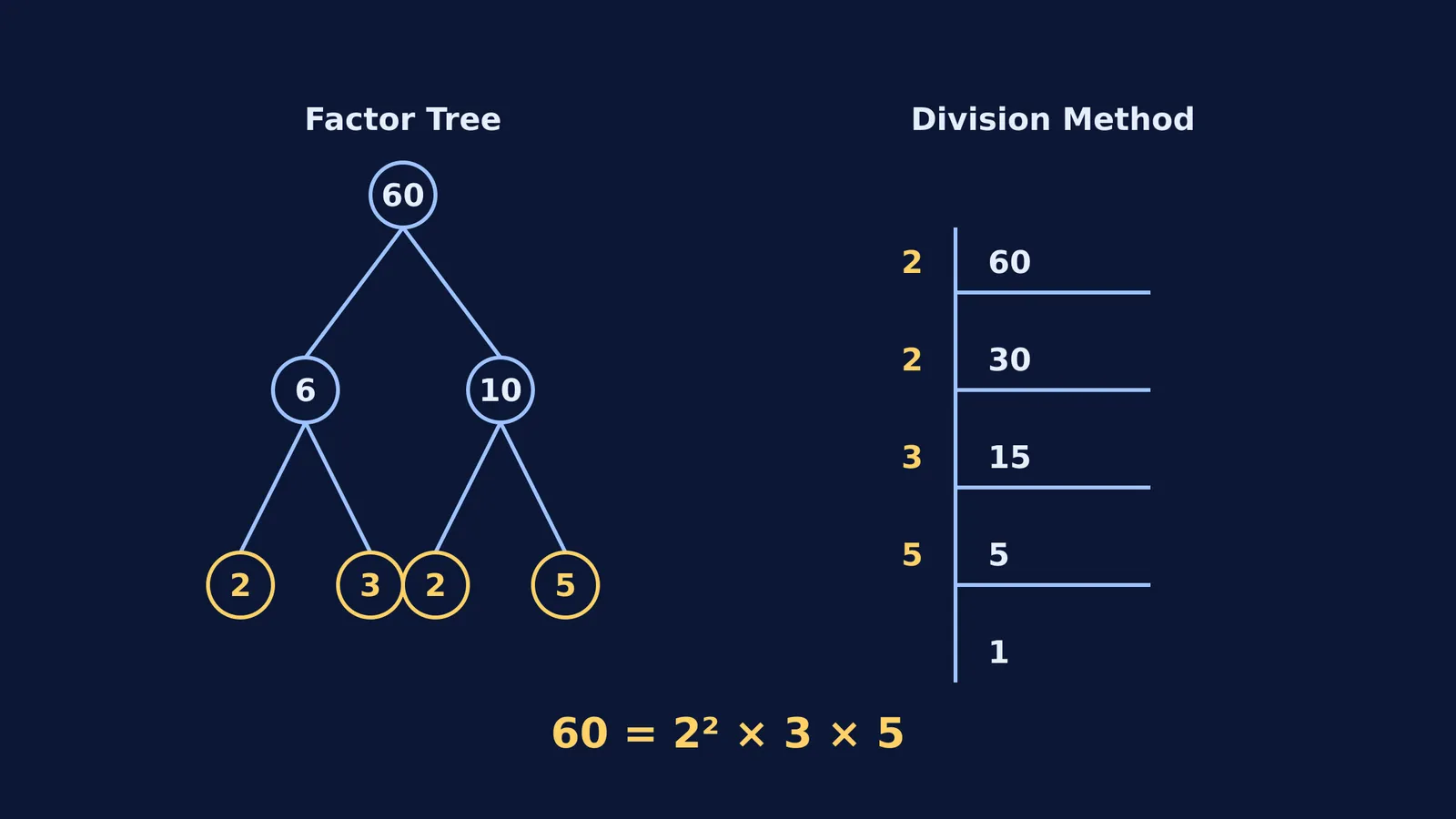
The factor tree method is a highly visual way to break down a number. You start with your target number at the top and split it into any two factors.
Write down the number (for example, 60).
Find any two numbers that multiply to make 60, such as 6 and 10, and draw branches down to them.
Check if these new numbers are prime. Since 6 and 10 are composite, break them down again.
Split 6 into 2 and 3. Both are prime, so you stop those branches.
Split 10 into 2 and 5. Both are prime, so those branches also stop.
Collect all the primes at the ends of the branches: 2, 3, 2, and 5.
This method is flexible because you can start with any pair of factors (like 2 and 30, or 4 and 15) and the tree will still grow the same prime "leaves" at the bottom.
What is the division method for prime factorisation?
Also known as the ladder method, the division method is a more systematic approach. Instead of finding random factors, you repeatedly divide the number by the smallest possible prime.
Write the number 60 inside an L-shaped division bracket.
Divide by the smallest prime number that goes in evenly, which is 2. Write the quotient (30) below.
Divide 30 by 2 again. Write the new quotient (15) below.
Since 15 is not divisible by 2, move to the next smallest prime, which is 3. Divide 15 by 3 to get 5.
Divide 5 by 5 to get 1.
When the quotient reaches 1, stop. Your prime factors are the numbers you divided by: 2, 2, 3, and 5.
Factor tree vs division method: which is quicker?
Choosing between the two depends largely on the size of the number you are working with.
The factor tree is often quicker for small numbers or mental maths because you can jump straight to large, familiar factor pairs (like knowing 100 = 10 × 10). It appeals to visual learners who prefer drawing out the relationships. However, a factor tree can quickly become disorganised and sprawling when dealing with numbers in the hundreds or thousands, increasing the risk of losing track of a branch.
The division method is generally faster and far more reliable for large numbers. Its rigid, step-by-step structure keeps your work compact and neat, making it the preferred method for competitive exams like the JEE or rigorous school tests. Because you always test small primes in order, you are less likely to miss a factor. If you find yourself stuck on finding divisors, Fermi's AI tutor can work out what you already know and build a plan for the session, guiding you through the divisibility rules you need.
How do you write prime factors in exponent form?
Once you have your list of prime factors, it is standard practice to write the final answer in exponent form (also known as index notation). This makes the answer shorter and easier to read.
Take the prime factors of 60, which are 2, 2, 3, and 5. Because the factor 2 is repeated, you group it using an exponent.
The final answer is written as 2² × 3 × 5.
Understanding this notation is essential for higher-level mathematics, such as using the prime factorisation method to calculate the number of divisors a number has. It also builds a strong foundation for algebraic factorisation for Class 8 and beyond. If you want to explore more properties of numbers, you can browse the Concept Library for a complete breakdown of number theory rules, or try applying your skills in the Fermi Problem Library, which features a step-by-step solver that explains the reasoning behind each step.


