On this page
"Find the smallest number which, when divided by 4, 6 and 9, leaves a remainder of 3 in each case." Questions like this turn up in school exercises and aptitude tests. One idea solves every version, and a quick check tells you if you are right.
Why does the answer come from the LCM?
Suppose N leaves remainder 3 when divided by 4, by 6 and by 9. Then N − 3 divides exactly by all three numbers. So N − 3 is a common multiple of 4, 6 and 9. The smallest such N comes from the smallest positive common multiple.
The least common multiple of two numbers is the smallest positive number that is a multiple of both, as defined on Wolfram MathWorld. The same idea extends to three or more numbers.
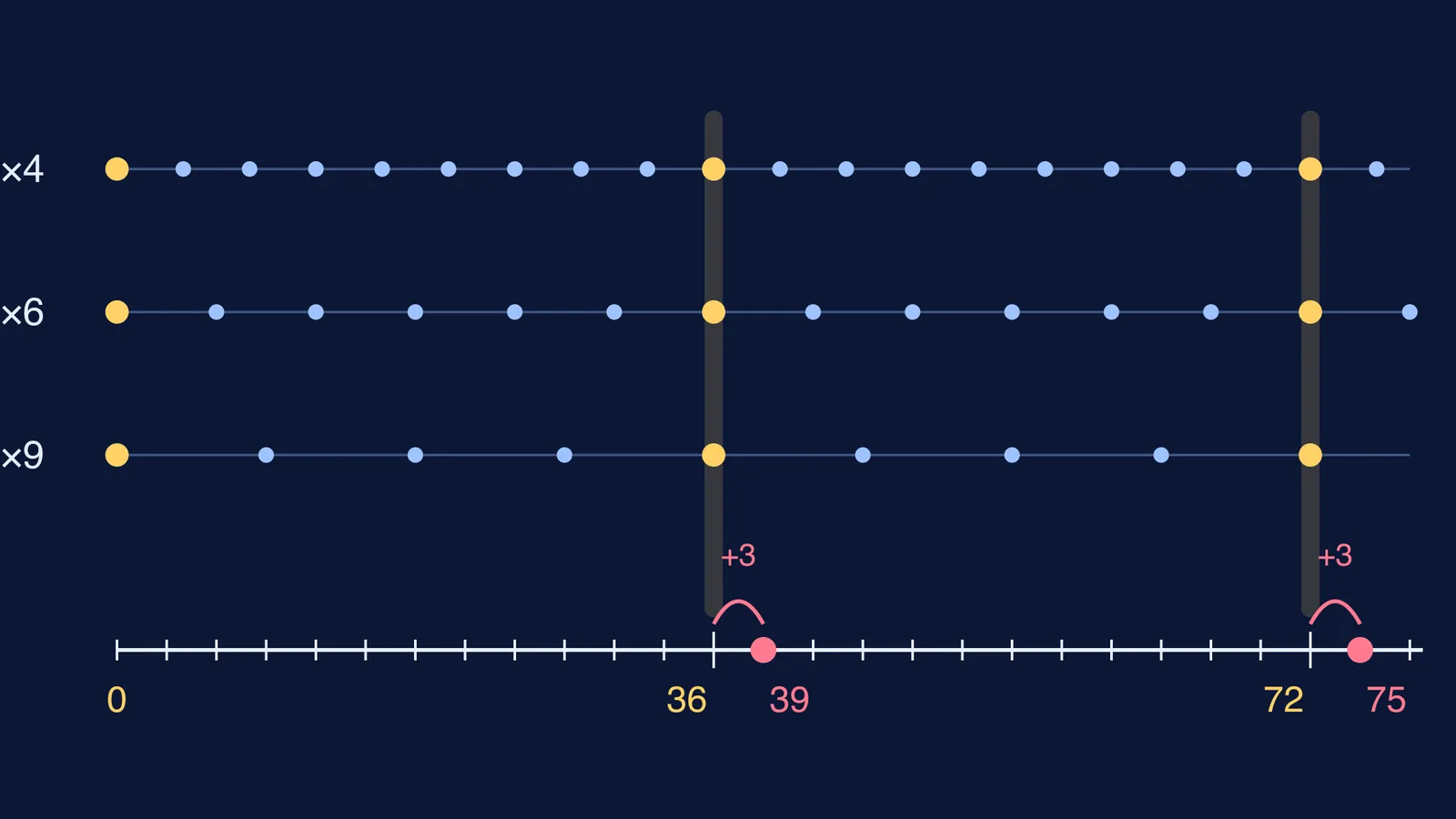
In the diagram above, the gold columns are where multiples of 4, 6 and 9 line up: 36 and 72. Step 3 to the right and you reach 39 and 75.
How do you find the smallest number that leaves remainder 3 when divided by 4, 6 and 9?
Use prime factorisation. NCERT's Class 10 chapter on Real Numbers states the rule: the LCM is the product of the greatest power of each prime factor involved in the numbers.
Factorise: 4 = 2², 6 = 2 × 3, 9 = 3².
Take the highest power of each prime: 2² and 3².
LCM = 2² × 3² = 4 × 9 = 36.
Add the remainder: 36 + 3 = 39.
Check: 39 = 4 × 9 + 3, 39 = 6 × 6 + 3, 39 = 9 × 4 + 3.
Every number of the form 36m + 3 works: 39, 75, 111 and so on. The question asks for the smallest, so the answer is 39.
Multiplying gives the LCM only when no two divisors share a prime factor.
A fussy point: 3 itself leaves remainder 3 (quotient 0), but textbook questions mean a number bigger than the remainder, so 39 is the expected answer.
What if the remainders are different, each k less than the divisor?
Here is the "k less" variant: find the smallest number which, when divided by 4, 6 and 9, leaves remainders 2, 4 and 7.
Look at the gap between each divisor and its remainder: 4 − 2 = 2, 6 − 4 = 2, 9 − 7 = 2. The gap is the same, k = 2. That means N + 2 divides exactly by 4, 6 and 9, so N + 2 is a multiple of 36.
Smallest N = 36 − 2 = 34.
Check: 34 = 4 × 8 + 2, 34 = 6 × 5 + 4, 34 = 9 × 3 + 7.
So the two patterns are:
Same remainder r: N = LCM × m + r for m = 1, 2, 3 and so on, smallest is LCM + r.
Each remainder k less than its divisor: N = LCM × m − k, smallest is LCM − k.
If the gaps are not equal, neither shortcut applies. The general tool is the Chinese remainder theorem, which MathWorld states for divisors that are relatively prime, meaning they share no common factor except 1. That is beyond most school papers.
How do you solve the four-digit and "largest number" versions?
Smallest four-digit number leaving remainder 3 with 4, 6 and 9. List multiples of 36 near 1000. 36 × 27 = 972 gives 975, which is too small. 36 × 28 = 1008 gives 1011. Check: 1011 = 4 × 252 + 3 = 6 × 168 + 3 = 9 × 112 + 3.
Largest number that divides 43, 91 and 183 leaving the same remainder. This is the HCF cousin. If d leaves the same remainder for all three, d divides their differences: 91 − 43 = 48, 183 − 91 = 92, 183 − 43 = 140. HCF(48, 92, 140) = 4. Check: each number leaves remainder 3 when divided by 4.
What should you check on exam day?
Circle the divisors and the remainder or remainders.
Same remainder? Use LCM + r. Equal gaps? Use LCM − k.
Find the LCM by prime factors, never by multiplying the divisors.
Adjust for "four-digit", "greater than" or "largest".
Divide your answer by every divisor and confirm each remainder.
If step 3 is where you slip, the Fermi Concept Library covers every concept in mathematics, each with its own lesson, so you can fix the gap before the next test. For more practice, the Fermi Problem Library has worked problems with a step-by-step solver that explains the reasoning rather than printing an answer.