On this page
Chapter 4 of the new NCERT Class 9 Social Science book, *Understanding Society: India and Beyond* Part I (the 2026-27 edition), runs from the first stone tools to the Bronze Age cities of the Sindhu–Sarasvatī valley, Mesopotamia, Egypt and China, and the full chapter is free on the NCERT textbook site.
The big idea is that most of the human story has no written record. The NCERT chapter says more than 99 per cent of human history comes before writing, so it is rebuilt from tools, bones and fossils, and its dates are approximate. The Harappan script, or Sindhu lipi, is still undeciphered, while Sumerian cuneiform and Egyptian hieroglyphs have been read.
Who were our human ancestors?
All dates here are from the NCERT chapter:
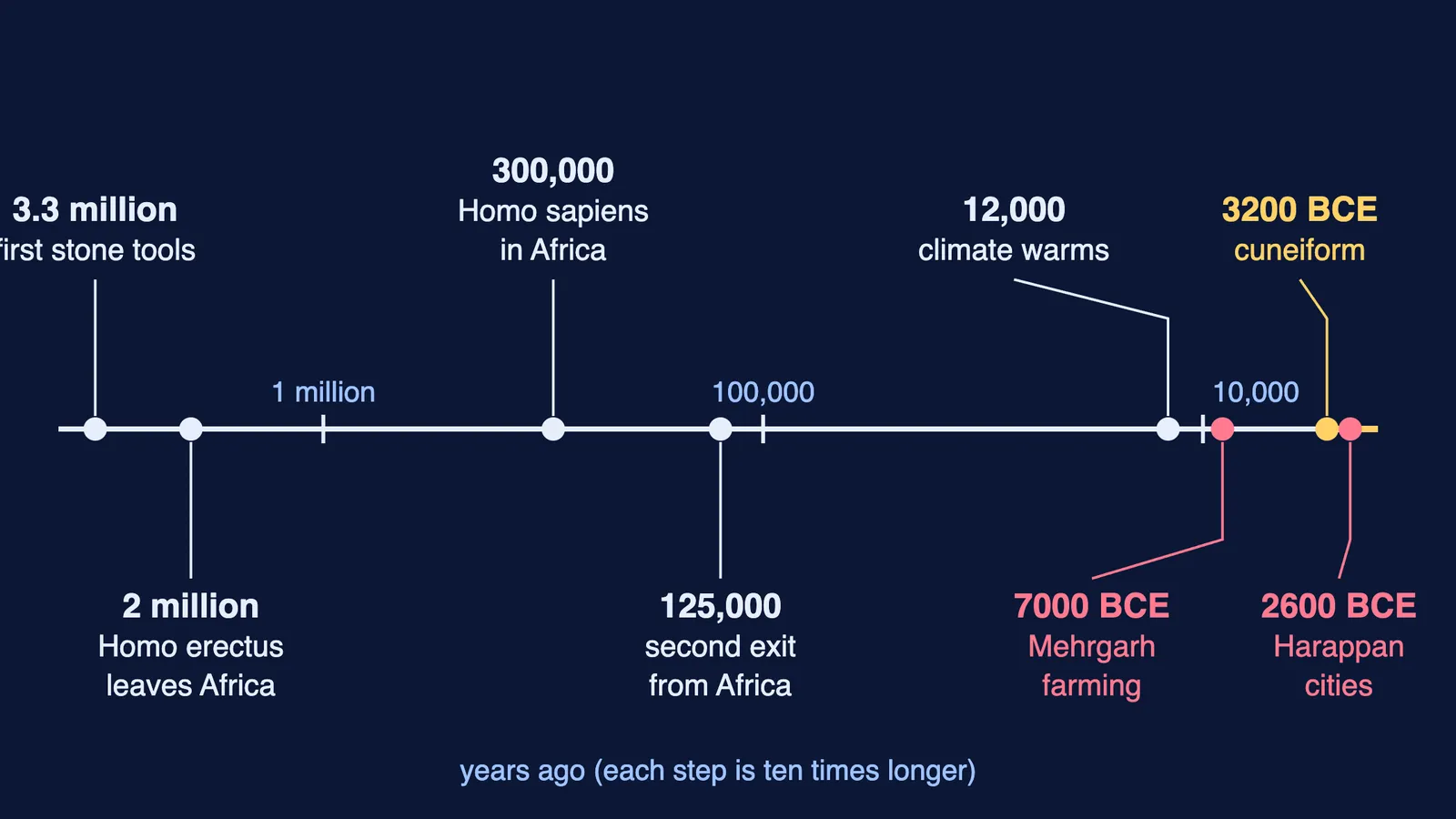
About 3.3 million years ago, one of our ancestors made the earliest known stone tools.
Homo habilis, whose name means handy man, lived in Africa. Fig. 4.6 prints "2-6 million years ago"; the Smithsonian gives about 2.4 to 1.4 million, so ask your teacher which to write.
Homo erectus, maker of handaxes and cleavers, was the first hominin to leave Africa, around 2 million years ago.
Homo sapiens evolved in Africa about 300,000 years ago and left in a second wave around 125,000 years ago.
In India, Attirampakkam in Tamil Nadu is dated to about 1.5 to 1.7 million years ago, and Isampur in Karnataka to 1.2 million years ago.
What are the periods of early human history, in order?
The chapter orders them by technology:
Palaeolithic (Old Stone Age): hunting and gathering with handaxes, cleavers and scrapers; later bows, cave painting and beads.
Mesolithic: tiny stone tools called microliths. Around 12,000 years ago the climate warmed, forests and grasslands spread. Bhimbetka in Madhya Pradesh has hundreds of painted rock shelters.
Neolithic: farming, tamed animals, polished stone tools, pottery and the first villages. The chapter calls this shift the Neolithic revolution.
Chalcolithic: copper used alongside stone.
Bronze Age: copper mixed with tin, trade, towns and early civilisations.
Iron Age: smelted iron for stronger tools.
How did Mehrgarh lead to the Harappan cities?
Mehrgarh, on the Bolan River in present-day Pakistan, is the chapter's oldest Neolithic site and earliest farming village in the subcontinent, dated to about 7000 BCE. Its people grew wheat and barley, kept sheep, goats and zebu cattle, and made copper objects by about 4000 BCE. The chapter's timeline puts the Mature Harappan phase from 2600 BCE to 1900 BCE (NCERT chapter).
The book says some radiocarbon dates from Bhirrana and Kunal suggest a Pre-Harappan phase began between 7000 and 5500 BCE; write it as a suggestion, as the book does.
Harappan weights doubled (1, 2, 4, 8, 16) for small units and used multiples of ten for large ones. An Early Harappan ploughed field at Kalibangan, with furrows in two directions, points to double cropping, which the chapter likens to rabi and kharif. For the cities themselves, revise our Class 6 guide to Harappan cities, drains and seals; for how archaeologists read the finds, see Bricks, beads and bones in Class 12.
How were Mesopotamia, Egypt and China different?
Mesopotamia (Tigris and Euphrates): the first city-based civilisation. Sumerians began writing cuneiform around 3200 BCE and counted in sixties; the chapter credits them with the 60-minute hour and the 360-degree circle. Akkad rose in 2334 BCE, and its tablets mention trade with Meluhha, generally identified with the Harappans. Hammurabi of Babylon, from 1792 BCE, is known for his law code.
Egypt (Nile): city-states around 3000 BCE, a 365-day calendar and pyramids. The Rosetta Stone, found in 1799, let Champollion decipher hieroglyphs in 1822.
China (Huang He and Yangtze): the Shang (1600–1046 BCE) and Zhou (1046–256 BCE) dynasties, oracle bones, and iron in wide use by 600 BCE.
If base sixty or the doubling weights feel slippery, the Fermi Concept Library has every concept in physics, chemistry, biology, mathematics and computing, each with its own lesson.
Which mistakes cost marks in this chapter?
Swapping 3.3 million years (first tools) with 2 million years (leaving Africa).
Giving microliths to the Neolithic. They mark the Mesolithic; polished tools are Neolithic.
Reading BCE dates the wrong way: 2600 BCE is later than 3200 BCE.
Calling the Harappan script deciphered.
Writing that Egypt and China traded closely with the Harappans. The chapter finds little evidence of direct contact; Mesopotamia is the strong link.
How should you prepare for CBSE 2026-27?
The CBSE Class IX Social Science curriculum for 2026-27 gives this theme 9 teaching hours. It expects you to explain how prehistoric time is divided and how people lived before writing. It says the course structure will be provided shortly, so chapter-wise marks are not yet published.
Day 1: draw two timelines from memory, one in years ago (ancestors) and one in BCE (civilisations).
Day 2: for each period, name one tool and one Indian site.
Day 3: for each river civilisation, write its river, its script and one date.
Day 4: explain aloud, in two minutes, how Mehrgarh led to the Harappan cities.
Then check what stuck with our 20-minute Sunday study review.