On this page
Many study plans fail quietly: a long list on Monday, half of it done, an even longer list on Sunday. A short weekly review breaks that loop. Here is a 20-minute template and a filled-in example for a Class 12 student preparing for JEE Main.
How do you review your study week in 20 minutes?
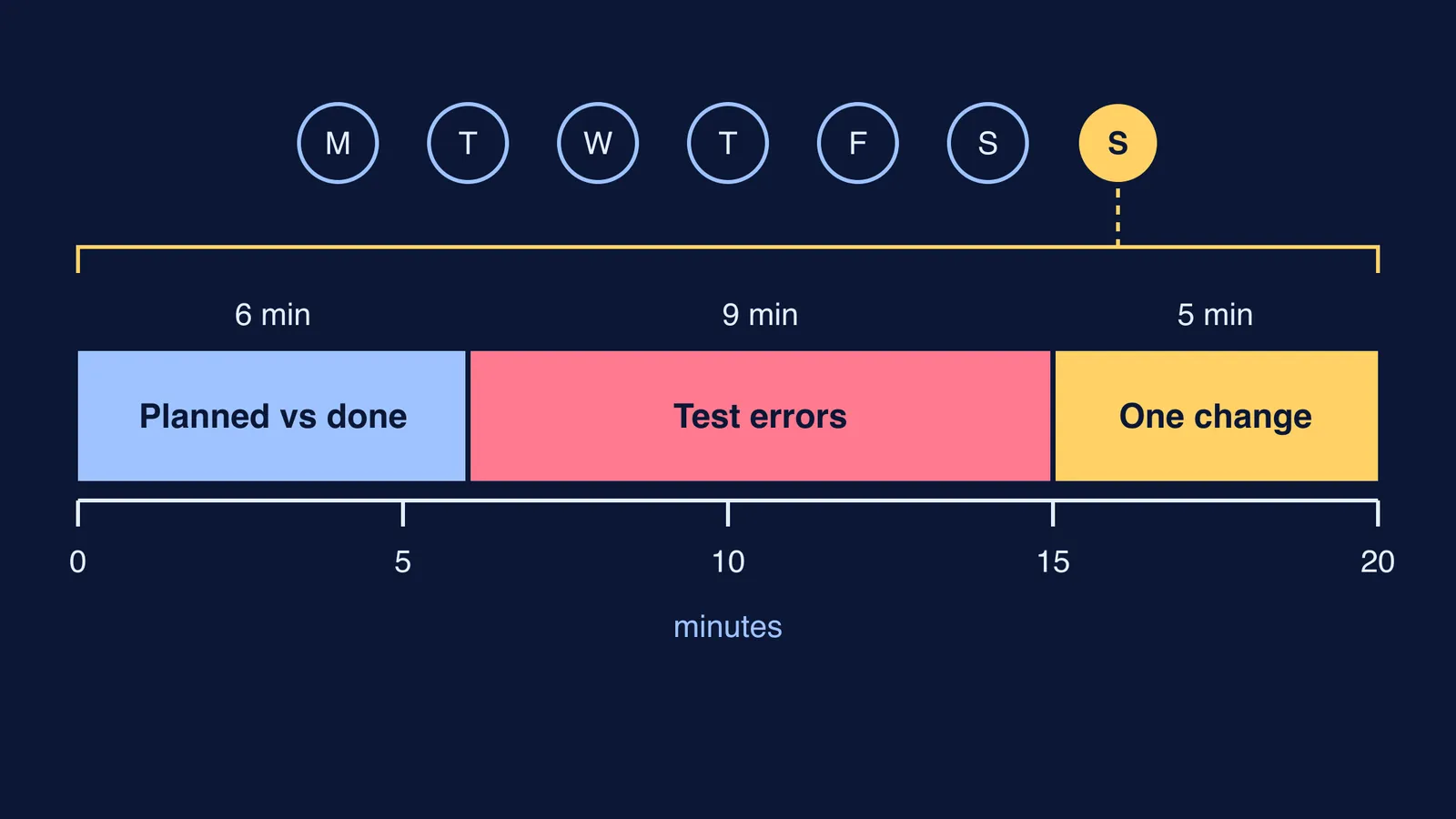
Every Sunday, sit down with your planner, this week's tests and a timer:
Planned vs done (6 minutes). For each subject, write what you planned and what you actually finished, in countable units: problems, chapters, hours.
Test errors (9 minutes). Go through every mark you lost this week in tests, practice sheets or homework. Tag each mistake with one of four labels: concept, method, calculation or misread.
One change (5 minutes). Pick a single change for next week and write it as "When X happens, I will do Y".
Stop when the timer ends, so the habit survives busy weeks.
Why compare what you planned with what you did?
Because plans run optimistic, and your own record corrects them. In a 1994 study, psychology students predicted they would finish their honours theses in 33.9 days on average but actually took 55.5 days (Buehler, Griffin and Ross, Journal of Personality and Social Psychology). Only 29.7% finished by the time they had predicted. The same paper reports that the optimistic bias disappeared in one experiment when people were asked to connect relevant past experiences with their prediction.
The planned-vs-done block gives you that past experience. If you plan 40 physics problems and most weeks finish about 25, next week's plan starts near 25. If you keep falling short, add slack rather than hours; our guide to building buffer time into a study plan shows how.
What should you do with this week's test errors?
In a review of laboratory studies, psychologist Janet Metcalfe concluded that making errors and then getting corrective feedback helps learning, and that feedback including "analysis of the reasoning leading up to the mistake" is crucial (Metcalfe, Annual Review of Psychology, 2017). She also notes that errors made with high confidence are corrected more readily than low-confidence ones, so mark the wrong answers you felt sure about.
The four tags tell you what kind of fix you need:
Concept: you did not understand the idea. Reread the theory, then redo the question.
Method: right idea, wrong approach. Compare your path with a correct solution, step by step.
Calculation: a sign, unit or arithmetic slip. Build a checking habit.
Misread: you answered a different question. Underline what is asked first.
Copy concept and method errors into one notebook; our guide on how to keep an error notebook covers the format. For method errors, the Fermi Problem Library has worked problems with a step-by-step solver that explains the reasoning rather than printing an answer, so you can see where your path split from the right one.
How do you choose one change for next week?
Ask: which single change would have saved the most marks or hours this week? Write it as an if-then plan, which psychologists call an implementation intention. A meta-analysis of 94 independent tests by Peter Gollwitzer and Paschal Sheeran found that implementation intentions had a medium-to-large effect (d = 0.65) on goal attainment (Gollwitzer and Sheeran, Advances in Experimental Social Psychology, 2006).
Keep it to one change so next Sunday you can tell whether it worked. If you plan in blocks, this guide to weekly time-blocking shows where it fits.
What does a filled-in Sunday review look like?
Here is one for Riya, an imaginary Class 12 CBSE student preparing for JEE Main, after a week ending in a Saturday physics test on electrostatics.
Block 1: planned vs done
Physics (electrostatics): planned 40 problems, did 24.
Chemistry (solutions): planned the NCERT chapter and 30 questions, did all of it.
Maths (definite integrals): planned 50 problems, did 38.
What stands out: physics slips, and it is always the last thing she starts at night.
Block 2: test errors (7 questions wrong on Saturday)
Concept, 2: both applied Gauss's law to charge arrangements without enough symmetry.
Method, 2: integrated where symmetry gave the answer in two lines.
Calculation, 2: sign errors in potential energy.
Misread, 1: found the field when the question asked for potential.
What stands out: four of seven mistakes are concept or method errors, not slips.
Block 3: one change
"On Monday, Wednesday and Friday, when I get home from coaching, I will do 12 electrostatics problems before I open chemistry or maths."
Next Sunday, Riya checks that first: did physics climb from 24 problems?
If your review keeps showing the same concept gap and you are not sure where to start, Fermi's AI tutor can work out what you already know and build a plan for the session.
The helpline number is listed on the National Mental Health Programme page.