

On this page
The common division method, also called the ladder method, is a fast, tidy way to find the LCM of three numbers on paper. The one rule that trips students up is this: a prime only has to divide one of the numbers, not all three. The numbers it does not divide just move down a row unchanged.
What is the common division method for LCM?
The least common multiple of a set of whole numbers is the smallest positive number that every one of them divides into, as Wikipedia's article on the least common multiple defines it for two or more integers.
In the division method, as Calculator Soup's LCM guide describes it, you divide the row of numbers by a prime that divides evenly into at least one of them, bring down any number that is not divisible, stop when the last row is all 1s, and multiply the primes in the first column. The same guide works LCM(10, 18, 25) this way and gets 2 × 3 × 3 × 5 × 5 = 450.
How do you find the LCM of three numbers step by step?
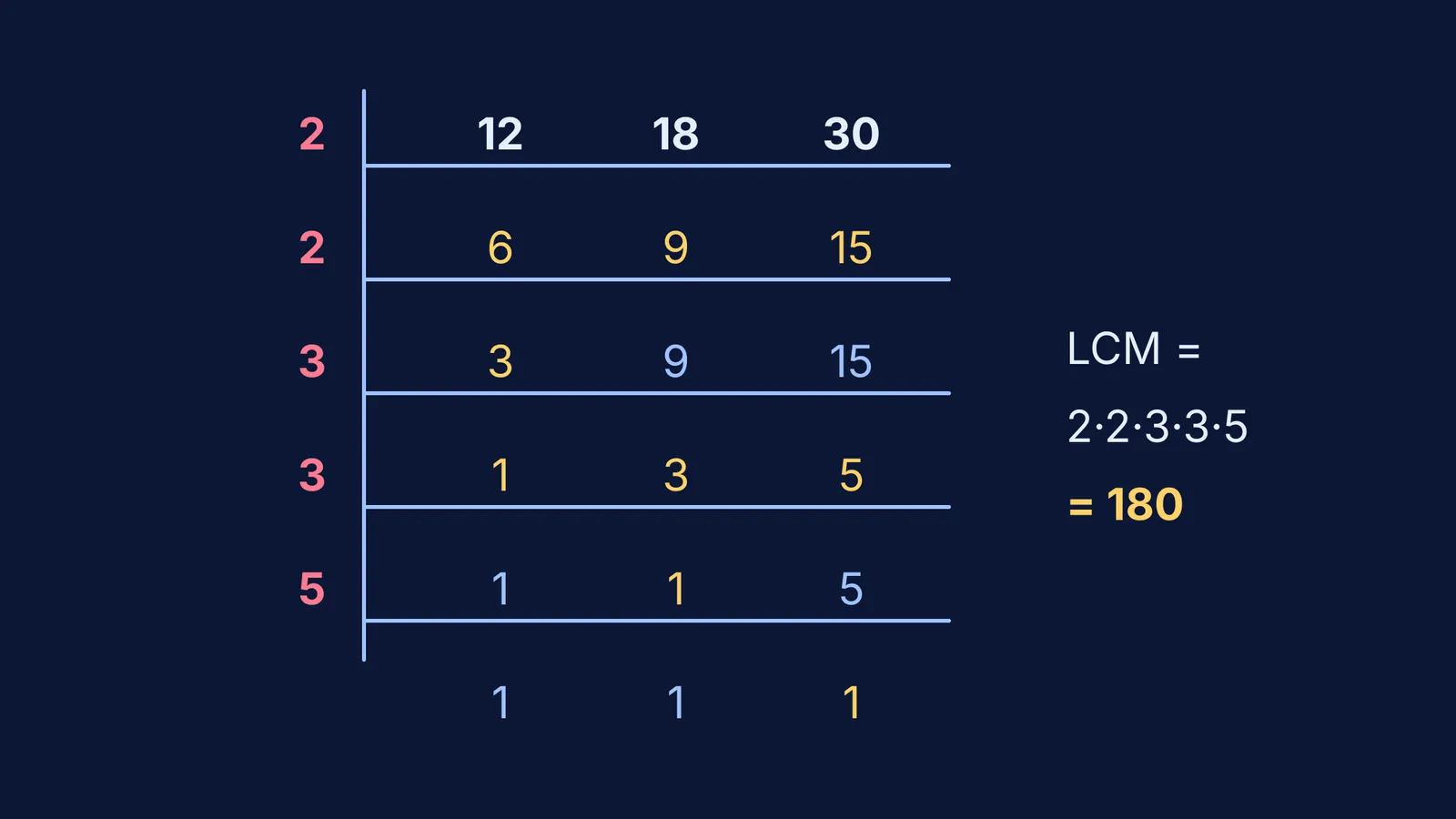
Take 12, 18 and 30.
Write 12, 18, 30 in a row, with a line to the left and one underneath.
Divide by 2. All three are even: 6, 9, 15.
Divide by 2 again. Only 6 is even, so write 3 and bring 9 and 15 down: 3, 9, 15.
Divide by 3. All three divide: 1, 3, 5.
Divide by 3 again. Only the 3 divides: 1, 1, 5.
Divide by 5: 1, 1, 1. Stop.
The primes in the left column are 2, 2, 3, 3 and 5, so LCM(12, 18, 30) = 2 × 2 × 3 × 3 × 5 = 180.
What do you do when a prime divides only one or two numbers?
You still use it. For the HCF you stop when no prime divides all the numbers; for the LCM you keep going until the row is all 1s.
Mix them up and it goes wrong. Try 6, 10 and 15. No prime divides all three, so a student with the HCF habit stops at once and multiplies 6 × 10 × 15 = 900. The ladder gives a different answer:
÷ 2: 3, 5, 15 (only 6 and 10 are even; 15 comes down)
÷ 3: 1, 5, 5
÷ 5: 1, 1, 1
So LCM(6, 10, 15) = 2 × 3 × 5 = 30, and 900 is 30 times too big. Each pair shares a prime (6 and 10 share 2, 6 and 15 share 3, 10 and 15 share 5), but no prime is common to all three. Try primes in order (2, then 3, 5, 7), and count that each new row still has three numbers.
To see the same ladder used on a single number, our post on factor trees versus the division method compares the two side by side.
How do you check the LCM with prime factors?
Write each number as a product of primes, then take the highest power of every prime that appears. That product is the LCM, as Wikipedia's least common multiple article states, with the example LCM(8, 9, 21) = 2³ × 3² × 7 = 504.
For our example:
12 = 2² × 3
18 = 2 × 3²
30 = 2 × 3 × 5
The highest powers are 2², 3² and 5, so the LCM is 4 × 9 × 5 = 180. That matches the ladder: its left column, 2, 2, 3, 3, 5, is exactly 2² × 3² × 5, so each method checks the other.
Why doesn't HCF × LCM equal the product for three numbers?
The rule HCF × LCM = product is true for two numbers: gcd(a, b) × lcm(a, b) = ab, as shown in the same Wikipedia article. It does not carry over to three.
With 12, 18 and 30, the HCF is 6 and the LCM is 180, so HCF × LCM = 1,080, while 12 × 18 × 30 = 6,480. Never use that shortcut for three numbers.
For word problems where bells ring together again, see our guide to bell and traffic-light LCM word problems; the Class 10 real numbers overview puts HCF and LCM in the context of the board syllabus.
If you keep getting a different answer from the book, the Fermi Problem Library has worked problems with a step-by-step solver that explains the reasoning rather than printing an answer, so you can see which row went wrong. To go back over primes and factors from the start, the Fermi Concept Library gives each mathematics concept its own lesson.
Try the ladder now on 8, 12 and 20, then check it with prime factors. You should get 120 both ways.


